
- Part of ViennaUP, PeaceTech Conference in Vienna explored AI’s role in energy transition and global resilience
- Experts highlighted AI-driven efficiency gains, circular energy systems, and real-world industrial applications
- They discussed decentralized infrastructure, digital sovereignty, and technology’s potential for global peace
- The speakers concluded that Europe’s cautious, security-focused approach may become an advantage in sustainable AI development
As the world wrestles with the staggering resource demands of the AI boom, the dominant narrative surrounding AI and the environment is often one of climate dread. Data centers consume vast amounts of electricity, grids are pushed to their limits, and carbon footprints continue to climb.
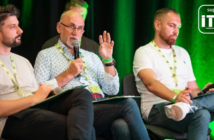
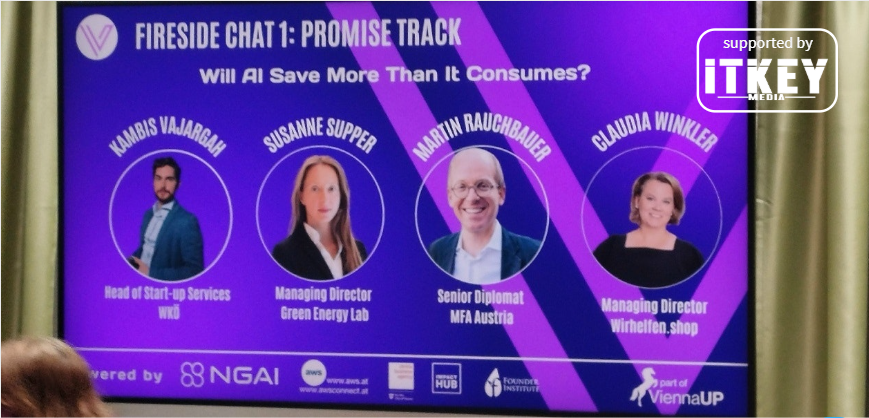
However, the PeaceTech Conference, held at Vienna’s Impact Hub on May 20th as part of Vienna’s massive ViennaUP festival, gathered a powerhouse panel to look at the flip side of the coin. During ‘The AI Promise’ fireside chat, experts explored how cutting-edge intelligence can optimize the energy transition, unlock hyper-efficient circular economies, and perhaps even pave the way for a more peaceful, democratized global infrastructure.
The panel featured:
- Martin Rauchbauer, Co-Founder of the Tech Diplomacy Network, Senior Diplomat at MFA Austria
- Susanne Supper, Managing Director at Green Energy Lab
- Claudia Winkler, Founding Partner at Adjacent Possible Network, Managing Director at Wirhelfen.shop
- Kambis Vajargah, Head of Startup Services at WKÖ
Together, they mapped out why the future of AI isn’t just about large language models—and why Europe’s deliberate pace might actually be a hidden superpower.
Mapping the Energy Curve: Hype VS Efficiency Gains

Martin Rauchbauer, Co-Founder of the Tech Diplomacy Network, Senior Diplomat at MFA Austria
To ground the conversation, Mr Rauchbauer shared data from the International Energy Agency’s 2025 report. As of 2025, data centers accounted for roughly 1.5% of global electricity consumption, with about a third of that demand directly linked to AI workloads.
Predictions show that this overall data center energy demand will double by 2030, meaning 3% of global electricity will go to data centers, with 1.5% being entirely AI-related. But what happens after 2030?
‘The future depends on three scenarios: exponential skyrocketing, the boom fizzling out as a hype, or the third—and most critical—scenario: massive efficiency gains. If innovation outpaces demand, energy consumption in AI data centers could actually plateau after 2030,’ Mr Rauchbauer explained.
Ms Winkler drew a parallel to the early days of the internet explosion in the telecom industry. When streaming and internet traffic first surged, telecom players faced immense cost pressures that forced them to innovate. They built content delivery networks (CDNs) and pushed traffic to the edge, making the entire system radically decentralized and efficient.
The panelists agreed that as big AI platforms face the brutal financial realities of localized electricity costs, the market will naturally force a massive wave of efficiency innovations.
From Waste Heat to Physics-AI: Real-World Use Cases

Susanne Supper, Managing Director at Green Energy Lab
The panelists emphasized that moving past ‘glorified image generators’ means investing in AI that interfaces directly with the physical world. Ms Supper highlighted how her Green Energy Lab is utilizing automation and AI to orchestrate regional energy systems and recapture industrial waste heat.
In Vienna, for instance, 60% of the heating sector still relies on fossil fuels, but AI-driven solutions are already making a dent. A specialized heat pump installed at Vienna’s Oberlaa thermal baths captures waste heat from hot wastewater to heat 2,000 local households. Similarly, the famous Spittelau waste incineration plant utilizes advanced heat pumps to extract energy from flue gas—a process heavily reliant on digital energy solutions and granular AI weather forecasting to balance the grid when solar and wind fluctuate.
Mr Vajargah pushed this a step further, highlighting the massive global shift toward circular energy economies. He noted that in Sweden, nearly 10% of households are already warmed using recycled heat waste piped directly from commercial data centers.
He also spotlighted a massive win for the local Austrian ecosystem: the acquisition of Austrian startup ME-AI by European AI giant Mistral.
‘ME-AI doesn’t build another LLM wrapper; they focus entirely on Physics-AI. They look at physical process management, smart grids, and industrial optimizations. These are the models that require energy upfront but ultimately generate massive net-positive savings for the planet,’ Mr Vajargah noted
Can AI Build a Bedrock for Global Peace?

Kambis Vajargah, Head of Startup Services at WKÖ
History shows how nations frequently clash over scarce, centralized resources like oil and water. The panel went on to explore whether a digitized decentralized grid could reduce geopolitical friction and democratize global energy.
Ms Supper pointed out that the barrier to entry for energy production has collapsed. Thanks to European Union directives enabling regional energy communities, Austria alone has seen its energy producers skyrocket to 600,000, driven largely by residential solar panels (PV).
Vajargah outlined the direct structural link between secure energy infrastructure, stable growing economy, and global/regional peace.
By leveraging AI to manage decentralized grids, countries can significantly lower their foreign energy dependencies. At that, the panel warned against naive optimism. While regional energy independence rises, new global dependencies are forming rapidly—specifically around the highly consolidated semiconductor supply chain and rare hardware components controlled by just a few global players.
Mr Rauchbauer warned that true digital sovereignty cannot be achieved through isolation. Tech diplomacy requires profound international collaboration between governments, civil societies, and private tech sectors to navigate hyper-complex, shifting alliances.
The Austrian Superpower: The Wisdom of Going Slow

Claudia Winkler, Founding Partner at Adjacent Possible Network, Managing Director at Wirhelfen.shop
When asked what the biggest roadblock to implementing these world-saving AI technologies is, the panel pointed directly to regulatory deployment and infrastructure safety.
Ms Supper reminded that unlike pure software markets, the energy grid cannot be a chaotic tech playground. Possible blackouts may cause immediate societal crises, meaning infrastructure safety must always take precedence over speed-to-market.
Mr Rauchbauer closed the session with an anecdote about tech futurist Jaron Lanier, who recently discovered his Austrian heritage and visited Vienna.
‘Lanier told me that if the world ever collapses or the apocalypse happens, he wants to be in Vienna—because apparently, everything here happens 20 years later,’ the speaker joked. ‘But there is deep wisdom in that. Our reluctance to blindly rush into tech, combined with our rigorous focus on critical infrastructure security, is actually Europe’s ultimate competitive advantage.’
Key Takeaways:
- The Power Efficiency Pivot: Market cost pressures and localized energy limits will force the AI industry to shift toward hyper-efficient edge computing and decentralized infrastructure, mirroring the early evolution of the internet.
- Physics-AI Over Hype: Europe is leading in high-impact physical AI applications, evidenced by Mistral’s acquisition of Austrian startup ME-AI to optimize smart grids and industrial processes.
- Circular Energy is Real: Data center waste heat is being actively weaponized to heat cities, with countries like Sweden already heating roughly 10% of households via industrial data exhaust.
- Security is the Moat: While the US pushes for unchecked speed, Europe’s deliberate, security-first regulatory framework ensures that its critical energy infrastructure remains resilient against systemic collapse.
The discussion at the PeaceTech Conference highlighted how AI’s greatest impact may come not from bigger models, but from its ability to transform critical systems like energy, infrastructure, and sustainability. As global demand for resources intensifies, Europe’s focus on responsible deployment, resilience, and innovation in the physical world could become a defining competitive advantage. The future of AI in Europe and beyond will ultimately depend on balancing technological ambition with efficiency, security, and international cooperation.

Kostiantyn is a freelance writer from Crimea but based in Lviv. He loves writing about IT and high tech because those topics are always upbeat and he’s an inherent optimist!