
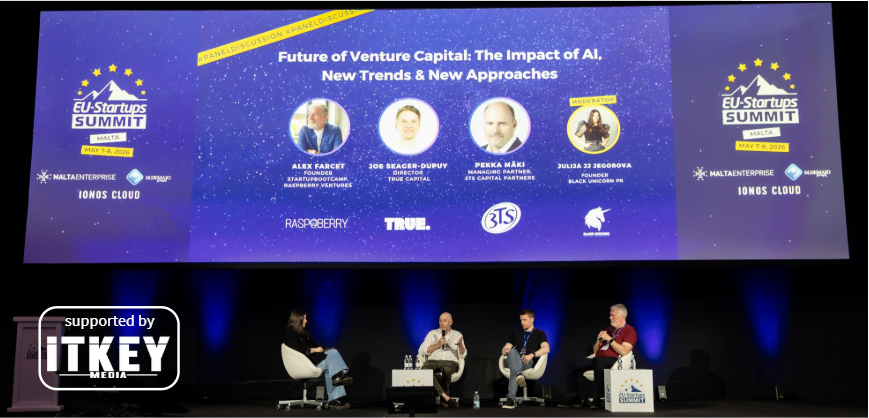
- A panel discussion on the Future of VC and the Impact of AI at the EU-Startups Summit explored how AI is reshaping venture capital investment strategies and decision-making
- Europe’s funding market is increasingly divided between AI-driven startups and traditional tech companies
- Despite AI’s growing role, investors agreed founder quality remains the decisive factor in funding
The European venture capital landscape is undergoing a profound transformation. As capital flows consolidate around artificial intelligence, the gap between ‘frothy’ AI valuations and the strict financial discipline demanded of traditional tech sectors has never been wider.
EU-Startups Summit took place at the Mediterranean Conference Centre in Valletta, Malta, on May 7–8th. Here, tech leaders gathered to unpack these shifting dynamics during the panel discussion: The Future of Venture Capital: The Impact of AI. The panel featured seasoned voices from across the investment ecosystem:
- Julija JJ Jegorova, Founder at Black Unicorn PR (moderator)
- Alex Farcet, Co-Founder at Raspberry Ventures
- Pekka Mäki, Managing Partner at 3TS Capital
- Joe Seager-Dupuy, Investment Director at True Capital

Julija JJ Jegorova, Founder at Black Unicorn PR
Together, they shared an unfiltered look into how VCs are deploying AI internally, how Europe’s fragmented market serves as an unexpected superpower, and what it truly takes for a founder to stand out in today’s demanding market.
The ‘Tale of Two Cities’ in European Venture Capital
The current fundraising market presents a stark contradiction. Startups riding the AI wave find themselves in an environment that feels flush with cash and high valuations. Meanwhile, companies without an AI narrative are facing an uphill battle.
‘If you don’t have the AI tailwind or story, the hurdles are incredibly high,’ Mr Seager-Dupuy noted as his fund True Capital splits its investments between consumer-facing brands and retail-enabling infrastructure. ‘Investors are demanding exceptionally strong unit economics and clear paths to profitability just to get interested.’
Mr Mäki’s 3TS Capital focuses on growth-stage companies with EUR 5M to EUR 15M in revenue. He described the market as a double-edged sword. While current entry pricing is highly favorable for VCs making new investments, the lack of liquidity remains an industry-wide bottleneck.

Pekka Mäki, Managing Partner at 3TS Capital Partners
‘The entry environment is great, but the exit market is completely stuck. Even high-performing companies are struggling to find meaningful exits right now,’ Mr Mäki explained
Despite these macroeconomic pressures, the panelists pointed out a hidden advantage that’s unique to the region: Europe’s inherent market fragmentation. Rather than viewing cross-border, regulatory, and foreign exchange complexities as roadblocks, Mr Seager-Dupuy argued that navigating them early forces European startups to build superior operational muscle.
‘Look at Spotify or Revolut—they had to figure out complex multi-market expansion almost from day one. That friction makes them highly resilient global contenders,’ Mr Seager-Dupuy added.
How VCs Use AI: The ‘Pre-IC’ Devil’s Advocate
While venture capitalists spend their days evaluating AI startups, they are also proactively integrating those technologies into their day-to-day operations. Funds are leveraging intelligence platforms like Harmonics or Specter to scan for founder background signals, automate top-of-funnel sourcing, and conduct rapid competitive benchmarking.
However, one of the most compelling use cases shared during the panel involves stress-testing investment theories. Mr Seager-Dupuy admitted that True Capital utilizes LLMs like Claude as an internal sparring partner before pitching a company to their investment committee.

Joe Seager-Dupuy, Investment Director at True Capital
‘We upload our investment memos into Claude and explicitly instruct it to find every single hole, risk, and flaw in our logic. It acts as a brutal devil’s advocate, allowing us to prepare for the toughest questions our committee will throw at us,’ Mr Seager-Dupuy shared.
Despite these efficiencies, the panel agreed that AI remains a tool, not a decision-maker. The consensus labeled AI as equivalent to a ‘highly overconfident graduate-level hire’—exceptional at data aggregation and formatting, but fundamentally incapable of reading human nuance, grit, or boardroom dynamics.
What VCs Look For: Adaptability, Paranoia, and the Character Red Line
When it comes to evaluating founders, the investors emphasized that long-term adaptability far outweighs a polished product roadmap. Mr Farcet, whose syndicate Raspberry Ventures prioritizes climate tech and impactful innovation, noted that the best entrepreneurs are obsessed with the problem they are solving, rather than their specific software solution.

Alex Farcet, Co-Founder at Raspberry Ventures
He also turned some heads by highlighting the psychological makeup required to succeed in a harsh economic climate.
‘The best founders are often slightly psychotic,’ Mr Farcet remarked, referencing the radical immunity to public doubt and the sheer force of will required to scale a business against the odds.
Complementing this trait, the panel stressed the necessity of ‘healthy paranoia.’ In an era where tech giants like Microsoft, Google, and Amazon can quickly duplicate software features, startups must build structural moats—either through unmatched customer experiences or proprietary cost efficiencies—that incumbents cannot easily replicate.
The Ultimate Investor Pet Peeves:
- Lazy ‘AI-Native’ Labeling: The panelists expressed exhaustion over startups slapping ‘AI-powered’ onto basic applications. It seems as though the core technology can be easily replicated by a hundred other teams, and the label bears no meaning.
- Sloppy Inbound-Outbound: Mass-blasting generic emails to VCs without a concise pitch deck or a single compelling paragraph explaining why the possible meeting may matter is an instant pass.
- ‘All We Need is Money’: Mr Mäki warned that claiming your startup has everything entirely figured out and all it lacks is capital presents a major red flag. ‘If a founder tells me all they need is money, the conversation ends right there,’ Mr Mäki stated.
The Non-Negotiable Human Element
When asked what part of the due diligence process they would absolutely never delegate to an AI, the panel was unanimous: the human connection.
As Mr Farcet succinctly summarized, evaluating a founder’s true character, resilience, and vision still requires the age-old tradition of ‘dining and drinking.’ No algorithm can replace the intuition gained from sitting across a table from a founder and understanding what truly drives them.
Key Takeaways:
- The VC Divide: Capital is heavily concentrated in AI-driven startups, while non-AI companies face incredibly strict metric checks.
- Internal AI Tools: VCs benefit from platforms like Claude, Specter, and Harmonics by automating deal sourcing and actively stress-testing investment memos before committees.
- Founder Moats: Investors are prioritizing founders with a high learning curve, healthy market paranoia, and clear operational moats over trendy tech buzzwords.
- Human First: The absolute red line for VCs in due diligence remains face-to-face evaluation; assessing human character cannot be automated.
As Europe’s venture capital market continues to evolve, it’s up to founders to navigate an increasingly polarized investment landscape where compelling AI narratives alone no longer suffice. As the panel made clear, while AI is reshaping how investors source, analyse, and challenge opportunities, the qualities that ultimately determine investment decisions remain deeply human. In a market defined by higher expectations and greater scrutiny, adaptability, resilience, and authentic founder character continue to be the strongest differentiators for long-term success.

Kostiantyn is a freelance writer from Crimea but based in Lviv. He loves writing about IT and high tech because those topics are always upbeat and he’s an inherent optimist!