
- MSCA Lviv 2026 successfully brought together 130 global tech figures from 14 countries to Lviv for a cross-border, deep-tech innovation showdown
- The prize capital was deployed across UGV Robotic Platform’s defense robotics, GMD’s orthopedic medical devices, and AC Biode’s Japan/Luxembourg waste-to-energy project
- Academic Acceleration: Four university-linked engineering projects across Ukraine secured direct angel investment commitments outside the main tracks
- The platform will open its next major international cohort applications in September 2026 with a dedicated focus on AI, Cybersecurity, and Water Security
Despite severe wartime pressures and shifting geopolitical landscapes, the Ukrainian tech ecosystem continues to prove itself as a resilient hotbed for dual-use innovation and deep-tech breakthroughs. Following its call for global submissions earlier this spring, the inaugural Melville Sikorsky Challenge Accelerator (MSCA) Lviv 2026 pitch final successfully wrapped up on May 6st, 2026.
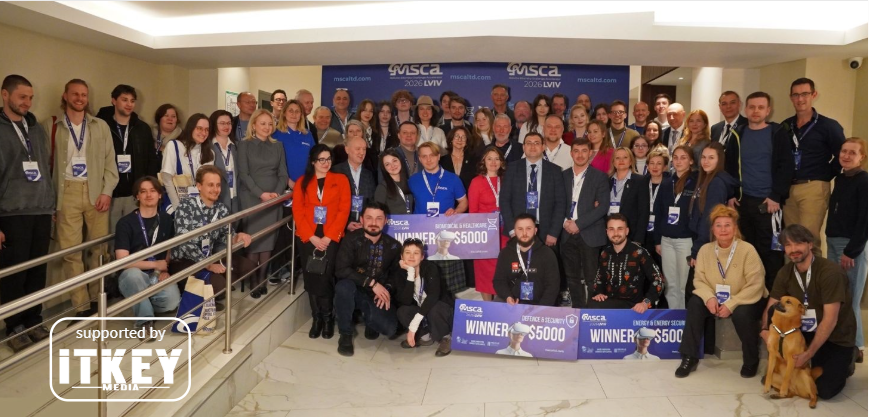
The high-stakes event transformed Lviv’s Hotel Dnister into a vibrant international innovation hub, uniting 130 founders, venture capitalists, corporate partners, and academic researchers from 14 countries across the globe to pitch solutions aimed squarely at wartime resilience and post-war reconstruction.
The Hard Numbers: Global Scale, Local Impact
The sheer volume of engagement for a first-time accelerator program highlights the intense international interest in Ukrainian engineering capability. The cohort metrics tell a compelling story of cross-border collaboration:
- 126 global applications submitted across three deep-tech tracks.
- 44 finalist teams selected, representing 15 Ukrainian cities alongside top-tier global tech hubs.
- 42 breakthrough projects delivered live pitches and physical prototype demonstrations to the jury panel.
- 130 total participants, with 96 attendees coming to Lviv in person and another 34 joining the hybrid stage online.
The competitive roster featured a highly unique demographic blend: 34 elite teams originating from Ukraine’s technical universities and defense clusters, alongside 10 international startup teams representing ecosystems in the US, Japan, Greece, Belgium, Italy, Spain, Luxembourg, Ireland, Turkey, Switzerland, Portugal, and Poland.
Strategic Tracks: Tackling Critical Bottlenecks
Rather than focusing on light consumer software or typical SaaS platforms, MSCA Lviv 2026 prioritized three high-consequence, hardware-heavy verticals critical for global stability:
- Defense & Security: Teams presented battle-tested systems spanning automated demining technologies, logistics and combat robotic platforms, and advanced counter-unmanned aerial vehicle (C-UAV) electronic warfare shields.
- Biomedical Engineering & Health: The biomedical vertical emphasized emergency frontline diagnostics, advanced physical rehabilitation technologies, and modular medical devices built to handle severe trauma.
- Renewable Energy & Energy Security: Addressing infrastructure vulnerability, this track showcased decentralized grid resilience models, innovative waste-to-energy recycling solutions, and high-efficiency energy storage systems.
The Champions: USD 15K in Non-Dilutive Capital Deployed
Three standout teams walked away with cash prizes of USd 5K each after dominating their respective tracks:
- Defense & Security Winner — UGV Robotic Platform (Ukraine): An advanced unmanned ground vehicle engineered for high-risk tactical support. Due to the dual-use nature of the technology, specific operational capabilities remain strictly classified under an NDA.
- Biomedical Engineering & Health Winner — Meniscus Resector by GMD (Ukraine): A highly specialized surgical medical device designed to drastically optimize recovery windows for complex orthopedic and trauma surgeries.
- Renewable Energy & Energy Security Winner — Plastalyst by AC Biode (Japan / Luxembourg): An international climate-tech project focused on transforming complex plastic waste into chemical components, capturing global attention for circular energy.
Direct Angel Backing and Commercial Pipelines Ignite On-Site
Beyond the non-dilutive track prizes, MSCA Lviv 2026 proved to be an active deal-making platform rather than a purely ceremonial pitch stage. Strategic investor matching sparked immediate traction for deep-tech hardware, while non-competitive angel investments were fast-tracked to inject vital capital directly into elite academic spin-offs from Ukraine’s top technical universities:
- The ALLIGATOR Boiler: This highly efficient, universal heat boiler is engineered to deliver decentralized infrastructure resilience. Originally winning top honors at the 11th Sikorsky Challenge Festival for its brilliant fuel-to-heat conversion and independence from vulnerable centralized gas grids, it captured intense attention from institutional energy investors looking at Ukraine’s immediate post-war reconstruction needs.
- Manuscriptum (Igor Sikorsky KPI): Emerging out of KPI’s elite engineering and linguistic computing tracks, this university-backed spin-off is an AI-driven, advanced forensic text-analytics system. It is engineered for precise author identification and the deep stylistic deconstruction of historical, intelligence, and legal documentation.
- PHYSREHAB (Odesa Polytechnic National University): A highly technical rehabilitation project that previously stood out at the 14th Sikorsky Challenge Festival. It functions as an automated hardware-software complex engineered to provide precise physiological monitoring and customized therapeutic feedback loops for patients recovering from severe neuro-trauma and musculoskeletal injuries.
- AURA (Igor Sikorsky KPI): Formed within KPI’s advanced engineering systems laboratories, this deep-tech infrastructure initiative focuses on energy resilience. It utilizes localized signal processing and automated grid-balancing technology built specifically to operate reliably in high-interference environments.
- RehubHand (National University of Water and Environmental Engineering): A robotics-driven healthcare solution centered on fine-motor recovery. The project integrates smart, automated orthopedic gloves designed to physically guide a patient’s hand through rehabilitation exercises while translating and voicing gestures, allowing trauma victims to execute high-repetition physical therapy autonomously.
The Strategic Bridge: Capital Meets Extreme Engineering
The Melville Sikorsky Challenge Accelerator operates with an aggressive, founder-friendly commercial mandate designed to serve as a friction-free pipeline between Ukraine’s technical brilliance and UK/EU venture capital. For startups joining the acceleration pipeline, the ecosystem standardizes terms at a 5% equity stake (with tailored arrangements for mature growth-stage scaleups) paired with a 3% success fee on international capital raised via their investor networks.
The overarching goal of the Melville Sikorsky Challenge Accelerator is to establish a functional, strategic bridge connecting the Ukrainian innovation ecosystem directly with UK and European venture capital to help local startups scale internationally. According to the organizers, the Lviv competition successfully demonstrated how Ukraine maintains a powerful engineering and scientific potential despite ongoing wartime disruptions, yielding high-consequence technologies that are already mature and ready for global deployment.
What’s Next for MSCA?
The accelerator is keeping its foot on the gas. Melville Sikorsky Challenge Accelerator has already announced its next international innovation challenge scheduled for September 2026. Shifting its gaze toward critical digital and natural infrastructure protections, the upcoming cycle will explicitly scout global startups working in:
- Cybersecurity (Critical infrastructure protection and network defense)
- Artificial Intelligence (Enterprise automation and advanced analytics models)
- Water Resource Protection and Restoration (Ecological tech and sustainable resource management)

Kostiantyn is a freelance writer from Crimea but based in Lviv. He loves writing about IT and high tech because those topics are always upbeat and he’s an inherent optimist!