
- TechChill Riga 2026 attracted 2,300+ participants, uniting local and global startups and investors
- ITKeyMedia spotlights BlockBen achieving Latvia’s first MiCA license, advancing regulated crypto services on the EU scale
- BlockBen’s founder points out strategic planning, talent acquisition, and human networking as critical for fintech success
- According to him, the future growth of the crypto space relies on comprehensive compliance and regional ecosystems fostering sustainable innovation
On March 25–27th, Riga’s Hanzas Perons and a number of landmark venues across the Latvian capital hosted over 2,300 venture capitalists, startup founders, talent, and tech enthusiasts at TechChill Riga 2026. Attendees gathered from Latvia, the Baltics, CEE, and beyond, turning the city into a vibrant hub for innovation and networking.
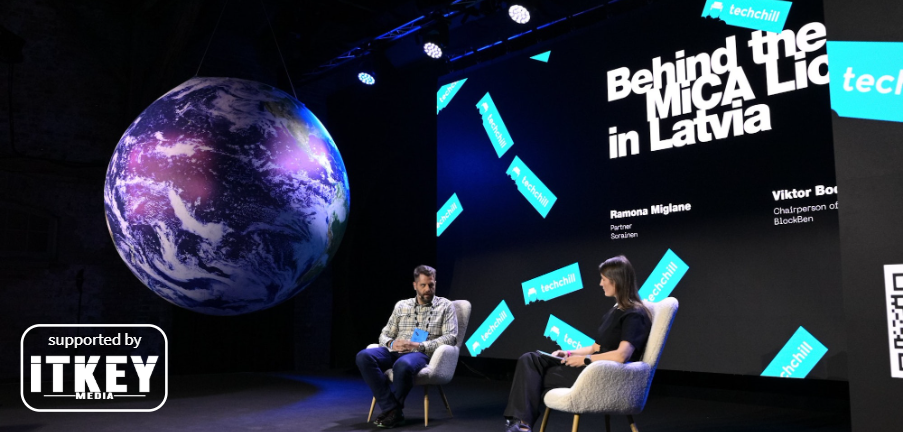
Around 100 prominent industry speakers took the stage, exploring key trends, challenges, and opportunities shaping both regional and global startup ecosystems. ITKeyMedia spotlights Behind the First MiCA License in Latvia — a fireside chat of Sorainen’s partner Ramona Miglane with Blockben’s chairperson of the management board Viktor Bodnar.
A Regulatory Milestone for European Crypto
BlockBen has become the first crypto-asset service provider in Latvia (and the second in the Baltics) to secure a MiCA license in December 2025, marking a significant regulatory milestone. This authorization enables the company to offer, custody, and trade crypto-assets, as well as issue, list, and transfer utility tokens across the European Union. During the session, Ms Miglane and Mr Bodnar discussed how MiCA is transforming financial regulation, aligning crypto companies with traditional institutions such as banks, investment firms, and payment providers under a unified framework.
BlockBen was started in 2017 when Mr Bodnar, a serial entrepreneur, was first introduced to the idea of providing crypto-asset services. According to him, the envisioned business was meant to anticipate the regulatory framework for crypto assets and be prepared to operate within it when it lands. At the time, however, there were no crypto regulations — neither on the EU-level, nor on most state-levels, and most entrepreneurs were openly sceptical about the idea of building a business around crypto regulation.
BlockBen’s core business is issuing crypto assets, i.e. creating crypto currencies for companies, as well as assisting these companies in bringing this product to the market. What BlockChain doesn’t do is any form of trading. According to the entrepreneur, a lot of companies want to have their own crypto, and BlockBen has an opportunity to choose its clients. The company finds established tech companies willing to introduce crypto into their ecosystems the most interesting.
Institutional Integration in an Evolving Market

Viktor Bodnar, Chairperson of the Management Board at BlockBen
Mr Bodnar shares that when BlockBen was beginning, the ideas for the real-life application of crypto were also vague and mainly revolved around fundraising. Seeing how it was a grey area, it was inevitable that the regulations emerged and began to grow stronger (not only MiCA), bringing along the support infrastructure. At first, it was quite pedantic — e.g. companies willing to operate crypto still needed full-fledged bank accounts; without it, even so much as a company balance was impossible. The entrepreneur is convinced that this is because there weren’t many companies “willing to play by the book” like BlockBen (because there was no “book” yet).
Seeing how the structure of the entire crypto market has changed since then, an uncontrolled variety of crypto services drifted toward a regulated set of services. The more regulation came in, the more institution money entered the crypto space, making it more mainstream. This lead to today’s situation where, according to Mr Bodnar’s number, 10-12% of the European population are in some way involved with crypto.
Ms Miglane reminded that such an established player as JP Morgan released its own token recently, backed by its assets. Around the same time, Christine Legarde, head of the European Central Bank, expressed scepticism about the case of stablecoins, especially non-EU ones. To this, Mr Bodnar comments that stablecoins are not to be looked at in isolation but rather as an organic part of the global infrastructure, including such financial instruments as SWIFT or SEPA. Apparently, these instruments can get increasingly political, leaving more room for the development of stablecoins and CBDCs, keeping in mind that progress remains to be made in this regard.
What Made Latvia a Strategic Choice
Looking at BlockBen as a non-Latvian company that chose to get its MiCA license in Latvia, Mr Bodnar mentions that there are many factors to be taken into account. It begins with a welcoming environment, courtesy of the National Bank of Latvia and other reputable infrastructure players. Overall, the region is rich with innovation and talent, which is notably easy to hire.
To this, Ms Miglane inquired whether there is more that Latvia (and the Baltics) can do to attract more fintech founders and investors. In Mr Bodnar’s opinion, the local stakeholders and policymakers don’t need to leap over their heads, just stay on the same track at the same pace. He pointed out how these stakeholders took their time to prepare their own talent pool to be able to welcome the said fintech founders and investors.
Licensing as a Strategic Advantage
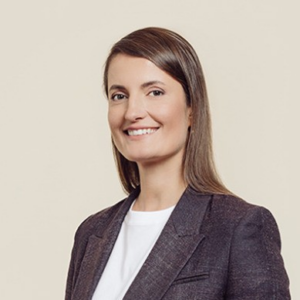
Ramona Miglane, Partner at Sorainen
Mr Bodnar recollects that BlockBen had to go through a lot of licensing in addition to MiCA throughout its path, and this brought a lot of knowledge into the company. Contrary to how many startups and smaller companies see MiCA and other regulations as overkill, the BlockBen team is convinced that formalizing market entry actually makes it easier, for small teams as well. The market, in turn, has a lot of room for various companies who are welcome to enter it. Regulation should be seen as part of the company journey and not an irritating obstacle.
Specifically for BlockBen obtaining its MiCA license in Latvia, the process took only 6 months. However, Mr Bodnar shares that his company was under time pressure and had no means to speed up the regulator, which made the team feel stressed, even though they realize that the process could have taken several times longer.
The entrepreneur stated it’s unfair to call Europe overregulated compared e.g. to Asian markets. In this perspective, MiCA is not much different from GDPR which was also declared as overkill when it first rolled out and many claimed it made it impossible to work in Europe at all. Moreover, he suggests that beginning startups shouldn’t go for a MiCA license from the get go because it may take more than 6 months like it did in the case with BlockBen, i.e. applicants should be prepared to wait for a prolonged period of time and remain operational in the meantime.
Having reached this licensing milestone, it became significantly easier for BlockBen and its clients to cooperate with Apple and Google on various levels because its very presence looks convincing to those international juggernauts.
The Power of Human Networking and Talent Acquisition
Finally, when asked what he would have done differently if he had to start BlockBen today, Mr Bodnar answered that he and his team would put even more emphasis on hiring and retaining strategic talent.
In conclusion, Mr Bodnar implored young entrepreneurs to make as many connections as possible. He emphasized the critical importance of human networking in the age of AI. He insisted that even the most extraverted people can find peers with whom they can achieve more in whatever they’re doing.
The session highlighted the transformative role of regulation like MiCA in shaping a secure and mainstream European crypto market. It underscored the value of strategic planning, compliance, and talent acquisition in building sustainable fintech ventures. Most importantly, the discussion reinforced that strong networks and human connections remain critical for founders navigating innovation in an increasingly digital and AI-driven world.

Kostiantyn is a freelance writer from Crimea but based in Lviv. He loves writing about IT and high tech because those topics are always upbeat and he’s an inherent optimist!