
- MSCA Lviv 2026 connects startups with global investors through hybrid accelerator competition
- The evaluation of the applicants combines scientific rigor with venture potential, emphasizing scalability and investment readiness
- Powerful international partnership integrates universities, investors, and global innovation ecosystems
- The initiative aims at building a continuous pipeline turning research-driven innovations into scalable commercial ventures
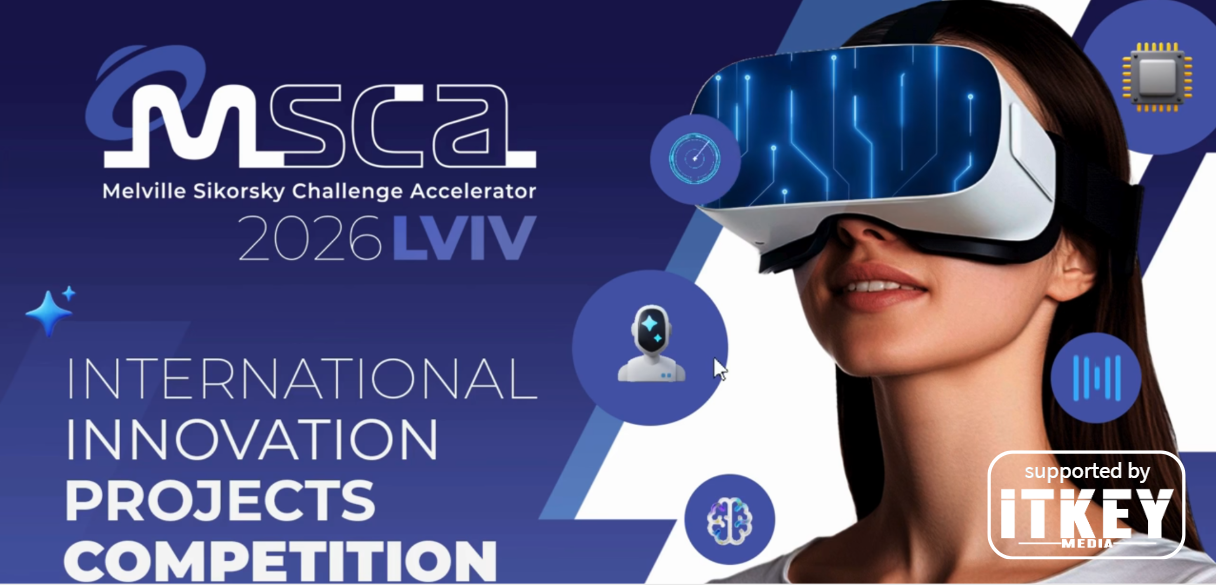
This February, the Melville Sikorsky Challenge Accelerator teamed up with Sikorsky Challenge Ukraine and opened applications for the MSCA Lviv 2026 International Innovation Projects Competition — a hybrid accelerator and pitching platform aimed at linking cutting-edge technologies with global investors and expert mentors. Scheduled for April 29–30th, 2026 in Lviv (+online), with an online participation option, the event will gather startups, R&D teams, and established technology companies from Ukraine and internationally. The programme is free to join, offering participants access to funding opportunities and support. Applications are currently open and will be accepted until March 31st, 2026.
Behind the Name
The event’s name prominently features ‘MSCA,’ which in other contexts refers to Marie Skłodowska-Curie Actions (EU research mobility & training), and the two are not to be confused. The Melville Sikorsky Challenge Accelerator’s name and its acronym reflects the strategic partnership between the British Melville Innovation LP and the Sikorsky Challenge Ukraine innovation ecosystem. Together, they are developing an international platform for accelerating and scaling deep-tech startups.
The original concept was initially proposed under the name International Accelerator Sikorsky Challenge, but during discussions with the British partners it was decided to include Melville in the title to clearly reflect the role of the UK investment partner and the joint venture structure behind the initiative. As a result, the name Melville Sikorsky Challenge Accelerator was adopted, with the natural acronym MSCA.
‘To be completely transparent, the name was derived from the identities of the founding partners rather than from any attempt to replicate existing international abbreviations,’ Dr Inna Maliukova, co-organiser of the Accelerator and Head of the Sikorsky Challenge Ukraine Innovation Ecosystem, clarifies. ‘We are aware that MSCA is widely associated with the Marie Skłodowska-Curie Actions within EU research programmes. However, our missions are fundamentally different.’
Marie Skłodowska-Curie Actions focus on research mobility and academic training, while the Melville Sikorsky Challenge Accelerator focuses on technology commercialization, startup acceleration and venture investment.
‘In our communications, we consistently use the full name — Melville Sikorsky Challenge Accelerator — to ensure clarity,’ Dr Maliukova adds. ‘The acronym is simply a practical shorthand.’
Importantly, the Accelerator is intended to operate not as a single event but as a continuous series of competitions and acceleration activities designed to identify and accumulate promising technologies. Each competition serves as a mechanism to discover, evaluate and build a pipeline of investment-ready startups. For the competitions organized by the Accelerator, a clear naming convention is used: MSCA + host city + year—for example, MSCA Lviv 2026.
Future competitions are already planned across different technological areas, ensuring a continuous process of technology discovery and investment preparation.
As Dr Maliukova concludes, ‘our acronym ultimately reflects the partnership at the heart of the initiative — Melville and Sikorsky Challenge working together to connect Ukrainian innovation with global investors and markets.’
How Projects Get Evaluated
The criteria and evaluation framework that the Accelerator’s expert panel uses in the selection process are structured as a two-stage evaluation designed to identify technologies with both scientific depth and strong commercial potential.
During the first stage, all submitted applications undergo an expert screening. The expert pool includes:
- researchers with relevant scientific degrees,
- technical specialists in the competition sectors,
- and industry and business representatives with commercialization experience.
This stage focuses on filtering projects based on several core criteria:
- completeness and clarity of the application,
- technological feasibility of the solution,
- credibility of the development roadmap,
- and overall innovation potential.
A key factor is the Technology Readiness Level (TRL). While the competition does not impose formal TRL restrictions — allowing both early-stage innovations and mature technologies to participate — projects with higher technological maturity and clearer commercialization pathways typically have a stronger chance of advancing.
Following this screening, up to 15 finalist projects get selected in each sector.
The second stage takes place during the Demo Day where finalists pitch their technologies live to an international jury and the investment committee. At this stage, the evaluation shifts toward investment and scaling potential. Projects get assessed across such dimensions as:
- strength and originality of the idea,
- technological sophistication and defensibility,
- global market and export potential,
- scalability of the business model,
- investment attractiveness.
‘The goal of our evaluation framework is not simply to reward promising ideas, but to identify technologies that can realistically become scalable companies,’ Serhii Serhiienko, Deputy Director of the Innovation Holding Sikorsky Challenge and co-organiser of the Accelerator competition, explains. ‘In other words, we look at projects through both a scientific and a venture lens — assessing not only technological novelty, but also whether the solution can attract investment and compete in global markets.’
Embracing Interdisciplinary Innovation
The three prize categories are defence & security, biomedical engineering & healthcare, and renewable energy & energy security. Beyond them, the organizers have a strategy for handling interdisciplinary projects that don’t fit neatly into a single category.
‘In fact, interdisciplinary innovation is not the exception for us — it is the norm,’ Volodymyr Reznik, co-organiser of the Accelerator from the UK side, explains further. ‘Modern deep-tech solutions rarely fit neatly into rigid sectoral boxes. Technologies such as AI-enabled diagnostics, autonomous dual-use systems, energy storage for defence mobility, or digital resilience platforms simultaneously combine elements of defence, healthcare, energy and digital infrastructure. For this reason, while each competition publicly highlights several prize categories for clarity, the Accelerator itself operates within a much broader technological framework.’
Because the Accelerator runs a continuous series of thematic competitions, different sectors can be addressed at different stages of the programme. For example, after the April competition in Lviv, additional competitions are planned in September in areas such as cybersecurity, environmental technologies, humanitarian demining, and water resource management.
A structure allows the Accelerator to evaluate hybrid technologies without forcing them into artificial categories. In practice, interdisciplinary projects get assessed using a dual-track classification model. Each project is considered according to a primary application domain — for example, energy security — and one or more enabling technology layers, such as artificial intelligence, advanced materials or cyber resilience. This approach allows the project to be reviewed by multiple domain experts and positioned more accurately for potential investors.
The evaluation process itself is also designed to accommodate convergence technologies. Instead of assigning a project to a single judging stream, the Accelerator can convene cross-sector expert panels when necessary. For example, a medical technology built with defence-grade materials may be reviewed jointly by biomedical and defence specialists, while an advanced battery platform could involve both energy and defence experts. This approach helps avoid bias and ensures that no breakthrough technology gets disadvantaged simply because it sits at the intersection of multiple sectors.
It’s worth adding that, from an investment perspective, interdisciplinary technologies are often among the most attractive opportunities. ‘They tend to be more resilient, scalable and commercially versatile,’ Mr Reznik notes.
Thus, the evaluation framework focuses less on sector labels and more on core venture criteria such as:
- the strength of intellectual property,
- scalability potential,
- the credibility of the commercialization pathway,
- and the overall strategic relevance of the technology.
Another advantage of the Accelerator model is the ecosystem behind it. Because the initiative connects UK investment infrastructure, Ukrainian scientific institutions, and an international partner network, projects can be directed toward the part of the ecosystem where they generate the greatest impact — regardless of whether it’s defence procurement, healthcare innovation or energy infrastructure deployment. The evaluation framework focuses less on sector labels and more on whether a technology can realistically become part of a strong investment portfolio of scalable companies.
The Role of Universities and Research Institutions
In view of Sikorsky Challenge’s connection to the Kyiv Polytechnic (KPI), local universities and research institutions play a foundational role in the Sikorsky Challenge innovation ecosystem. KPI has long served as one of Ukraine’s flagship institutions in engineering and applied science, with a strong tradition of integrating scientific research with technological development. Within the Accelerator framework, the university acts as the scientific backbone and strategic advisor, helping coordinate — on equal partnership principles — a wider network of universities and research institutions that form part of the Sikorsky Challenge Ukraine ecosystem.
‘This network allows us to connect academic research directly with global innovation markets,” Oleksii Strutsynskyi, Director of the Innovation Holding Sikorsky Challenge, tells ITKeyMedia.
For partner universities and research organisations, participation in the Accelerator provides an opportunity to present their scientific developments, technologies and research projects directly to international partners and the investment committee at a very early stage. This creates a rare opportunity for academic teams to showcase their innovations to global investors and industry representatives.
At the same time, the process is not only about visibility. It also enables universities and research teams to gain practical experience in the commercialization of scientific research, including interaction with venture investors, technology transfer practices and global market positioning.
‘In other words, universities do not only contribute knowledge and technologies — they also gain critical competencies in turning research into scalable businesses,’ Mr Strutsynskyi points out. ‘This cooperation model plays an important strategic role for Ukraine’s future. It gives research institutions a unique opportunity not only to promote their innovations internationally, but also to acquire the commercialization expertise that will significantly accelerate Ukraine’s technological transformation during the wartime recovery and the post-war development period.’
Global Networks and Investor Integration
Conversely, partnerships with European and global research funding networks connect participants to broader ecosystems beyond MSCA. There are presupposed mechanisms to ensure that international investors are actively engaged rather than passively observing.
‘MSCA is not designed as a standalone competition — it is an entry point into a much broader international innovation and investment ecosystem,’ Stewart Ford, co-organiser of the Accelerator from the UK side, states.
The Accelerator builds on the long-established Sikorsky Challenge Ukraine innovation ecosystem, which boasts a developed international network of partnerships and representative links across the United Kingdom, European Union countries, the United States, Israel, Japan and more. Through this network, participating startups gain access to international collaboration channels, including research partnerships, technology pilots and global market opportunities.
At the same time, the UK side of the initiative adds a strong investment dimension. Through the partnership with Melville Innovation LP, the Accelerator is connected to the British venture environment and to a wider circle of international investors.
‘In practical terms, this means that startups are not only pitching ideas — they are entering a structured investment pipeline,’ Mr Ford explains.
A key component of this pipeline is Family Ventures, a network of British and European private investors associated with the Melville group. These investors are actively looking for opportunities in such sectors as defence technologies, renewable energy, advanced engineering and healthcare innovation.
To ensure that investors are meaningfully engaged rather than simply observing, the Accelerator integrates them directly into the process. Investors participate in evaluation sessions, the investment committee, and post-event negotiations, while startups undergo structured preparation for investor discussions, including refinement of their business models and commercialization strategies. In cases where investment is agreed, it is structured through an equity-based participation model, ensuring alignment between investors and startup teams.
Mr Ford additionally emphasizes that participation in the competition is fully international: ‘The competition is open to innovators and startups from anywhere in the world. However, we do place particular emphasis on technologies that can contribute to Ukraine’s recovery and long-term development.’
This means that foreign projects capable of supporting post-war reconstruction, infrastructure modernization, energy resilience, defence technologies or healthcare solutions may receive particular attention within the evaluation process.
Our goal is to create a global platform where international innovation can work together with Ukrainian talent to address some of the most urgent technological challenges of the coming decade,’ Mr Ford concludes. ‘MSCA is the gateway — but the real value lies in the global network of investors, research partners and commercialization platforms behind it.’
From Pitch to Pipeline
‘Importantly, we do not treat the competition as a one-day event where winners simply receive a prize and the process ends,’ Maria Reznik, co-organiser of the Accelerator competition from the UK side underscores. ‘For us, each competition is part of a broader long-term process of identifying, preparing and scaling startups for investment.’
According to Ms Reznik, the post-event support system is designed differently depending on the maturity stage of the startup. Broadly, the Accelerator works with two categories:
- emerging startups that are still developing their technology,
- and companies that already operate as established businesses.
For early-stage teams, which may still be refining their product or may not yet have a registered company, the focus is on preparing the technology and the team for investment. These startups enter a tailored acceleration programme that includes technology validation, intellectual property and patent review, market positioning, refinement of the business model and preparation for negotiations with investors.
‘In many cases, the investment process involves the creation of a new company structure — often in the UK or another mutually agreed jurisdiction,’ Ms Reznik reminds. ‘Within that structure, investors may receive a minority equity participation of up to around five percent in the newly formed company.’
This stage is described as a process of ‘investor-driven refinement,’ where promising technologies are strategically prepared to match the expectations of specific investors who have already shown interest in the project.
In turn, for startups that already exist as operating companies, the support focuses on growth and international expansion. These teams may benefit from follow-on funding, access to international markets, strategic partnerships, and support in scaling their production or technology deployment.
‘In their cases, investment is typically provided in exchange for an equity stake,’ Ms Reznik specifies.’The exact percentage gets negotiated individually with each startup and usually reflects the scale of the investment. In practice, we often see discussions in the range of roughly one to five percent equity.’
The general principle, she adds, is straightforward: the larger the investment, the larger the potential equity participation under negotiation.
Over the 12–24 months following the competition, selected startups are welcome to continue working with the Accelerator through structured mentoring and advisory support, participation in additional investment sessions, introductions to international investors and assistance with forming joint ventures or international business structures when appropriate.
‘The key point is that the Accelerator is designed as a long-term commercialization platform. Our goal is not simply to showcase innovative ideas, but to help transform them into investable, scalable companies operating in global markets,’ Ms Reznik concludes.
Success Beyond Prizes
‘For us, success is not measured by the number of prizes awarded,’ Dr Maliukova adds. ‘The real measure of impact is the amount and quality of the technologies moving from ideas to scalable companies and the international capital and expertise we manage to bring into that process.’
According to her, the Accelerator operates as a continuous platform rather than a single competition, where multiple thematic contests help identify promising technologies across different sectors. Each competition feeds into a broader investment pipeline, allowing the Accelerator to systematically accumulate a portfolio of promising startups:
- At the investment level, the team tracks how many startups get selected and successfully integrated into the acceleration pipeline each year, the amount of capital deployed into promising technologies, and the level of follow-on investment attracted from international partners. Another important indicator is the growth of the accelerator’s technology portfolio and the long-term value created through equity participation in successful ventures.
- Equally important are commercialization and scaling indicators. The Accelerator monitors how many projects progress from early-stage research into market-ready technologies, how many joint ventures or international business structures are created, and how successfully startups expand into global markets. The ability of portfolio companies to generate revenue and scale production is considered a key sign that the innovation pipeline is functioning effectively.
- Another key indicator is the growth of the accelerator’s technology portfolio and the long-term value created through equity participation.
- At the ecosystem level, the team also evaluates how the initiative strengthens cooperation between universities, research institutions, industry partners and investors. This includes tracking new R&D partnerships, international innovation agreements and the creation of high-skilled jobs in sectors such as engineering, advanced manufacturing and digital technologies.
Because the Accelerator operates within a UK–Ukraine partnership structure and works closely with international investors, another important dimension is global integration. This includes measuring the participation of foreign investors, the attraction of international startups to collaborate with Ukrainian innovators, and the diversification of the technology portfolio across strategic sectors such as defence technologies, energy resilience, healthcare innovation and others.
‘In the long term, our benchmark is quite simple,’ Dr Maliukova wraps up. ‘We want to see more Ukrainian technologies entering global markets, more international venture capital working with Ukrainian innovators, and more deep-tech companies being built around research coming from our partner company, universities, and engineering teams. Altogether, we measure our success in ventures built, capital mobilized, and innovation capacity strengthened.’
The Melville Sikorsky Challenge Accelerator represents a strategically important bridge between scientific research, entrepreneurial talent, and global capital, particularly in the context of Ukraine’s economic recovery and further technological transformation. By combining international investment networks with a strong academic and innovation ecosystem, it creates a structured pathway for turning deep-tech ideas into scalable, market-ready companies. Ultimately, the initiative’s long-term value lies in strengthening global innovation collaboration while accelerating the integration of Ukrainian technologies into international markets.

Kostiantyn is a freelance writer from Crimea but based in Lviv. He loves writing about IT and high tech because those topics are always upbeat and he’s an inherent optimist!