
- Tallinn-based 2C Ventures joins Groundhawk’ EUR 2M Seed round
- The infrastructure SaaS platform digitises underground construction using AI, 3D scanning, and real-time data
- With this funding Groundhawk’s future expansion targets European scale, subsequently evolving into a global infrastructure data platform
This March, the well-known Estonian impact investor 2C Ventures (invested in Renewcast, among others) co-led the EUR 2M Seed round of Groundhawk, the Finnish infrastructure SaaS startup, alongside Greencode Ventures.
An Infrastructure SaaS Spin-out by a Founding Team with Deep Domain + Global Startup Experience
Groundhawk originated from Advian, a Finnish geospatial consulting company. It began to take shape, during an innovation competition by Caruna, where the team first took on the challenge: for decades, trenches had been surveyed only after being filled — leaving networks with inaccurate or missing location data. Fiber and electricity network contractors and owners were using offline solutions for follow-on mapping afterwards, surveyors would come later to a site having to half-guess where the cables were, and construction crews used pen and paper for making scribble updates on paper maps.
The Groundhawk core team consists of Christoffer Winquist (CEO) and Jonne Davidsson (CTO), both experienced startup entrepreneurs with proven track record in international sales, product leadership in the field of AI, geospatial solutions, and photogrammetry.
Throughout his career, Mr Winquist has worked in business development, product leadership and management consultant roles across tech businesses. Before concentrating on Groundhawk, he was building up the geospatial service business at ICEYE, a unicorn radar satellite company.
In turn, has worked in the intersection of geospatial technology and infrastructure construction for more than a decade. Before joining Groundhawk Jonne made a successful exit as CTO and co-founder of Pointscene.
They saw a better way to map inffrastructure—and a huge business opportunity. By capturing as-built data directly during construction, infrastructure could finally be digitized with true precision — improving safety, quality, and efficiency in every project. As the two observed the client interest grow, they spun Groundhawk out into a separate company in 2023 — focused entirely on redefining how underground networks are mapped and documented.
A Global Problem Hidden Beneath Our Feet

Christoffer Winquist, Co-Founder and CEO and Groundhawk
‘The real global problem Groundhawk wants to solve is that whenever someone builds a road or digs in the ground there is a risk of accidentally hitting existing cable and pipes, because there are no Google maps of underground infrastructure,’ Mr Winquist explains.
While Europe invests heavily in electricity grids, fibre networks, EV charging and renewable integration, a critical weakness remains, underground infrastructure is still documented using outdated, post-construction surveys and estimates, resulting in EUR 100B+ in annual damage, project delays, and safety risks caused by inaccurate mapping.
The Groundhawk team suggests an example: an estimated four million km of pipes and cables are buried underground across the UK. A hole is dug every seven seconds to install, fix, and maintain these assets that are critical in keeping the water running, gas and electricity flowing, and the citizen’s communications with the outside world connected. There are believed to be around 60,000 accidental strikes on those pipes and cables every year – putting workers’ safety and lives at risk, as well as causing disruption to the public and businesses.
Core Benefits for Modern Infrastructure
Meanwhile, the need for accurate mapping of underground infrastructure like fiber, electricity and pipe utilities is additionally increasing due to stricter requirements and rapid installation of fiber and upgrade of the electricity network. Mr Winquist lists four benefits that Groundhawk brings into building new electricity or fiber cable routes (>20million km every year, according to his numbers):
- help in visualizing existing infrastructure and plans on site to help the team build correct;
- mapping of the built cables with cm-precision ;
- documenting the quality of the build with 3D scan and photos;
- real-time reporting from the field for managing the process and collaboration.
‘We have built a technology that combines high-precision satellite positioning, 3D scanning, and AI analytics to embed quality assurance directly into the construction workflow.
By capturing accurate depth measurements, installation details, and visual documentation while trenches are still open, Groundhawk enables crews and project managers to verify that cables, ducts, and connection points are installed correctly before the site is closed. This real-time capture transforms documentation from a passive record into an active quality-control tool, allowing issues to be identified and corrected immediately rather than discovered weeks later during post-build surveys,’ Mr Winquist recaps.
To summarize, improving mapping accuracy delivers diminishing returns beyond roughly 10 cm for most underground cables and pipelines, where the primary goal is reliable identification and damage avoidance. The big issue today is that many existing network records are still inaccurate by several meters, which creates ongoing risks for maintenance and network expansion. Despite the availability of better tools today, underground assets often get documented after trenches are closed, relying on visual estimation rather than precise measurement. This continues to increase the ‘information debt’ in underground infrastructure data. Groundhawk addresses both accuracy and transparency of this information, providing real-time, build-time verification of construction quality. This enables better coordination between stakeholders, reduces unnecessary site visits, and helps ensure that infrastructure is correctly documented as it is built.
According to the CEO, this is precisely what the company name reflects. The name Groundhawk reflects the company’s mission to bring construction from reactive decision-making to real-time, data-driven management through spatial intelligence. ‘Ground’ represents the physical reality of construction sites, while ‘hawk’ symbolizes the precision and high-level visibility needed to understand them clearly from above. Together, the name captures the idea of combining on-the-ground accuracy with a strategic, real-time overview of what is happening in the field.
Prompt Product-Market Fit and Early Adoption
Like many startups, Groundhawk was originally operating in a bootstrapped mode. Staying lean, close to customers, and highly focused on building a product that effectively solves real industry problems. The product-market fit was reached quickly thanks to close attention to users feedback and fast iteration on it. During this phase, the young company also actively participated in startup competitions and industry fairs across Europe, which helped them enforce visibility and establish early partnerships.
Thanks to this, Groundhawk enjoyed strong early adoption in Finland within a year from first field trials, representing the startup’s key early milestone. This gave the team both confidence and concrete proof that the market need was real. As the company and its product matured, the focus shifted toward scalability.
Simplicity Drives Growth
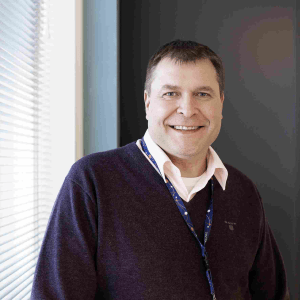
Seppo Rytilä, Head of HSSEQ at Eltel Networks
Mr Winquist points out that Groundhawk doesn’t require a lot of market education: once the field crew tries their product, they understand that it’s as easy to use as a mobile phone. The startup can boast about more than 50 European contractors already trusting Groundhawk when building underground infrastructure. One of them is Eltel Networks, the leading service provider for critical infrastructure in the Nordics.
‘Eltel has extensive experience in planning and building and maintaining fiber networks and as of today, the company is a leader in the Nordic region in the development of fiber optic networks. To ensure these networks operate smoothly and reliably, advanced mapping technology is essential. By utilising the new Groundhawk AI-based mapping technology, Eltel has been able to speed up the FTTH/B (Fiber-to-the-Home/-Building) construction processes. In addition, technology has helped to guarantee good network mapping and documentation,’ Mr Winquist tells ITKeyMedia.
‘Groundhawk has transformed how we manage documentation and project delivery in our FTTH projects. Previously, we relied on external surveyors measuring trenches after they were closed, resulting in delays and imprecise data. Now, our crews can capture accurate location, depth, and visual quality data, including traceable images, within minutes while the trench is still open, and it’s instantly available to our project managers. Removing the surveyor from the chain has simplified subcontractor management, accelerated handovers, and removed uncertainty at project completion. When the last excavator leaves the site, the mapping is already done, accurately and fully compliant,’ Eltel Networks’ head of HSSEQ Seppo Rytilä confirms.
Groundhawk’s quality control is based on standardised operating models with the correct components and correct locations all visible in the system. This supports both internal quality monitoring and the requirements of clients and authorities. Such digital mapping not only records data, but also supports the development of expertise as the Groundhawk platform enables user-specific feedback: if deficiencies are detected in mapping, they can be addressed immediately.
‘Learning thus takes place alongside work, and quality improves across the entire organisation. Standardised practices and continuous feedback are reflected in smoother daily operations, higher customer satisfaction, and more reliable documentation,’ Mr Winquist comments.
Competitive Advantage in an AI-Accelerated World
With software development becoming faster and easier due to AI, the CEO lists three persistent sources of Groundhawk’s competitive advantage:
- Exclusive data sets. Having access to data for training models and understanding of how the use cases actually work. According to the startup’s numbers, the platform has already been used to capture ‘over 5000km of data’ to learn from.
- User and industry insight. An in-depth understanding of customer needs, preferences, and business processes assured successful product development and go-to-market. Developing its product in close collaboration with customers and users, Groundhawk managed to ensure its alignment with real-world requirements.
- Innovation. Groundhawk has developed several core innovative technical approaches in positioning as well as 3D AI data processing.
Strong Traction Drives Investment Decision

Ines Bergmann-Nolting, Managing Partner at Greencode Ventures
2C Ventures’ investment in Groundhawk aligns with its broader thesis of backing technically strong founding teams building scalable, software-driven solutions for traditionally under-digitized industries. By supporting Groundhawk, the Estonian fund reinforces its focus on companies that sit at the intersection of real-world infrastructure and data, where proprietary technology can unlock significant efficiency gains. The deal also reflects 2C Ventures’ gravitation toward startups with early traction and clear pan-European potential of evolving into foundational platforms—here, potentially becoming a system of record for underground infrastructure.
Likewise, Greencode Ventures is thrilled to back a transformative blend of software and hardware that advances infrastructure mapping through real-time documentation and AI-driven automation.
‘The team brings an exceptional combination of profound sector insight and deep technical expertise, and their strong early traction convinced us to invest. As fiber networks expand and electricity grids transform for the energy transition, accurate underground infrastructure documentation has never been more critical. Groundhawk is building exactly the right solution at exactly the right time. The rare combination of deep geospatial expertise in the founding team, strong traction with major Nordic and European contractors, and a clear AI-driven automation roadmap convinced us to invest,’ Greencode Ventures’ partner Ines Bergmann-Nolting shares.
Funding to Scale Across Europe and Beyond
This funding round is meant to support Groundhawk building a scalable B2B sales organisation across key European markets, expanding its engineering team to advance the AI and spatial intelligence capabilities, and developing new product features.
‘There are a lot of different directions we can take but right now we are very focused on underground cable and duct buildout mapping and documentation use cases. This year we are building out our presence in Europe. Next year we plan to go beyond Europe but we will announce more plans as they get closer to realization,’ Mr Winquist hints.
Addressing a critical structural gap in modern infrastructure development, Grounhawk transforms underground asset mapping from a fragmented, post-construction process into a real-time, data-driven workflow that improves safety, efficiency, and long-term network reliability. By embedding spatial intelligence and quality assurance directly into construction, the solution reduces costly errors and closes the persistent ‘information debt’ that continues to affect utilities and contractors across Europe. The involvement of 2C Ventures places the Baltic VC ecosystem firmly within a broader European infrastructure technology narrative, highlighting how CEE-based investors are increasingly backing companies with ambitions to become foundational players in the digital transformation of Europe’s physical infrastructure.

Kostiantyn is a freelance writer from Crimea but based in Lviv. He loves writing about IT and high tech because those topics are always upbeat and he’s an inherent optimist!