

- The launch of JIC Ventures marks Brno-based entry into CEE seed venture capital
- JIC’s new EUR 16.3M fund targets deep tech startups with up to EUR 1M investment tickets
- Combining private capital, public institutions, and JIC’s long-standing ecosystem expertise, the new fund is poised to scale regional innovation and reshape CEE early-stage funding landscape
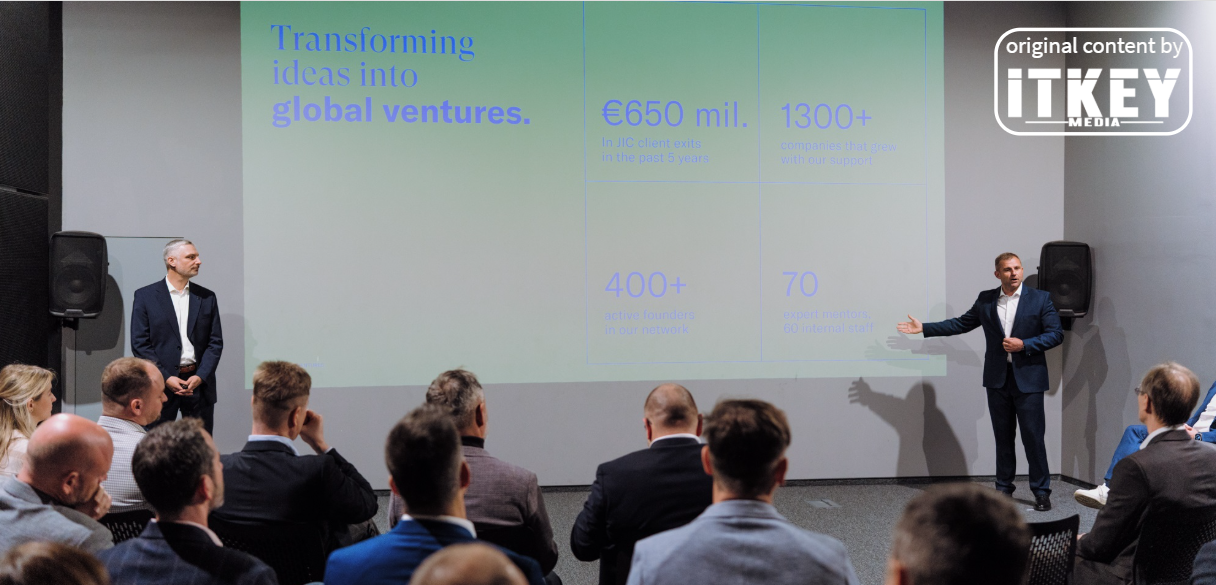
The official launch of JIC Ventures took place in Brno on April 7th, 2026, in the presence of Czech President Petr Pavel, alongside investors and innovation leaders from across the country. The new fund, created by JIC South Moravian Innovation Agency, targets Pre-Seed- and Seed-Stage tech startups from Central and Eastern Europe, with tickets of up to EUR 1M million per company and an ambition to back around 20 startups over the next four years.
From Ecosystem Builder to VC

Juraj Šabatka, CEO at IDEA StatiCa
With more than 20 years of experience supporting over 1,300 startups—including Kiwi.com, Y Soft, and Flowmon—JIC is now expanding its role from ecosystem builder to lead investor. Building on its co-investment activities since 2015, the new EUR 16.3M fund combines capital with hands-on support and access to a broad network of founders, experts, and partner institutions.
JIC Ventures aims to address a persistent gap in early-stage funding for deep tech and research-driven startups in the region, while contributing to a broader shift toward an innovation-led economy. Its model—bringing together private investors, entrepreneurs, and public institutions—remains relatively uncommon in CEE.
The fund is backed by around 40 limited partners, including major companies, financial institutions, and experienced founders reinvesting into the ecosystem. They include CTP, Česká Spořitelna, IDEA StatiCa, and many more.
‘We started years ago at JIC as a technology startup ourselves, and we know how important it is to have the support of experienced mentors in the early stages. We want to contribute not only capital, but also experience,’ IDEA StatiCa’s CEO Juraj Šabatka shares.

Jakub Kodr, Managing Director in the Czech Republic at CTP
‘The Czech economy cannot develop without technology firms that provide a high level of added value. We see JIC Ventures as a practical tool to accelerate the foundation and growth of start-ups that can succeed globally, while also further cementing the South Moravian Region as an innovation hub. We are joining the fund as the largest investor because we firmly believe that this model will help develop the innovation ecosystem and foster the creation of many successful companies. Besides capital, technology companies need space to grow, from R&D to prototyping and scaling. CTP injects infrastructure, knowledge, facilities, and services into the South Moravian ecosystem, which eases expansion and accelerates decision-making. We want to partner with innovative companies from the beginning,’ CTP’s Managing Director in the Czech Republic Jakub Kodr adds.
Notably, while most capital comes from private sources, the South Moravian Region (and even the Diocese of Brno) also participates, making the fund a notable example of public-private collaboration in venture capital.
Bridging Public and Private Capital to Close CEE’s Early-Stage Capital Gap
ITKeyMedia approached JIC Ventures’ managing partners Radim Kocourek and Miloš Sochor to find out more about the new fund’s unique position, mission, and ambition:
What particular trigger inspired the idea to create JIC Ventures and enforced its realization?
Radim Kocourek: The idea itself is older than people think. It appeared in the Regional Innovation Strategy document back in 2002, a year before the JIC Innovation agency was even founded. So, the ambition was always there. What changed is that several things came together at the right moment. Miloš Sochor brought hands-on fund management experience from Y Soft Ventures. On our side, the capital from the first fund was fully deployed and we were looking for the next step. The data made the case clearly: the US invests around USD 800 of venture capital per capita, Europe around USD 100, the Czech Republic around USD 20 and of that, 80% goes to Prague, 19% to Brno, and 1% to the rest of the country. Where capital concentrates, the best startups follow. Having the best incubation and acceleration services alone didn’t suffice anymore. We needed to respond. And everything converged: deeper deal flow, stronger JIC positioning, and the right people.
How do you balance JIC Ventures’ dual identity as both a market-driven VC and an initiative rooted in a public innovation agency like JIC?

Miloš Sochor, Managing Partner at JIC Ventures
Miloš Sochor: The structure does the heavy lifting here. The majority of the fund’s capital is private – around forty limited partners, from CTP and Česká spořitelna to successful founders who built their companies through this ecosystem.
The fund was designed to fully comply with market standards – it is subject to the same requirements for management, governance, reporting, and asset manager obligations as any other venture capital fund. Public institutions, such as the South Moravian Region, participate in the investments under the same terms as everyone else. They do not make the investment decisions; we do.
That separation matters. We operate to full market standards – the governance, the return expectations, the investment process. What the JIC roots give us is something private funds have to build from scratch: two decades of deal flow, university relationships, and a network of founders who trust us because we were there before for them. Our public origin is the source of the edge, not a constraint on how we use it.
Do your return expectations differ in any way from regular private seed funds in CEE?
RK: No, and they shouldn’t. The average European VC fund returns roughly 2 to 2.5x invested capital. Our target is to beat that. We’re not a subsidized vehicle with softer return requirements. The investors who trusted us with their capital – whether a major bank, a property developer, or a founder who sold their company – expect market returns. What we believe gives us the edge is that we enter companies with significantly more knowledge than a typical fund. By the time we make an investment decision, we often know the team, the technology and the trajectory already. That’s not a guarantee, but it’s a meaningful advantage at the point where most funds are starting from zero.
How do you approach potential conflicts of interest when investing in startups emerging from universities or institutions closely connected to JIC?
RK: When a company comes from within the JIC ecosystem, we apply the same investment criteria as for any external project: team, technology, global potential, market. The prior relationship gives us better information, not a lower bar. If anything, knowing a founding team for two or three years before the investment conversation means we’ve also seen the difficult moments, not just the pitch.
Looking at the pipeline from JIC’s incubation programs, how do you avoid bias toward ‘internally groomed’ startups and ensure competitive deal flow?
MS: Roughly 5 to 10 new startup projects enter JIC’s incubation program every month – that’s over a hundred companies a year. So, the internal pipeline is large enough that selection within it is genuinely competitive. But we also actively look beyond it: across the Czech Republic, Slovakia, Poland, Austria and the wider CEE region. The fund’s geographic scope is CEE, not the JIC alumni list. What the internal pipeline gives us is earlier and deeper knowledge of companies we might eventually back. What it doesn’t do is set the ceiling. The best company wins the investment, regardless of where it came from.
Beyond capital and mentoring, what specific operational support will portfolio companies receive that meaningfully contributes to their chances of global success?

Radim Kocourek, Managing Partner at JIC Ventures
RK: A few things are genuinely hard to replicate elsewhere.
- First, sector-specific expertise – in cybersecurity, software/hardware platforms, nanotechnology and precision instruments, space tech and dual-use, and semiconductors, we have advisors who have built and exited companies in those exact spaces. When a founder hits a specific technical or commercial challenge, we’re not connecting them to a generalist network. We’re connecting them to someone who has been through that specific problem.
- Second, speed – from term sheet to closing in weeks, not months, which matters enormously at seed stage when a company’s momentum is fragile.
- Third, the wider JIC infrastructure: programs, events, university connections, and a community of alumni founders who have a cultural habit of giving back. This last part isn’t a service we deliver, it’s a flywheel that’s been running for twenty years.
What does success look like for JIC Ventures in 10 years, both in financial terms and in terms of ecosystem impact?
MS: Financially: we return our investors’ capital multiplied, at least two or three of our portfolio companies become category leaders globally, and we’ve already started working on the next fund – bigger, with a broader mandate, able to reach other sectors like eg. life science. On the ecosystem side: the map changes. University spin-offs become a normal part of the regional economy rather than a rare exception. And JIC Ventures becomes a reference point – the proof that you can build a world-class VC fund from Brno, and that the CEE region doesn’t have to send its best companies west to find serious capital.

Tomáš Salomon, CEO and Chairman of the Board at Česká Spořitelna
RK: I’d add one thing. In ten years, I want the model itself to have spread. Not just the fund, but the idea that a public innovation agency, a regional government, private investors and founders can build something like this together. It works here because twenty years of ecosystem building created the required conditions. If what we’re doing in Brno becomes an inspiration for other Czech and CEE regions, that’s a success that goes beyond our portfolio numbers.
To conclude in the words of Česká Spořitelna’s CEO and chairman of the board Tomáš Salomon, ‘Hardly anyone today still doubts the necessity of an economic transformation based on innovation and high added value. We are looking for ways to support this transformation as effectively as possible. Connecting private capital with an initiative from an innovation agency established by public-sector institutions can serve as a model for effective cooperation and as an example for similar projects. Importantly, this initiative emerges from the bottom up – in the South Moravian Region with its strong universities. We are pleased to support the effective transfer of knowledge from the scientific and academic environment into business.’

Jan Grolich, Governor of South Moravia
‘If we want to compete on the European and global stage, we must seek out new tools to support the founding and development of new enterprises. This fund takes our innovation policy to a higher level,’ South Moravian Governor Jan Grolich agrees.
The launch of JIC Ventures marks a significant step in the rapid progress of the South Moravian innovation ecosystem from a long-standing talent and startup incubator into a fully-fledged capital formation platform. By combining deep regional roots in JIC with institutional and private investors’ capacities, the new fund strengthens the early-stage financing infrastructure that has been missing across much of the CEE region. Ts success could serve as a reference model for how regional ecosystems can translate decades of capability-building into globally competitive venture capital structures.

Kostiantyn is a freelance writer from Crimea but based in Lviv. He loves writing about IT and high tech because those topics are always upbeat and he’s an inherent optimist!