
- ÄIO secures EUR 1M RUP grant to advance cosmetics-focused sustainable fats R&D
- Founded in 2022, the TalTech spin-off develops fermentation-derived oils that cut land, water, and emissions versus palm, coconut, and animal fats
- EU-aligned biotech innovations position ÄIO to lead in global sustainable fat alternatives
This July, ÄIO, the Estonian developer manufacturer of alternative sustainable fats and oils, received a grant of EUR 1M from Estonia’s public Applied Research Program (RUP), coordinated by the Estonian Agency for Innovation and Economic Development (EIS). The grant is meant to fund the startup’s three-year cosmetics-focused R&D project with a budget of EUR 1.8M (with the remaining funding bootstrapped by ÄIO).
From Academic Roots to Entrepreneurial Growth

Dr Petri-Jaan Lahtvee, Co-Founder and COO at ÄIO
ÄIO was started in 2022 by Dr Petri-Jaan Lahtvee (COO) and Dr Nemailla Bonturi (CEO), two scholars with in-depth expertise in biotechnology, fermentation, and sustainable process development. The idea for ÄIO was born during their research at TalTech’s BioEng group, where they explored ways to turn agricultural and wood industry side-streams into high-value products.
What began as a TalTech spin-off with early lab-scale work in 1L bioreactors, got validated with a handful of successful grant applications and growing international collaborations in 2023. In 2024, ÄIO raised EUR 6.1M of Series A investment from Voima Ventures, 2C Ventures, SmartCap, and Nordic Foodtech VC. The current grant from EIS for cosmetics-focused R&D marks another milestone for ÄIO.
‘Our biggest challenges included navigating complex regulatory pathways for novel ingredients, and ensuring scalability without compromising sustainability. Strong partnerships and R&D discipline have helped us overcome these hurdles,’ Dr Lahtvee recalls.
Backing from Estonia’s Innovation Agency

Ene Viiard, R&D Expert at the EIS Applied Research Programme
EIS RUP’s R&D expert Ene Viiard notes that that her organization prioritizes supporting the development of Estonian innovations that have clear potential to become globally competitive products with high added value and impact on pressing worldwide challenges. Biotechnology and sustainable biomaterials are key spaces for EIS.
‘Competition for RUP support is high, but in ÄIO, we see an exceptional team with the scientific knowledge and disruptive attitude that proves that even from a small country like Estonia, it is possible to produce and scale world-changing innovations,’ Ms Viiard comments.
Cosmetics Industry at a Turning Point
To reiterate, palm and coconut oil production are cited to drive deforestation, biodiversity loss, and heavy water and land use. Animal fats, in turn, raise ethical concerns around animal welfare and high greenhouse gas emissions. Finally, mineral oils are fossil-based and can pose human health and environmental risks.These issues, combined with tightening regulations and shifting consumer values, are major reasons why cosmetics brands are seeking high-performance, sustainable alternatives like ÄIO’s.
‘The cosmetics industry is at a turning point. All brands, large and small, are realizing that sustainability is no longer a bonus, but an essential requirement driven by consumers. Until recently, sustainable solutions have been hampered by performance or cost barriers to ingredients such as palm or coconut oil. Through research, development and rigorous scientific validation, we are demonstrating that ingredients derived from fermentation have immense commercial potential for a future where beauty, whether everyday or luxury, will no longer be at the expense of the planet or human health,’ ÄIO’s head of cosmetics development Magdalena Koziol adds.
Brewing Oils with Yeast and Scaling with Safety and Compliance
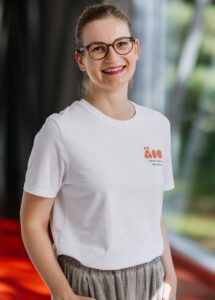
Magdalena Koziol, Head of Cosmetics Development at ÄIO
Specifically, ÄIO’s alternative solution uses special yeast to turn organic side-streams, like sawdust sugars, into rich, healthy oils and fats.
‘It’s like brewing beer, but instead of alcohol, our yeast becomes rich in lipids and we can make sustainable oils. Compared to palm oil, coconut oil or animal fats, producing our oils we use up to 97% less land and 90% less water, produce 10 times faster and they’re free from deforestation, animal cruelty, and fossil-based origins. We also avoid deforestation-linked sourcing entirely and valorise local organic side-streams, cutting transport emissions,’ Dr Bonturi explains.
Naturally, entering the cosmetics market requires ingredient safety assessments, toxicological testing, and compliance with the EU Cosmetic Regulation. ÄIO already applied for INCI and is working with regulatory experts to ensure compliance. Future hurdles to anticipate will include applying for novel food permits and ongoing adaptation to new regulations.
However, the primary challenge is about scaling bioprocesses from lab to pilot—scaling fermentation is a significantly more profound process than just ‘making it bigger.’ Challenges include maintaining consistent yields, ensuring product quality at large volumes, and adapting downstream processes for higher throughput.
Dr Bonturi tells ITKeyMedia that ÄIO addresses this through a stepwise scale-up process, moving from 1 L to 300 L, then to 10,000 L and eventually 100,000 L. This is supported by close collaboration with experienced contract manufacturers, alongside continuous process monitoring, data-driven optimization, and clear standard operating procedures. In addition, the team continues to invest in its Pilot Plant to build in-house scaling capabilities before transitioning to full-scale plant operations.
Growing in a Whole World of Applications
ÄIO’s versatile ingredients for cosmetics span everyday soap, high-performance moisturizers, serums, and makeup with specialized pigments. It is also worth remembering that microbial fats have applications beyond cosmetics, including:
- Food—as palm oil and coconut oil alternatives;
- Pharmaceuticals—as carriers for active ingredients;
- Bio-lubricants and oleochemicals—for industrial applications.
The versatility of fermented lipids makes them relevant across multiple high-value markets. Such adaptability makes ÄIO an attractive partner for both global brands seeking scalable, sustainable supply chains and indie players driving innovation in formulations.
The company proactively engages in discussions with manufacturers and sends out product samples to cosmetics producers, laying the groundwork for commercial expansion. To support its growth, the company plans to raise new funding in H2 2026. Positioned within the rapidly growing alternative fat market—projected to expand 6% annually to USD 4.5B by 2032—ÄIO is primed for impact.
Alternative Lipids for a Healthier Planet

Dr Nemailla Bonturi, Co-Founder and CEO at ÄIO
‘By replacing palm oil, coconut oil, and animal fats with fermentation-derived alternatives, we directly reduce demand for ingredients linked to deforestation and habitat loss. Our local, side-stream-based sourcing model supports biodiversity by avoiding land conversion and promoting circular use of resources. On a global scale, widespread adoption of such alternatives can play a meaningful role in restoring ecosystems and protecting endangered species,’ Dr Bonturi concludes.
Developing alternative fats and oils in the EU is undoubtedly essential to replace palm, coconut, animal, and fossil-based sources that drive deforestation, emissions, and ethical concerns. Biotech solutions like ÄIO’s fermentation-derived lipids use local side-streams, cut land and water use, and avoid biodiversity loss while meeting performance needs for cosmetics and beyond. Such innovations illustrate the EU’s decisive movement toward its circular bioeconomy goals and strengthen its role as a global leader in sustainable industry transformation.

Kostiantyn is a freelance writer from Crimea but based in Lviv. He loves writing about IT and high tech because those topics are always upbeat and he’s an inherent optimist!