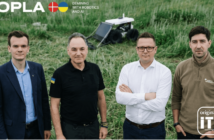


- Ostrava-based industrial AI debugging platform Edmund received EUR 2.5M Seed investment from FORWARD.one, University2Ventures, and Tensor Ventures
- Founders combine in-depth factory, PLC, and automation experience from early careers
- The platform unifies fragmented industrial data to diagnose machine failures faster
- The startup’s future plans focus on global expansion, PLC coverage, and becoming factory intelligence layer
This April, Edmund—the Czech AI-powered debugging platform for industrial maintenance—nabbed EUR 2.5M of Seed investment. FORWARD.one became the lead investor of the round, with University2Ventures and the well-known Czech VC fund Tensor Ventures (invested in Repsense, among others) joining in.
Founders Built for the Factory Floor
Before starting Edmund in 2023, Benjamin Przeczek (COO) and Jakub Szlaur (CEO) were building industrial automation together as early as their high school years. They met in a mechatronics program and quickly became a team, winning multiple national competitions in programming, industrial automation, and engineering design. Their graduation project was a fully functional miniature production line, hardware, control software, and monitoring layer, an early sign that they naturally thought about factories as integrated systems rather than isolated disciplines. They continued together into university-level studies in Industry 4.0 at VŠB Technical University in Ostrava, where Mr Szlaur earned recognition for both his bachelor’s and master’s theses.

Jakub Szlaur, Co-Founder and CEO at Edmund
In parallel, the two co-founded Edima Solutions, a services company designing custom industrial machines, control systems, and monitoring software for real manufacturing clients. That’s where the problem behind Edmund started to take shape. Working directly with maintenance teams on the shop floor, the same pattern recurred: when a machine went down, the knowledge needed to fix it was scattered across PLC projects, electrical schematics, mechanical drawings, PDFs, and the heads of a few senior technicians, and under the pressure of downtime nobody could pull it together fast enough.
Miroslav Marek (CSO) is the third co-founder, bringing industry seniority to the table. He has more than 15 years of managerial experience inside manufacturing and industrial companies, including senior roles at Continental and Siemens, complemented by nearly two decades as a project manager and over a decade as a consultant, mentor, and coach focused on management systems and leadership development. In recent years, he has concentrated specifically on digitalisation and applied AI in industry and in maintenance above all. Where Mr Szlaur and Mr Przeczek bring deep engineering and automation expertise from the machine side, Mr Marek brings the operator’s and manager’s perspective: how plants are run, how transformation projects succeed or stall, and how technology has to land in an organisation to deliver measurable results. This rare combination is what convinced the three of them that they could build Edmund rather than just diagnose the problem.
The specific trigger for Mr Szlaur came during an all-nighter before state final exams. As he bluntly recalls, four Red Bulls deep, studying with a classmate, the thought landed: what if there was a digital technician who could look under the hood of a PLC, cross-reference the electrical schematics with the mechanical drawings, and just tell you what broke, why, and how to fix it? For Mr Przeczek, the conviction came from the other direction. After years inside corporates and consulting, seeing the same knowledge-transfer and downtime problems repeat themselves across plant after plant and watching ‘predictive maintenance’ arrive as a buzzword without actually solving the hard part, he moved into the startup world specifically to help build that digital colleague. The three founders converged on the same insight from different angles: that the real bottleneck in modern manufacturing isn’t data, it’s context, and that fixing it required a team fluent in PLCs, plant operations, and AI all at once.
Edmund sits exactly at the intersection of what the three co-founders have already been doing for years. Mr Szlaur and Mr Przeczek have written the PLC code, drawn the schematics, designed the machines, and sat next to maintenance crews trying to keep them running at 2 AM, while Mr Marek has run the factories in which those machines live and spent years helping industrial companies turn strategy and know-how into operational results. They are engineers and operators who lived inside the problem long enough to see exactly where AI could finally do something about it.
Edmund’s Journey in Recap
To recap Edmund’s history so far:
- 2023 — The company was founded, emerging from Edima Solutions. The founders repeatedly encountered the same issue across factories: critical operational know-how was disappearing, firefighting was constant, and breakdowns often happened overnight. This led to a key turning point—moving away from solving problems plant by plant and instead building a scalable product.
- February 2025 — Edmund raised a EUR 500K pre-seed round led by another famous Czech VC fund Lighthouse Ventures (invested in Ranketta, among others), with participation from Czech Founders VC, Borovicka Capital, and Tensor Ventures. An alpha version of the product was launched, and around 12 proof-of-concept deployments were signed. The main challenge at this stage was gaining the trust of conservative industrial customers and convincing them to allow AI systems to interact with production environments.
- 2025 — The company entered its beta phase and began working directly on factory floors. It shifted to continuous deployment, expanded its AI team, and tested the product in live manufacturing environments, including participation in US industry events. Now, the key technical challenge was building systems capable of interpreting highly unstructured and manufacturer-specific data, including PLCs, schematics, and machine documentation.
- Later in 2025 — Edmund reached early product-market fit, securing its first recurring customers, including Amcor. The company released Edmund AI 1.0, focused on 24/7 industrial reliability. Around this time, it also expanded its internal structure by building out customer success, implementation, and sales teams. The main challenge was transitioning from founder-led proof-of-concepts to a scalable and repeatable SaaS model.
- 2025–2026 — Edmund entered its scaling phase, opening an office in Prague and launching Poland as a second core market. The product evolved to include specialized AI agents for documentation, PLC analysis, data health, alerts, and knowledge sharing. The team grew to more than 25 people, with the central challenge being rapid growth while maintaining technical depth and reliability in industrial environments.
The Solution
Today, Edmund has grown into a full-fledged AI-powered industrial maintenance platform that connects factory data—such as PLC programs, technical documentation, sensor readings, and maintenance logs—into a single system to help engineers quickly diagnose and resolve equipment issues. It acts as a ‘digital technician’ that identifies root causes of breakdowns and provides step-by-step troubleshooting guidance in minutes instead of hours or days.
It also preserves and organizes company know-how, turning fragmented or tacit maintenance knowledge into a searchable, reusable knowledge base for teams. Over time, it becomes an operational layer inside the factory that supports faster decision-making and reduces downtime.

Beau Anne-Chilla, Partner at FORWARD.one
‘Edmund is solving one of the most overlooked challenges in industrial maintenance: how knowledge is transferred and applied under pressure. Their approach has the potential to become a foundational layer for modern manufacturing,’ FORWARD.one’s partner Beau Anne-Chilla states.
‘The real challenge is not a lack of data, but a lack of context. We’re building AI agents that understand how machines actually work, down to the PLC project level, so instead of searching through documentation or waiting for experts, engineers can act immediately,’ Mr Szlaur explains.
Adoption Challenges and Workforce Reality
While the Edmund team did notice technicians having a psychological barrier for trusting AI recommendations, they found out it’s not with the recommendations themselves, but with a broader fear that AI is going to replace them. Edmund’s answer to that is simple: the platform is not not replacing technicians, but filling the gaps left by a lack of personnel.
Indeed, tens of thousands of engineering roles remain unfilled in Europe alone, while around 20% of the current workforce is expected to retire within the next decade. The remaining maintenance teams work in an environment where knowledge, data, and information are scattered across multiple verticals and siloed systems which makes their job unnecessarily hard. In this situation, Edmund’s mission is to amplify what the operator, technician, or maintenance manager can already do, letting these professionals work faster, with less friction, and at a higher quality. In practice, Edmund cites its users claiming that the platform frees up around 30% of their time during a downtime.
‘On the market education side, the trust gap is actually the biggest challenge we face, bigger than any technical one. Manufacturers have lived through a decade of Industry 4.0 promises that didn’t deliver. Dozens of tools came through their plants and fell short. Thanks to generative AI, the industry is finally in a position to deliver on what was promised back then but that history means every new AI conversation starts from a place of healthy scepticism,’ Edmund’s CMO Ladislav Švábek tells ITKeyMedia.
As such, Edmund carries a deliberately educational rather than promotional narrative through all channels: explaining what AI can do, what it can’t do, and specifically what Edmund does. The team has to be very careful about how it frames its technology, and very thorough about its real capabilities and limits. Seeing how overpromising is how the previous wave lost the industry’s trust, the startup is interested in not repeating that.
Ground Truth and Validation
The need arises to validate ‘ground truth’ in complex industrial environments and ensure that the AI-suggested root cause is indeed correct beyond correlation. Ground truth in complex industrial environments is tricky, but our approach is grounded in two principles: closed data and rigorous pre-deployment testing.

Ladislav Švábek, CMO at Edmund
In this regard, Edmund only works with the documentation and data the client already has: schematics, PLC projects, technical documentation, layouts, operational data (but they are scattered and unorganized or hard to understand for a normal technician). Without being connected to the open internet or pulling from external sources, Edmund can ensure both the security profile industrial clients need and a clean, bounded input space. It reasons over what the company actually knows about its own machines.
Before any rollout to a production line, Edmund runs a rigorous validation phase with the client, with explicit success criteria on response reliability. Reportedly, Edmund has not produced an answer that would put manufacturing or safety at risk to this date.
‘Beyond that, the deeper reason it holds up isn’t statistical; it’s physical. Machines behave in deterministic ways. Once you properly connect the PLC logic, the schematics, the documentation, and the live operational data, there isn’t much room left for speculation. Edmund isn’t inferring a root cause from loose correlations; it’s tracing it through the actual system of record. Correlation is how generic AI tools fail in this industry. Context is how Edmund avoids that failure mode,’ Mr Švábek specifies.
Competitive Edge and Enterprise Proof
He further shares how one of Edmund’s larger customers recently ran a proof of concept with roughly ten different solutions in the mix, including Siemens and Amazon. Edmund was the only one that actually performed, and it outperformed what both Siemens and Amazon were offering.
‘That’s not an isolated data point either; we’re in regular contact with Siemens experts on the technical side and remain open to collaborating with them where it makes sense. The deeper reason we hold the edge is structural. Incumbents like Siemens are anchored to their own ecosystems, so their AI tooling tends to work best on their own hardware, their own PLCs, and their own stack. Edmund is universally compatible by design, Mr Švábek adds.
The Edmund platform works across manufacturers, across PLCs, across whatever legacy and modern documentation a plant may have accumulated over decades. This neutrality matters, because almost no real factory is a single-vendor environment.
Additionally, Edmond is faster, onboarding a client’s data and delivering an MVP-ready deployment in around 48 hours, which is a timeline large incumbents simply cannot match with their procurement, integration, and release cycles.
‘Finally, Edmund is built by engineers and operators who have actually run the machines, written in the PLC code, and sat with maintenance crews at 2 AM. That hands-on understanding of how factories actually work is hard to replicate from a corporate R&D lab,’ Mr Švábek boasts.
This makes the Edmund team confident that if Siemens shipped an equivalent tomorrow, the startup would still win on vendor neutrality, speed of deployment, and depth of industrial context.
Europe to US Expansion
In view of the coming US expansion Mr Szlaur’s team doesn’t see American industrial software buying significantly different from European ones. They are broadly similar on both sides of the Atlantic, and the team can see how those decisions get made in practice as many of Edmund’s current customers already run plants across Europe, North America, and Asia.
‘The more interesting difference is the state of the industry itself. Digitalisation is actually further along in Europe than in the US. A lot of American plants still run on legacy, sometimes even analogue equipment, not because they can’t afford the upgrade, but because the machines work and there’s no reason to replace what’s reliable. That shapes how we position Edmund there: less about riding an existing digitalisation wave and more about meeting plants where they actually are, which means working well with older PLCs, scattered documentation, and tribal knowledge that has never been digitized. That’s squarely where Edmund is strong anyway.
So the strategy isn’t a different playbook. It’s the same product, tuned to a market where the gap between ‘what the plant runs on’ and “what modern software assumes” is often wider, and where our vendor-neutral, legacy-friendly approach is arguably even more of an advantage than it is in Europe,’ Mr Švábek shares.
Investor Confidence
According to Tensor Ventures’ partner Ondrej Lipold, his fund’s main reason why they invested in Edmund was the founders’ exceptional energy and drive, combined with rare first-principles understanding of how industry machinery actually works — and what it takes to bring a fundamental change to it.

Ondrej Lipold, Partner at Tensor Ventures
‘Edmund is turning the factory floor into an intelligent, self-diagnosing system that gives manufacturers real-time answers instead of costly downtime. Our corporate network spans exactly the industrial players Edmund needs to accelerate its expansion, and we look forward to helping Edmund expand,’ University2Ventures’s founding partner Dr Johannes Triebs agrees.
What the New Investment Unlocks
The fresh funding is meant for Edmund to grow its team, expand across European and US markets, and further develop its platform toward fully contextual, AI-driven troubleshooting and diagnostics for industrial operations. Mr Švábek elaborates on steps, time frames, and anticipated outcomes:
- ‘Team. We’ve already hired aggressively. The developer and AI scientist teams are now in place, and we’re currently bolstering the Customer Care and Implementation side alongside Go-to-Market. That’s where we feel we need to step up next.
- European expansion. Already underway. We’ve brought on a sales engineer from Poland and another one for Germany. Poland is the market we’re entering right now, including a local event we’re hosting there, and Germany is next. The rough timeline: within a year we expect to be actively present in Czechia, Poland, and Germany. Two years out, we’re looking at additional markets where it genuinely makes sense, likely Austria, with Romania and USA as strong signals from our existing customer base exist there. The pull is coming organically. A number of our current European customers have US subsidiaries that have asked about Edmund directly. Two years from now, the US could mean a real commercial presence for us, not just exploration.
- Platform. Edmund is mainly a debugging platform, and on the PLC compatibility front we’ve already implemented support for the major providers: Siemens TIA Portal, Allen-Bradley (Rockwell), and notably Omron, where we’re the first platform in the world to support it. The next phase is broadening that further covers both modern and older PLCs wherever it technically makes sense.’
Because the product is now mature enough to deploy in most factories, Edmund’s primary metrics today are commercial rather than technical: customer acquisition, recurring revenue, retention, geographic footprint, and depth of deployment inside existing accounts. Two years from now, success looks like a healthy book of recurring customers across at least four European markets, a broader set of supported PLCs and data sources, and Edmund operating as the default diagnostic layer inside the plants that have adopted it.
Final Vision: The Factory as a Self-Diagnosing System
The overarching direction is to make Edmund the single source of truth for a factory: able to ingest everything, analyse data in real time, and say with confidence, ‘this happened because of this, and here’s what to do.’
Edmund’s funding round marks a significant step in accelerating a broader shift toward AI-native industrial operations, where fragmented machine data and human knowledge are unified into actionable intelligence. By targeting one of manufacturing’s most persistent bottlenecks—diagnosing and resolving downtime under pressure—the company is positioning itself as a foundational layer for next-generation factory reliability. Its approach is poised to meaningfully reduce operational inefficiencies across global manufacturing while reshaping how industrial expertise is captured, shared, and applied.

Kostiantyn is a freelance writer from Crimea but based in Lviv. He loves writing about IT and high tech because those topics are always upbeat and he’s an inherent optimist!