

As CEO of Digicode Europe, Alex Karichensky focuses on practical digital transformation in procurement and supply chain environments. He partners with enterprise teams to modernize sourcing, contract operations, and process governance through scalable, implementation-ready technology strategies.
Procurement teams have been automating for years, yet many still face the same workflow barriers: approvals that bounce between inboxes, supplier questions that go unanswered, and sourcing cycles that drag on because every “exception” requires a human to interpret context. That’s why the conversation about automation is shifting.
It’s obviously no longer about whether to automate, but what kind of automation actually changes outcomes.
Why the automation choice matters more than the tool
A decade ago, automating procurement meant standardizing a few repeatable steps: creating a requisition, routing it for approval, generating a purchase order, and matching an invoice. Those moves still matter, but they no longer create separation. Many organizations can implement workflow rules and robotic task execution. The advantage now comes from how quickly procurement can react to the messy reality: supplier disruptions, price swings, contract nuance, and stakeholder urgency without losing control.
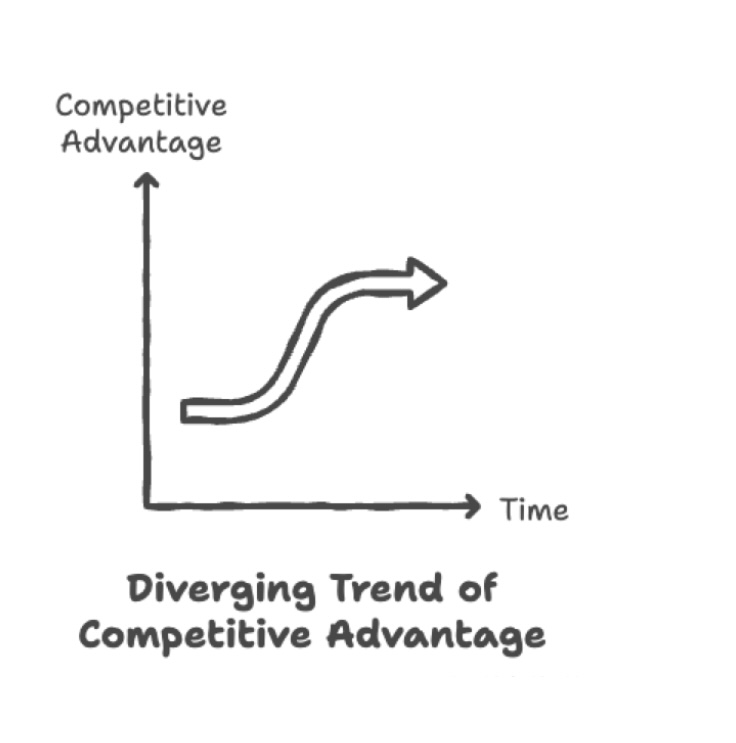
This is where the “diverging advantage” curve becomes useful. When automation only speeds up transactions, performance improves gradually. When automation helps people make better decisions faster, based on context and policy, the curve bends upward. That bend is what executives notice: fewer escalations, less tail spend, and a procurement team that’s seen as a partner, not a gatekeeper.
Traditional automation: great at volume, fragile with exceptions
Traditional automation is built for repetition. Think RPA, fixed workflow engines, and scripted integrations that move data between systems. In procurement, this style is powerful for tasks like:
- validating that required fields are present,
- routing approvals based on spend thresholds,
- sending reminders when an approver is late,
- generating standardized reports.
The value is speed and consistency. If the process is stable and the data is clean, traditional automation delivers reliable throughput.
Where traditional automation breaks down
Procurement rarely stays stable for long. The moment a stakeholder writes “urgent: need next week” in a comments field, or a supplier replies with “we can ship partial,” the process becomes semi-structured. Scripts don’t know what to do with nuance. They either fail, escalate, or create extra work through manual correction.
Traditional automation can also hide problems. If a bot moves bad data faster, you end up with inaccurate supplier records, misrouted approvals, and polished-looking reports that aren’t trusted. The result is predictable: people stop relying on the system and return to email threads and spreadsheets for “the real story.”
AI agents: less about tasks, more about decisions
AI agents are different. Instead of executing a fixed script, an agent is designed to interpret intent, use context from multiple sources, and take action within defined guardrails.
In procurement terms, agents can:
- read a supplier message and classify it (delivery risk, price change, compliance question),
- summarize contract clauses relevant to a purchase,
- draft a negotiation brief using category history and current signals,
- recommend alternate suppliers based on performance, lead time, and risk profile,
- monitor spend patterns and flag anomalies early.

The key difference: an “exception-first” mindset
Procurement’s hardest work lives in exceptions. AI agents are built for that reality. They don’t replace the need for good workflows; they sit on top of them to handle the gray areas that rules can’t cover. A practical way to think about it: traditional automation executes the happy path, while agents reduce the cost of exceptions.
A practical framework for choosing between them
Start with process maturity, not hype
If your procurement process is still being debated (roles are unclear, thresholds are inconsistent, policies are not adopted), AI won’t fix it. In that case, start with traditional automation to create a stable baseline. Clean up approvals, standardize templates, and integrate core systems. Once the baseline is established, agents can add decision intelligence without causing chaos.
Ask whether the work is rules-based or judgment-based
A simple test: can you write a short checklist that handles 90% of cases? If yes, automate traditionally. If not – if the task requires reading, interpreting, and choosing among options, an agent is a better fit.
Rules-based examples:
- PO creation from approved requisitions;
- three-way match validation;
- supplier onboarding form completeness checks.
Judgment-based examples:
- deciding whether a price increase is allowed under a contract;
- prioritizing which supplier disruption needs escalation today;
- choosing a sourcing route when requirements change midstream.
Evaluate data availability across systems
Agents work best when they can draw context from multiple sources: ERP, supplier portal, contract repository, ticketing tools, email, and spend analytics. If those systems are isolated, the first investment is integration and data access. Without it, an agent becomes a smart interface with limited authority.
Define guardrails early
The fastest way to lose trust is to let an agent act without boundaries. Procurement is a high-stakes function; guardrails matter. Examples of useful guardrails:
- An agent can draft communications, but a buyer approves sending
- An agent can recommend suppliers, but sourcing approves the shortlist criteria
- An agent can flag contract risks, but legal validates before signature
When guardrails are clear, agents move fast without creating fear.
What an “agent + automation” stack looks like in real life
In a modern procurement operating model, you typically combine both approaches. Take invoice handling:
- Traditional automation ingests invoices, extracts structured fields, and routes them.
- The agent reviews exceptions: missing POs, unit price mismatches, or unusual bank changes.
- The agent proposes a resolution: request clarification, route to a specific approver, or compare against contract terms.
- Humans approve high-risk actions; low-risk items auto-resolve under policy.
That hybrid pattern (workflow for structure, agents for exceptions) is where adoption sticks.
The outcome for which procurement leaders should aim
The goal isn’t to use AI. It’s to build procurement that feels responsive without being reckless. Done well, you get:
- faster cycle times without policy shortcuts,
- fewer escalations because issues surface earlier,
- higher stakeholder satisfaction because communication is timely,
- stronger compliance because decisions are logged and explainable.
Leaders who choose the right automation approach don’t just reduce effort. They change how the business experiences procurement: less waiting, fewer surprises, and greater confidence that spend is controlled for the right reasons.
Wrapping Up
Traditional automation is the engine room: reliable, repetitive, necessary. AI agents are the navigation: context-aware, adaptive, decision-focused. Pair them, and procurement stops being a bottleneck and starts being a competitive advantage that compounds.

Alex Karichensky is the CEO of Digicode Europe, a global consulting and custom software development company. With extensive experience in procurement and supply chain digital transformation, he works with enterprises to modernize sourcing, contract management, and operational workflows through practical, scalable technology initiatives.