
- Chișinău-based Paparuda Studio received EUR 210K pre-seed investment through Invest Moldova Agency
- The founding team combines business, R&D, and game development expertise to build original IP
- The studio targets indie-to-AA positioning focused on originality, culture, and creative freedom
- The startup’s long-term ambition includes building Moldova’s first globally recognized game development ecosystem
This April, the recently launched Moldovan gaming startup Paparuda Studio secured its Pre-Seed investment of MDL 4M / EUR 210K+ from angel investors through the Invest Moldova Agency.
A Bet on Moldova’s Game Development Future
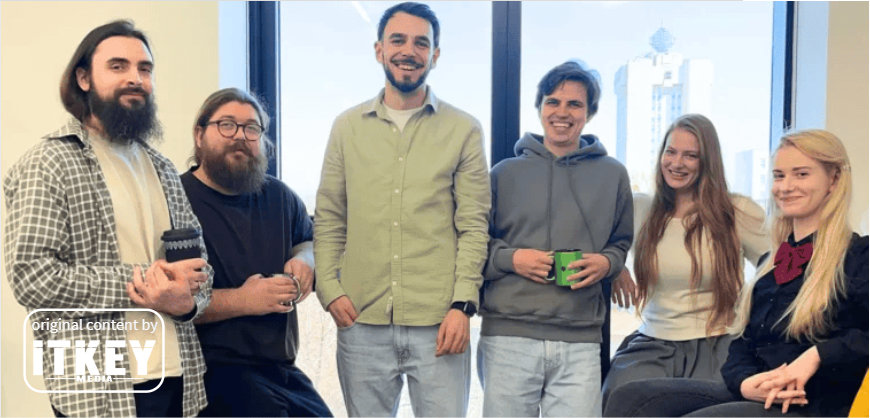
Paparuda Studio was started in early 2026 by three co-founders coming from different professional backgrounds:
- Victor Marchitan brings experience in business development, team structures, operational workflows, studio scaling, and strategic decision-making.
- Alex Culeva comes from an R&D background, with a strong focus on technology, experimentation, and technical problem-solving.
- Artiom Snegur comes from the game industry, with hands-on experience in game design, production, and leading teams through real game development processes.
Each of them had already worked on projects and managed teams before Paparuda Studio. What brought them together was sharing the same core idea and ambition to create something truly meaningful both for the local market and for the global one.
Their main trigger for creating Paparuda Studio was the realization that the game dev industry in Moldova was underdeveloped and, in some ways, stagnant. The country has talented experts with years of experience, but quite few stable companies that provide for this experience to be fully applied in the development of high-quality original products. The trio decided to build a place like this themselves: a studio where developers can reveal their skills and talent, creating meaningful gaming projects that are well-crafted and genuinely valuable for players.
The name Paparuda reflects a deep connection to Moldovan heritage, drawing from the traditional rain-bringing ritual associated with renewal, hope, and the power of community. Much like the ritual sought to bring new life and growth to the land, Paparuda Studio aims to spark the growth of Moldova’s creative industry by nurturing local talent and building original games with global ambitions. The name represents a bridge between cultural roots and a new generation of creators shaping the future of game development.
ITKeyMedia approached Mr Marchitan for a deeper dive into the new gaming studio’s mission, vision, and ambition:
What specific risks come with building original IP in a market historically driven by outsourcing?

Victor Marchitan, Co-Founder and COO at Paparuda Studio
Victor Marchitan: The biggest risk for us is lack of recognition. The video game industry is incredibly popular today, but it has been developing globally for decades, ever since the first machines capable of reading and executing programming languages appeared. While studios around the world were growing, building portfolios, gaining experience, and earning trust from players and partners, almost nothing was happening in Moldova in terms of a visible game development industry.
The more active phase of local game development here started only around 2008–2010. It’\s easy to understand how far behind the local market is compared to the global one. One phrase I often use is: we are the first among the last.
Players already know studios from many countries around the world. Even if we look at Moldova’s neighboring countries like Ukraine, Romania, or Poland, people know that there are big, even great, game studios. But when it comes to Moldova, the perception is often that nobody makes games here.
For us, this presents the biggest risk. We are entering a market where we have to compete with much better established players, while proving that a Moldovan studio can be on the same level creatively and professionally. We need to demonstrate that we are indeed a team with strong ideas, real production skills, and the ambition to build games that can stand next to global projects.
Our approach is to remain very honest about this challenge without getting intimidated by it. We understand that trust won’t come automatically. We need to earn it through the quality of our work, through consistency, through clear production discipline, and through games that are original, meaningful, and commercially understandable.
What unfair advantage does a Moldovan studio realistically have that Western European or North American studios can’t easily replicate?
VM: In general, I believe every original IP has an advantage, because by definition it can bring something unique and personal into the market. Our advantage comes from the place from which we are building. Moldova is located at a kind of crossroads between different cultures and ways of seeing the world. People here grow up with a mix of influences, contrasts, and perspectives, and we try to project that into our games.
This is something that can be difficult for Western European or North American studios to replicate — not because they are less creative, but because this specific cultural point of view is not simply to copy from the outside. It comes from living here, from understanding the local context, and from turning that experience into creative work.
As authors, we dream about things that have not yet been shown or told in games, revealing our identity as a Moldovan studio, as well as our nature, our style, and our way of thinking. This is what we want to share with players: a perspective that feels fresh, honest, and different, while remaining understandable and exciting for a global audience.
How do you plan to attract and retain top talent locally without triggering a brain drain toward higher-paying international studios?
VM: Of course, there are many opportunities abroad: both in terms of career growth and financial compensation. A small independent studio from Moldova cannot always compete with large international companies only through salaries. Yet there is one thing that studios like ours can offer much more naturally: creative freedom. Starting to develop a product, we still analyze the market, the players, the audience, and our own capabilities, but compared to larger companies, we try not to turn employees into meaningless pieces of a machine whose only job is to hit KPIs. We want them to feel like a real part of the team, their ideas matter, and they can meaningfully influence the product.
For us, attracting and retaining talent is not only about money; it is also about giving people the chance to show themselves, experiment, take ownership, and work on something genuinely interesting.
I believe this is also why indie studios are becoming more and more important in the industry. When you do not have unlimited resources, you have to adapt, think differently, and be creative. And when you are truly creative, you create something alive. That’s what attracts people to studios like ours. They come not only for a job, but for the possibility to be part of something meaningful from the beginning.
Positioning yourselves between indie freedom and AA production, where do you deliberately not compete with AAA studios and why?
VM: We cannot realistically compete with AAA studios directly, at least not at this stage. AAA is a massive part of the industry, with budgets, teams, infrastructure, and production capacity that we simply do not have right now. Of course, in the future we would like to stand closer to those players, but that requires a lot of work, time, experience, and growth.
When we say that we are somewhere between indie freedom and AA production, we understand that “AA” is often a financial term, mostly connected to budgets and production scale. At the same time, for both developers and players, this term has become a bit blurred. For us, it is less about trying to label ourselves perfectly, and more about direction.
As an independent studio, we want to grow beyond the limitations usually associated with small teams. We want to keep the freedom, personality, and creative risk-taking of indie development, while building stronger production discipline, higher quality standards, and more ambitious products.
Where we deliberately do not compete with AAA is in scale for the sake of scale. We are not trying to make the biggest open world, the most expensive cinematics, or the largest amount of content — that would be the wrong battle for us.
Instead, we focus on originality, style, strong concepts, emotional value, and meaningful gameplay. Where we want to compete is not by being bigger than AAA, but by being sharper, more personal, and more creatively focused.
What’s your stance on monetization early on—premium, live service, or hybrid?
VM: At this stage, we are focused on the premium model. Our strategy is to develop a complete product that players can buy and keep in their own game library, without building the entire business model around aggressive monetization or constant in-game purchases. Our priority is to create a game that has clear value as a product: something players understand, want to buy, and can enjoy directly after purchase.
At the same time, we are also looking toward working with publishers. For a premium game, strong publishing support can be very important, not only in terms of funding, but also in marketing, positioning, reaching the right audience, and increasing the pace and volume of sales.
So our current direction is premium first, with a strong focus on product quality, clear positioning, and the right publishing partnerships.
In a situation where partnerships with publishers can accelerate growth but reduce control, what terms would you refuse even if it meant slower scaling?
VM: Based on our experience, a good publisher usually tries to guide the project in the right direction, not simply take control away from the team. This is particularly important when playtests begin and we start to understand more clearly what players actually want from the game. For us, it’s critical to remember that we are not making the game only for ourselves. We are making it for players, and their experience matters the most.
Because of that, we welcome feedback, corrections, and changes if they make the product stronger, clearer, and more enjoyable. If our audience shows us that something does not work, we need to listen. That is part of building a better game.
The line we would not want to cross is a radical change that destroys the core experience of the game. If a publisher’s condition forces the project to become something fundamentally different and could confuse or push away the players who were attracted to the game in the first place, then we would be very careful with that.
The issue is not control for the sake of control. We are ready to collaborate and adapt. But we would refuse terms that damage the identity of the project, break its core gameplay promise, or turn it into a product that no longer feels honest to the audience we are building it for.
In case your first title fails commercially, do you have a fallback strategy?
VM: For us, it is very important to develop the identity of the company and build a strong portfolio, so our own projects will always remain the priority.
Of course, our business is always risky and there is always a chance that a project will not fully recoup its costs, or that the company will face serious financial pressure. At the same time, we have the tools, experience, and production understanding to reduce those risks as much as possible. We analyze the market, the audience, the product scope, and the way the game should be positioned and sold.
Our fallback strategy is never to abandon original IP immediately. We believe that sometimes the most important thing is to make a quality product that people actually want and sell it properly. If something doesn’t work as expected, we should analyze why, adapt our approach, and make the next step more carefully.
How exactly will Paparuda Studio use the new funding? What steps and timeframes do your plans presuppose?
VM: This investment is primarily intended to help us start our activity properly and begin building something that can support the studio’s financial growth in the future. Our first goal is to move from plans and prototypes into real production, with a clear product direction, a structured team, and a build that can be shown to potential partners.
We expect that within around 12 months we can create something strong enough to present to publishers, investors, and strategic partners. Games take time to develop, and we don’t want to shorten the development cycle in a way that would damage the product or force us to cut important parts of the experience.
What metrics or other outcomes will point at Paparuda Studio’s successful progress in view of this new funding e.g. 12-18 months from now?
VM: One of our main success metrics is a playable build that clearly demonstrates the game, its core mechanics, visual direction, and overall potential. Not just a rough prototype, but something that can show the product in its best possible form at that stage.
Another important outcome is that this initial investment gives us enough stability to start production and increase our chances of attracting additional financing. That could come from the current angel investor, other investors, funds, or publishers.
So this funding is not meant to cover every possible stage of the studio’s future. Its main purpose is to give us a strong start, help us build the first serious version of the product, and open the door to the next level of partnerships and financing.
Beyond revenue, what would your success look like five years from now? Do you envision yourselves as a hit studio, a platform, or a regional ecosystem anchor?
VM: All of this sounds ambitious, and those are exactly the directions toward which we are moving. Our plan for the next five years is to release our first projects, reach commercial sustainability, grow the team, and launch several productions in parallel or step by step. Of course, revenue and financial stability are important, because without them it is impossible to build a long-term studio.
Money aside, success would mean that Paparuda Studio becomes a visible example of what can be built from Moldova. We want to prove that high-quality original games can be developed here, and that local talent does not always have to leave the country or work only for international markets in order to grow professionally.
We want to train specialists, become a reference point for the local industry, and help create a stronger regional game development ecosystem. If our growth also helps other developers, students, artists, and small teams believe that this path is possible, that would already be a major achievement for us.
At the same time, we want our own projects to become stronger, more distinctive, and more diverse. Instead of repeating the same thing again and again, we want to explore different ideas, different formats, and different creative directions, while keeping a clear studio identity.
We started this journey because we are looking toward a future we believe we can reach. We believe in our team, we believe in our projects, and we believe that what we are doing has meaning.
According to Invest Moldova Agency, Paparuda Studio is an important example of Moldova’s transition from an outsourcing-focused technology sector toward building original, export-oriented products and intellectual property. This investment reflects a conviction that the studio can help create new opportunities for local talent, strengthen the country’s creative technology ecosystem, and demonstrate how Moldovan companies can compete on a global stage. Invest Moldova Agency emphasized that it supported not only a game studio, but also the growth of a new industry built around innovation, skills, and international ambition.
Paparuda Studio represents a significant shift in Moldova’s tech landscape, moving from a long-standing outsourcing model toward the creation of original, globally competitive intellectual property. Their ambition is to build successful games that establish a foundation for a sustainable local game development industry rooted in talent, creativity, and long-term vision. The studio has excellent chances to become a defining reference point for how emerging regions can transform cultural identity and technical expertise into internationally relevant creative products.
Kostiantyn is a freelance writer from Crimea but based in Lviv. He loves writing about IT and high tech because those topics are always upbeat and he’s an inherent optimist!