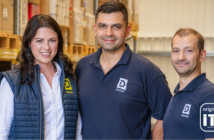


- DiffuseDrive raised its USD 3.5M seed round, co-led by Outlander and Presto Tech Horizons.
- The company solves data scarcity for autonomous systems using generative AI
- Its physics-aware diffusion models create photorealistic, high-fidelity datasets in hours, outperforming real-world data
- The new funds will help DiffuseDrive scale globally, launch self-serve tools, and expand across automotive, defense, and robotics sectors
This May, the Hungarian physical AI startup DiffuseDrive closed its Seed round of investment. The round was co-led by Outlander and the proactive Prague-based fund Presto Tech Horizons (invested in BlueQubit, among others) and joined by Diffuse Drive’s standing supporters from e2vc.
Introducing the Brains Behind the Breakthrough
DiffuseDrive was started in 2023 by Bálint Pásztor (CEO) and Roland Pintér (CTO). The duo’s acquaintance dates back to high school, but the idea of DiffuseDrive came to them as they worked together for Bosch where they witnessed first hand the lack of available data and the limitations of synthetic data for autonomous driving.

Bálint Pásztor, Co-Founder and CEO at DiffuseDrive
Mr Pásztor studied electrical and mechanical engineering at the University of Edinburgh and got a degree in mechanical engineering from the Budapest University of Technology and Economics. He is also a former national floorball and ice-hockey champion and team captain, now an endurance triathlete.
Mr Pintér earned his master’s degrees in physics from Eötvös Loránd University while simultaneously doing research at Brookhaven National Lab on the infamous STAR experiment. During this time he co-authored more than 50 papers, sharpening the large-scale software engineering skills. His resume includes the roles of an AI Lead Engineer at Bosch leading machine-learning and MLOps efforts for the company’s L4-driving programs and Senior Machine Learning Engineer at LiveJasmin building production-ready generative AI systems.
DiffuseDrive took shape when Pásztor led sales at Bosch and saw slow, manual data collection stall deployment. This experience set DiffuseDrive’s north star: give autonomy teams across industry, civil, and defense a faster and safer path to production by solving AI’s last big problem: data.
Both co-founders made their way to the Forbes 30 Under 30 Hungary list and hold American O-1 visas for extraordinary contribution in technology entrepreneurship.
Starting in Budapest in 2022, the founding team was awarded early grants and research awards that allowed for the creation of DiffuseDrive’s first diffusion models for robotics vision. The big leap, however, came in 2024 when the company relocated to San Francisco known as Cerebral Valley, the core of the AI innovation community. Since then, the startup scaled its computer infrastructure, expanded into automotive, warehouse automation, and defense, and its total funding reached USD 4.5M as of today. The founders admit that their biggest recurring challenge is convincing enterprise customers that synthetic data can indeed outperform real-world datasets.
Physics-Aware Realism Breaking the Game Engine Barrier
Today, DiffuseDrive is a next-generation physical AI company offering a brand new way for Fortune 500 companies to access high-volume, real-life data with unprecedented speed. Powered by generative AI, its platform delivers mission- and safety-critical synthetic datasets for camera-first autonomy, robotics, aerospace, and defense systems. DiffuseDrive replaces traditional data pipelines with deep understanding, transforming model blind spots into photorealistic image data in hours.
Offering a 4X performance boost and enterprise-grade scalability, it empowers companies to overcome data scarcity and gain a competitive edge. The company disrupts a USD 124B market, earning the trust of major industry leaders by delivering rapid, scalable, and realistic data solutions essential for next-generation autonomous and AI-driven technologies.
DiffuseDrive’s diffusion models are generative AI systems designed specifically for physical domains. Unlike standard image generators, they are physics-aware and they learn not just how objects look, but how they behave under real-world conditions like motion blur, occlusion, lighting variance, and material deformation.
‘We train these models using a curated corpus of multimodal data – lidar, RGB, depth, thermal, even force sensors so they can generate photorealistic, pixel-perfect sequences with semantic and physical coherence. It’s like having a sandbox where every frame is both beautiful and useful,’ Mr Pásztor tells ITKeyMedia.

Roland Pintér, Co-Founder and CTO at DiffuseDrive
‘Simulator-based synthetic pipelines built on game-engine renderers demanded weeks of painstaking scene design, produced limited scenario variety, and still looked like a video game. This depended on engineers predicting in advance which examples were missing, a guesswork exercise that often left critical gaps. DiffuseDrive changes the equation: our generative-AI platform quickly evaluates the data already on hand, pinpoints what is absent, and uses proprietary diffusion models to create vast amounts of photorealistic image data in a matter of hours, indistinguishable from real imagery to both human eye and machine-learning algorithms, ready to accelerate the next generation of autonomy,’ Mr Pintér explains further.
Three Breakthroughs That Empowered Synthetic to Beat Real
The co-founders list three technological breakthroughs that enabled DiffuseDrive’s generative platform to produce photorealistic data in hours:
- Domain-specific diffusion models trained and fine-tuned on physics-informed datasets with parallelized generation architecture, allowing rapid conditioning and rendering on GPU clusters;
- Zero-to-frame pipelines that skip traditional asset modeling and scene graph assembly;
- Proprietary Processes for Agentic Quality Assurance layer purpose-built low to no human intervention/interaction.
The realism of the generated imagery is validated on two fronts: visual fidelity and performance transfer.
- Visual validation includes side-by-side comparisons with real-world imagery, human evaluators, and structural similarity indices.
- Functional validation is key—the models trained on DiffuseDrive’s synthetic data get tested regarding whether they outperform or generalize better than those trained on real-world or simulated datasets.
Early Moonshots
DiffuseDrive can boast about an array of customers in leading automotive, aerospace, defense and robotics sectors including some of the biggest defense prime companies, biggest tier-one automotive supplier and Aisin, Continental, and Denso as examples, and more that the company isn’t at liberty to share.
‘We have showcased that we can quadruple the performance – in a public study with one of the biggest US defense primes in aerospace ATR situations, for autonomous and automated driving we carried out scene generation in hours that would have taken our customer 3-4 years and improved their performance over 40%,’ Mr Pásztor shares.
The founding duo admits that such progress is largely due to relocation to California. According to the CEO, Hungary has incredible talent and focus, but the exposure to venture, product builders and tech legacy companies is limited.
‘In Silicon Valley, we gained access to world-class innovation, visionary investors, and a technical community that thrives on moonshots. We’ve built a hybrid team of global engineers and Bay Area veterans, and the quality of conversations with clients and partners has scaled with us. It’s a more ambitious and accelerated version of who we’ve always been,’ Mr Pintér states.
The Road Ahead: Deployment, Scale, and Self-Service

Jordan Kretchmer, Senior Partner at Outlander
According to Outlander’s senior partner Jordan Kretchmer, his fund is looking for companies with the potential to reshape entire industries. He is convinced that DiffuseDrive is untapping a massive opportunity in physical AI by solving one of the fundamental challenges: data scarcity.
‘In a market where speed, realism, and scale matter, DiffuseDrive isn’t just ahead of the curve, they’re building the curve,’ Mr Kretchmer states as he joins DiffuseDrive’s board.
In view of the new investment and otherwise, DiffuseDrive’s plans include:
- Go-to-market – more deployments and more visibility in the US and Europe via organic marketing and partnerships;
- Customer Reach – giving customers self-serve control to generate, test, and deploy synthetic data tailored to their needs in automotive, robotics, aerospace, defense etc.;
- Onboarding new customers, scaling the capabilities and product deployment and demonstrations in key markets.
Overall, DiffuseDrive’s approach to maintaining a competitive edge in generative AI for the robotics and autonomy sector is about speed, specificity, and execution.
‘Advanced GenAI is transforming how machines make decisions – from the driver’s seat to the frontlines. Virtualized training and decentralized decision making are becoming mission-critical,” said “And with the automotive industry needing to crunch ever-growing volumes of data to improve passenger safety, DiffuseDrive is not only positioned to thrive on a global scale, but also at the forefront of saving human lives across both automotive and defense,’ Presto Tech Horizons’ partner Vojta Rocek concludes.

Vojta Roček, Partner at Presto Tech Horizons
‘While big players often generalize, we go deep on robotics, edge-case fidelity, and client-specific domains. Our models are purpose-built, not repurposed. We iterate faster, adapt faster, and partner more closely with our users. If our data makes a robot safer or a vehicle more reliable, we win. And so do our customers,’ Mr Pásztor adds.
DiffuseDrive is redefining the future of autonomy by solving one of AI’s most persistent challenges: the lack of high-quality, scalable training data. By turning generative AI into a precision tool for real-world impact, the company’s solution is enabling faster, safer, and more reliable deployment of autonomous systems across critical industries. As AI moves from research across real-world applications, DiffuseDrive positions itself at the forefront, transforming synthetic data from a compromise into a competitive advantage.

Kostiantyn is a freelance writer from Crimea but based in Lviv. He loves writing about IT and high tech because those topics are always upbeat and he’s an inherent optimist!