


- Vilnius-based Tingit raised EUR 1.5M to scale its AI-powered repair marketplace across Europe
- The startup combines AI, logistics, and craftspeople to simplify fashion and apparel repairs
- Strong early traction includes 14,000 customers andEUR 9M worth of evaluated items
- Future growth hinges on expansion, integrations, AI improvements, and network density
This February, the Lithuanian AI-powered fashion and apparel repair marketplace Tingit closed its Seed round of investment. The round amounted to EUR 1.5M, and the lead investor was the well-known Lithuanian VC firm CoInvest Capital (invested in Axiology, among others), joined by NGL Ventures (invested in Sort A Brick, among others), LitBAN — Lithuanian Business Angels Network (invested in Perfection42, among others), and all Tingit’s investors from its previous round, including FIRSTPICK (invested in Unive, among others), HEARTFELT_, BADideas.fund (invested in Breezit, among others), and PurposeTech.
The Founders Behind Tingit and a Broken Zipper
Tingit’s founding team consists of three seasoned Lithuanian entrepreneurs:
- Indrė Viltrakytė (CEO) spent more than a decade running the Robert Kalinkin Fashion House as co-founder and CEO (after having built and sold two service companies);
- Robertas Kalinkinas is one of Lithuania’s best-known fashion designers;
- and Tadas Maslauskas (CTO) came from engineering leadership roles at startups like Kilo Health and earlier lead developer positions across e-commerce, cosmetics, and gaming.
‘The trigger was almost embarrassingly ordinary. I was sitting in a café in Vilnius when the zipper on my handbag broke, and I realized that fixing it meant driving across town, negotiating in person, paying in cash, and coming back later to pick it up — a half-day of friction for a five-minute repair,’ Ms Viltrakytė recalls.
With such a substantial background in fashion, commerce, and engineering, the three had been having conversations for years about how broken the repair experience felt inside a supposedly circular fashion industry. They realized they were the right people to tackle this problem because they’d lived on both sides: made the products, watched customers throw them away, and knew the craftspeople who could save them. To connect these dots digitally, the trio started Tingit in 2024.
Early Traction and Expansion into France

Indrė Viltrakytė, Co-Founder and CEO at Tingit
‘Our first year was about proving the model worked: could we actually take a photo, get a real price from artisans, ship an item through a parcel locker, and return it repaired to a standard the customer loved? The answer came quickly as demand outran supply and we had to scramble to onboard more specialists,’ the CEO tells ITKeyMedia
In August 2024, Tingit closed its EUR 500K Pre-Seed round, allowing the company to expand into France. Facing the recent investment, Tingit reported more than 14,000 customers, over EUR 9M worth of items evaluated on the platform (from EUR 20 sneakers to EUR 15K Hermès bags), and a network of 150+ vetted craftspeople across Lithuania, France, and Poland.
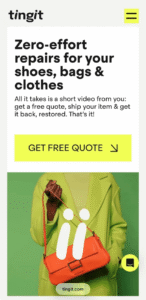
As of today, Tingit built an AI-powered repair marketplace that helps consumers get damaged or worn items repaired instead of replacing them. Users upload photos of an item (such as clothing, shoes, bags, electronics, or home goods), Tingit’s AI assesses the repair request, and the platform matches it with a suitable repair specialist while handling pricing, logistics, and communication.
Educating Both Sides of the Marketplace While Building AI for the Real World of Repair
According to the team, market education presented market education, i.e. teaching customers that sending a handbag through a parcel locker to a stranger will come back better than new, and teaching traditional craftspeople — many of whom are brilliant artisans who had never used a smartphone for work — to trust digital workflow. Neither side had a template, so Tingit essentially had to build two onboarding funnels in parallel and get both sides to trust and internalize the platform at the same pace.
On the technical side, a key challenge was in training the AI to assess damage and match specialists with jobs. The problem is that ‘damaged’ is not a clean computer-vision category. A scuffed toe on a sneaker, a worn heel, a torn lining, a broken zipper slider, or a faded leather patina look nothing alike, and the same damage on a calfskin Hermès and a canvas tote requires different materials, tools, and hours. That’s why Tingit’s model isn’t one classifier; but a stack:
- the first layer identifies the object class and material,
- the second localizes and categorizes the damage,
- and the third maps that damage to a service ontology built together with Tingit’s maker network, which feeds the pricing and timeline estimates.
A Proprietary Dataset of ‘Broken Things’
 ‘The training data problem was the hard one. There’s no public dataset of ‘broken things.’ Every repair on Tingit creates a before/during/after record, so we bootstrapped with labelled photos from our own early jobs and paired that with structured input from our specialists, who essentially taught the model what they see when they look at a photo. That closes the loop: every job the network completes becomes a training signal for the next one,’ Ms Viltrakytė explains.
On the accuracy VS variability tradeoff, the Tingit team decided early that the AI’s job was to narrow uncertainty, not eliminate it. The platform gives the customer an instant appraisal that’s right the vast majority of the time, and whenever the specialist opens the parcel and finds something the photo missed, they can send an adjusted quote back to the customer for approval before any work starts. Thus, the AI handles about 80% that is predictable and routes the 20% to a human without breaking the user experience.
‘That hybrid is the only honest way to do this. Anyone claiming 100% automated accuracy on physical damage is overselling,’ Ms Viltrakytė remarks.
Empowering Independent Craftspeople
Specialists working with Tingit are independent partners, not employees. This lets the platform offer hyper-niche skills (e.g. a specific kind of Italian leather edge-painting or a specific vintage sneaker sole replacement) that no in-house team could cover. At the same time, it means the craft stays with the craftspeople. Tingot’s role is providing the technology, the customer pipeline, the logistics (parcel-locker shipping with pre-generated labels), the payments, and the brand guarantee.
Recruiting craftspeople, the Tingit team looks for demonstrable craft: examples of past work, customer reviews, sometimes years of workshop history. Usually, new partners start with a small volume of jobs before opening the tap. Retention of these skilled craftspeople comes from giving them something they don’t get anywhere else: a steady, predictable flow of well-matched work, transparent pricing that they set themselves, and relieving the administrative drag of running their own customer-facing business.
Quality Control and Sustainability Metrics
Quality control happens on three layers:
- Before a parcel goes back to the customer, the specialist runs a documented checklist: no glue residue, even colour, clean surfaces, aligned stitching, — and compares the finished item against the customer’s original photos.
- Tingit then backs every job with a 30-day guarantee.
- Finally, completed jobs get rated, which feeds back into how the platform’s algorithm routes future work. Specialists who score well get more volume, while others get fewer jobs and a conversation with the management.
Ms Viltrakytė reminds that sustainability is another apparent benefit of repair. Every repair that keeps an item in use displaces, on average, the manufacturing and shipping of a replacement, which is the dominant part of the carbon footprint when it comes to fashion. Internally Tingit tracks repairs by category and estimates CO2 avoided and waste diverted per job against category baselines from lifecycle-analysis research (the numbers are very different for a pair of leather boots versus a polyester jacket, so category-level accounting matters). Because every item on Tingit has a digital record, including photos, materials, specialist, date, etc., it’s possible to roll those savings up per customer, per brand partner, and per market.
‘That data genuinely does shape strategy. When we saw how disproportionately high the footprint-savings were on leather goods and footwear, we doubled down on onboarding leather and shoe specialists and built deeper tooling for them. When appliance and audio repairs started growing faster than we expected, we treated it as a signal and began building out that vertical. Repair is moving from a nice-to-have to a measurable line in a brand’s impact report, and we want to be the infrastructure underneath that,’ Ms Viltrakytė states.
Repair Culture Across Different Markets
Expanding across markets, Tingit was able to spot quite curious differences in customer behaviour and cultural attitude toward repair. The team shares that in Lithuania, for instance, customers bring a huge variety of items: shoes, handbags, household appliances, audio equipment, eyewear, luggage, etc., indicating a strong inherited culture of ‘fix, don’t replace’ that predates any sustainability conversation — grandparents’ thrift. In France, on the other hand, a different phenomenon is observed: a deep relationship with leather and craft, a willingness to spend serious money maintaining luxury pieces, and customers who name their handbags.
At the same time, two patterns show up everywhere:
- First, sentimental value massively outweighs monetary value in the decision to repair. People send EUR40 sneakers from their first date alongside five-figure designer bags, equally anxious about both.
- Second, once someone has one item repaired successfully, they come back.
‘Repair, it turns out, is a habit, not a transaction – and that’s quietly the most important finding for how we design the product,’ Ms Viltrakytė concludes.
Investor Confidence, 2-Year Roadmap, and Future Success Metrics

Viktorija Trimbel, Managing Director at CoInvest Capital
‘Tingit identified a very clear market problem relevant to very many people and matched the solution with increasing use of apps and post terminals in the daily lives of people. This is also very much in line with ESG principles, encouraging sustainable consumption and circular economy. The team is very diverse, too, with complimentary skillset and experience. We loved their internal dynamics and focus on scaling the company internationally,’ CoInvest Capital’s managing director Viktorija Trimbel comments on the investment.
According to Ms Viltrakytė, the recently raised EUR 1.5M are meant to fund Tingit’s four parallel workstreams over roughly 18–24 months following the investment.
- First, geographic expansion: strengthening the company’s position in France in H1 2026, then opening two to three additional EU markets (the shortlist is driven by density of craftspeople, parcel-locker coverage, and fashion-brand HQs).
- Second, growing the specialist network toward a target that lets a customer anywhere in the EU get offers even for very niche repairs within hours/ This presupposes onboarding hundreds more craftspeople and investing in the tools they use.
- Third, the brand and e-commerce integration: embedding Tingit directly into fashion brands’ post-purchase journeys and e-commerce checkouts, so ‘repair’ ultimately becomes a button next to ‘return.’ (Tingit already has the pilot integrations and expects several named partners to go live this year.)
- Fourth, the AI and logistics layer: pushing the damage-detection model, expanding the categories, and expanding logistics methods.
The Tingit team expects the following metrics to indicate that the startup is on the right track 1–2 years from now:
- Network density. A customer in any of the platform’s live markets should be able to get a qualified offer for almost any category within 24 hours. The goal is to land 1000+ repair partners by 2027.
- Repeat-customer rate. Because, as the team found out, repair is a habit, the expectation is that the cohort curves should bend up, not flatten.
- Repair evaluations volume should move well past EUR 9M and well beyond that, with the mix broadening beyond fashion.
- Brand-partner integrations. Double-digit named fashion and e-commerce partners are expected to embed Tingit inside their own post-purchase flow.
- The sustainability metric. Verified CO2 avoided and items diverted from landfill, reported at a scale that’s credible to the brands using Tingit for their own ESG disclosures.
‘If these five lines are all moving the right way, we’ll know our thesis is working,’ Ms Viltrakytė concludes.
In view of all the discussion around AI, marketplaces, and funding, Tingit is making repair as convenient as replacement — a shift that could fundamentally change consumer behavior at scale. By connecting skilled craftspeople, intelligent technology, and seamless logistics, the company is building the infrastructure needed to extend the life of millions of products that would otherwise be discarded. Tingit is poised to create a new category of digital repair commerce while helping move circular consumption from an aspiration to an everyday habit.

Kostiantyn is a freelance writer from Crimea but based in Lviv. He loves writing about IT and high tech because those topics are always upbeat and he’s an inherent optimist!