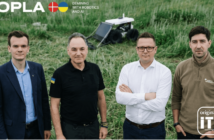


- Kaunas-based Luna Robotics raised EUR 1.08M Pre-Seed funding from Coinvest Capital, Plug & Play Tech Center, and angels
- The startup is founded by Lithuanian Riflemen’s Union members with notable military and drone engineering experience
- The team developed China-free, low-latency FPV night-vision cameras tested on Ukrainian frontlines
- With the new funding, Luna Robotics aims to scale production, expand into dual-use markets, and advance Europe’s defense autonomy overall
This October, Luna Robotics—the Lithuanian developer and manufacturer of tactical FPV drone cameras for military operations—landed a Pre-Seed investment of EUR 1.08M. The well-known Lithuanian VC fund Coinvest Capital (invested in Perfection42, among others) led the round, joined by Plug & Play Tech Center and several international angel investors.
Founders Shaped by Service and Defense Experience

Elvinas Kukys, Co-Founder and CEO at Luna Robotics
The founding duo of Elvinas Kukys (CEO) and Ramūnas Čereškevičius (CTO) are are members of the Lithuanian Riflemen’s Union, a voluntary organization of Lithuanian citizens with a shared desire to contribute to the defense and resilience of their country. The two can boast profound operational and technical experience in drones and defense: Mr Kukys has reconnaissance and FPV operations background from real military use, plus six years of business-building and law training, while Mr Čereškevičius spent seven years in drone manufacturing and 15 years in software engineering. They are aided by hardware and software leads with direct experience in electronic engineering and UAV systems development, including service in Lithuanian defense units.
‘We are creating what we dreamed of during our service — tools that help perform missions on the front line more accurately, efficiently, and safely. This technology is our contribution to the strength of soldiers, Lithuania’s security, and our allies’ advantage on the battlefield,’ the CEO shares.
Prototyping, Battlefield Validation, and a Europe-Controlled Supply Chain
The team came up with initial prototypes of night-imaging modules and got an opportunity to deploy them on Ukrainian frontlines to collect feedback as early as 2023. However, the company was established only in 2024. The ‘Luna’ in the name means moon and stands for vision in darkness without detection. (‘It also signals a European, not Far-East, identity and telegraphs the company’s design thesis: to win the night,’ Mr Kukys adds.)
Indeed, the co-founders list latency reduction in low light among the main challenges they had to overcome. Other challenges included battlefield survivability, maintaining manufacturability under stress-tested constraints, and non-China supply chain under price pressure.
‘For defense buyers, China origin implies three risks: supply denial, telemetry compromise, and sanction-triggered lockout from NATO systems. Our LunaCam electronics and software stack are China-free and built in Lithuania. Some commodity mechanical parts may be sourced globally. While we don’t claim legal certification as ‘100% EU,’ the security-critical stack is indeed Europe-controlled,’ Mr Kukys explains.
In the meantime, frontline data forced three recurring rules into the product:
- Put latency second to nothing;
- Low-light performance must be reliable, not ‘marketing-grade’;
- Integration friction kills adoption faster than performance gaps.
These rules got integrated in Luna Robotics hardware and software principles: aggressive latency budget, dual-mode imaging (color + night), mechanical ruggedization, and a clean integration surface for drone OEMs.
2024 marked Luna Robotics’ first sales in Lithuania, Ukraine, and the USA. Reportedly, the company shipped as many as 180 units and at the same time got awarded a handful of grants, including NATO DIANA. In 2024–25, the company formalized and finalized its China-free supply chain for electronics and software and started its industrialization roadmap.
Investor Confidence in Lithuania’s Defense Future

Viktorija Trimbel, Managing Director at CoInvest Capital
Coinvest Capital’s managing director Viktorija Trimbel is convinced that Luna Robotics embodies the much-needed defense sector products created and manufactured in Lithuania, based on practical experience and the latest technologies, that can be quickly adapted to a rapidly changing environment and deployed in real-world conditions. She firmly believes that this is the reason why LunaCam is already being well received in NATO country markets. Meanwhile, the company’s B2B sales model and the already strong customer interest suggest growth rates that are attractive to venture capital investors.
Ms Trimbel recalls following the progress of the Luna Robotics team for several years, since their first appearance at the annual defense innovation hackathon organized by the Lithuanian Riflemen’s Union and Tech-Park Kaunas.
A Proud Moment for Lithuania’s Riflemen’s Union
‘The Lithuanian Riflemen’s Union can be proud that the hackathons we organize together with Tech Park Kaunas are bearing fruit. Our members are achieving strong results and contributing to the defense industry by establishing high-tech companies. We thank everyone who supports our activities and invests in young teams. We do not intend to stop,’ Lithuanian Riflemen’s Union’s commander Colonel Linas Idzelis states.
‘Members of the Lithuanian Riflemen’s Union stand out among the defense innovators we meet for their excellent understanding of military needs, as they often work to solve problems they personally encounter during training. Together with its partners, Coinvest Capital has already invested nearly EUR 13M in defense and dual-use innovations, and Luna Robotics has become the fund’s milestone 50th portfolio company,’ Ms Trimbel adds.
Scaling Up: Compliance, Expansion Into Civil and Commercial Frontiers, and the Next Leap from Camera to Intelligence

Colonel Linas Idzelis, Commander of the Lithuanian Riflemen’s Union
The current Pre-Seed round is meant to help Luna Robotics scale production and enter government channels. More specifically, it will be allocated to production scale and cost reduction, machinery and in-house calibration and assembly, building sales and government supply channels, as well as compliance, logistics, and inventory.
‘Luna treats the product as dual-use. That implies three parallel tracks: classification of the camera under EU dual-use rules and US EAR plausibility, export licensing procedures for specific destinations, and early engagement with compliance advisors to avoid retroactive remediation. The principle is to design compliance early rather than bolt it on late,’ Mr Kukys comments.
Indeed, beyond the military vertical, the team envisions adjacent commercial and civilian markets where Luna Robotics’ technology could be adapted), particularly domains where ‘seeing without light’ and low latency matter, including:
- Police/first responders for night search on UAVs;
- Border and critical infrastructure perimeter drones;
- Industrial security robotics;
- Environmental or wildlife monitoring where passive IR is preferable to floodlight
‘Adaptation mainly concerns housing, spectrum masks, and software feature exposure — not reinvention,’ the CEO emphasizes.
Moreover, it’s not a far fetch to foresee Luna Robotics moving from providing a camera to delivering a full sensor+analytics subsystem. One of LunaCam’s differentiators is that it already embeds computers for on-camera processing, which naturally extends to a full sensor-analytics block (object scoring, geo-cues, target-type hints) with the camera as an edge-node rather than a simple sensor.
‘The company’s short-term plan is to dominate the imaging layer of FPV warfare. The long-term plan is to build the compute-sensor stack that will power the next generation of autonomous strike and ISR drones,’ Mr Kukys concludes.
Luna Robotics exemplifies Europe’s push for defense and technological autonomy, proving that critical innovation can thrive at home. By developing a fully Europe-controlled imaging and software stack, such companies and their products reduce dependence on foreign suppliers while enhancing frontline capability and resilience. Such work not only strengthens NATO-aligned defense systems but also marks a defining step toward a self-reliant, future-ready European defense ecosystem.

Kostiantyn is a freelance writer from Crimea but based in Lviv. He loves writing about IT and high tech because those topics are always upbeat and he’s an inherent optimist!