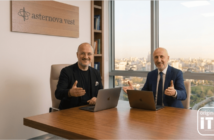


- Vestbee Angels emerged from stealth and presents one of CEE’s largest angel networks
- The network organizes syndicates co-investing with VCs into startups with traction and revenues
- No-fee model, education focus, and CEE mission differentiate Vestbee Angels from most other angel groups
- The platform’s mission is to deliver returns while also strengthening Poland and CEE startup ecosystems
This January, Vestbee Angels—the new angel investor network started by Marcin Łączyński of Next Road Ventures and Paweł Maj of Warsaw Equity Group—announced itself after almost two years of operation in stealth mode.
Founding Partners at a Glance
Both partners are quite well-known in the Polish and CEE investment scene. Paweł Maj has served as a partner at Warsaw Equity Group and as an investment director at the VC fund bValue Fund. At Vestbee Angels, he helps source and select start-ups for angel syndicates. His focus is to educate investors about startup investing in addition to active co-investments in the companies supported by the Vestbee Angels network.
In turn, Marcin Łączyński previously co-founded the VC fund Next Road Ventures with Ewa Chronowska and has been active in the startup and private equity ecosystem for years. At Vestbee Angels, his responsibility is to organize investment syndicates for startups with an emphasis on connecting experienced investors with promising companies from Poland and the CEE region.
The New Angels Network in a Nutshell
Vestbee Angels took shape around the Vestbee startup platform, developed by Ms Chronowska back in 2018 to connect founders, VC funds, business angels, accelerators, and corporations. Emerging as part of a growing ecosystem of organized angel investing in CEE, Vestbee angels organizes investment syndicates that co-invest with VC funds in startups that already have a product, customers, and early revenues.
Typically, the platform presents one vetted ‘company of the month’ to its network and proposes to invest no less than 250K USD / 1M PLN per round and 25K USD / 100K PLN. Its distinguishing features are a no-membership-fee model, close cooperation with VC-led rounds, and focus on educating investors while targeting more mature early-stage start-ups rather than idea-stage projects.
A New Force in CEE Angel Investing
To find out more about the new angel network’s organization, procedures, mission, and plans, ITKeyMedia sat down to talk to Marcin Łączyński and Paweł Maj:
First of all, could you reiterate the timeline of Vestbee Angels?
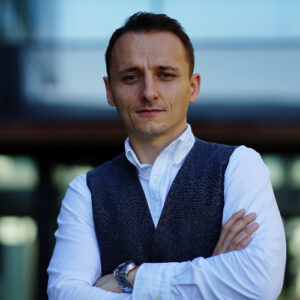
Marcin Łączyński, Partner at Vestbee Angels
Marcin Łączyński: We organized our first syndicate in June 2024, and that date we recognize as the start of Vestbee Angels. However, we decided to share our story just now, since we wanted to build our network of angels first and conduct at least a few successful syndicates for startups. Currently, our network comprises over 400 members, which makes Vestbee Angels, to our best knowledge, the largest angel network not only in Poland, but in CEE country. So far, we conducted eight syndicate investments and already scheduled three more: in January, February and March 2026. Our biggest challenge was achieving a flywheel effect where founders whose rounds we organized recommend Vestbee Angels to other founders and angels, VCs with whom we co-invested recommend us to their portfolio companies, and angels in our network — who appreciate the high quality of our deal flow — recommend Vestbee Angels to other angels and startup founders. We believe we’ve achieved that effect now.
What are the most important green flags and red flags for you in candidate startups?
Paweł Maj: Instead of talking only about red and green flags, it makes sense to expand this taxonomy to must-haves, nice-to-haves, and red flags.
So, must haves are:
- a VC fund present in the round to take the responsibility for legal and financial due diligence, prepare the paperwork and negotiate the terms,
- at least one founder from CEE, because our mission is to support the CEE ecosystem, including the diaspora,
- painkiller: the solution tackles users’ have a real, urgent problems,
- clear ICP: the founders can explain exactly who buys and why,
- strong timing,
- founder-market fit,
- high ownership of the founding team.
Nice haves are:
- fast learning loops,
- revenue and retention,
- credible distribution,
- capital efficiency,
- hard-to-copy execution.
Red flags are:
- too small market,
- ‘we have no competitors’,
- service businesses,
- messy cap table,
- product is a feature,
- founder misalignment.
Vestbee Angels relies heavily on VC-led due diligence. How do you guard against collective blind spots or herd behavior when both funds and angels converge on the same narratives and metrics?
PM: We do require the VC-led due diligence, but only for legal and financial evaluation. We evaluate the actual business and its potential ourselves, separately from VCs. After all, both of us run VC funds, so we know the game pretty well.
Have you ever passed on a deal that later succeeded spectacularly?
ML: This hasn’t happened yet at Vestbee Angels, but it’s only a matter of time. Such instances did happen to both of us quite a few times while managing funds. Likewise, it’s inevitable that such lessons will occur with Vestbee Angels when they do.
How do you prevent Vestbee Angels from drifting into a ‘check-writing club’ rather than an investor community that adds actual value to portfolio companies?

Paweł Maj, Partner at Vestbee Angels
PM: We avoid becoming a ‘check-writing club’ by making contribution the default and keeping engagement lightweight:
- shared norms: from day one, it’s clear the group exists to help founders, not just invest;
- simple ways to participate: regular updates and founder requests make it easy for anyone to plug in when they have relevant experience or contacts;
- visibility and feedback: we track whether support is actually happening and use founder feedback to improve continuously.
Vestbee Angels operates with transaction-based economics instead of formal membership fees. How do you think this model shapes investor behavior?
ML: It lowers entry barriers for angels, but at the same time, this model is much more challenging for Vestbee Angels as the angel network operator. Without recurring revenues, we only have a management fee that gets reinvested into startups anyway. Our main challenge is to keep growing the network and provide value for both angels and startups regardless of this financial constraint.
When exits are stretching to 10+ years and IPOs are increasingly rare, what does ‘success’ realistically mean today for an angel portfolio?
PM: Success for an angel portfolio today usually means a modest number of meaningful liquidity events—acquisitions, secondaries, occasional IPOs—that return the portfolio, while most companies return little or nothing.
Angels should calibrate their expectations by:
- expecting longer hold times, up to 10+ years, and illiquidity as the default,
- underwriting deals for power-law outcomes where a few winners will drive results,
- diversifying with enough shots on goal and reserving follow-on capacity,
- viewing partial liquidity/secondaries, not only IPOs, as a win as well.
Looking e.g. 10 years ahead, what would convince you that Vestbee Angels has succeeded?
ML: Vestbee Angels represent the interests of member angels, so our main KPI is and always will be great returns on their investments. To make it happen, our portfolio startups have to continue rapid scaling, usually raising additional capital from VCs/PE funds. This might bring opportunities for exit for our angels. Finally, full exits to PE funds, strategic investors or IPO are also milestones of success.
The emergence of Vestbee Angels adds meaningful depth to the startup financing landscape in Poland and across CEE by mobilizing experienced private investors and channeling their capital into vetted, growth-ready companies. By connecting regional founders and diaspora entrepreneurs with structured angel syndicates and facilitating VC-backed rounds, the new angel network helps close funding gaps that often slow promising startups. Continuing to combine capital with education and network effects, Vestbee Angels is poised to strengthen the long-term resilience and global reach of the CEE startup ecosystem.
Kostiantyn is a freelance writer from Crimea but based in Lviv. He loves writing about IT and high tech because those topics are always upbeat and he’s an inherent optimist!