

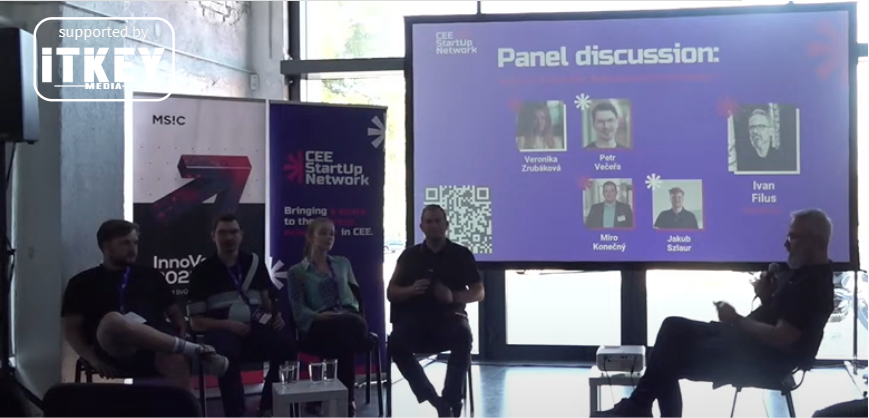
- CEE Startup Network’s Funding Horizons 2025 in Ostrava, the Czech Republic, showcased CEE Startup Voucher and discussed early-stage funding opportunities
- Panelists debated flexible vouchers, startup validation, and connecting grants to later-stage investment
- Cross-border cooperation and hybrid funding mechanisms were emphasized for stronger CEE ecosystem growth
- The event additionally highlighted inclusivity, resilience, and EU twin transition alignment for early-stage ventures
On September 4th, Ostrava’s FUTUREUM welcomed Funding Horizons 2025—CEE Startup Voucher‘s regular side event. The hybrid event gathered entrepreneurs, investors, and industry experts to discuss the latest trends, challenges, and opportunities in the world of startup financing.
Empowering Early-Stage Ventures Across CEE

Martin Mikuláš, Startup Scout at MS-IC
Moderated by Ivan Filus of BIC Bratislava and Adéla Píchová of MSIC, the evening began with MS-IC’s startup scout Martin Mikuláš outlining the CEE Startup Voucher initiative’s mission, goals and conditions.
The purpose is to empower early-stage companies with small, flexible funding tranches to test ideas, pilot technologies, and gain market traction. The vouchers were framed as a ‘de-risking mechanism’ to prepare ventures for larger Horizon Europe or EIC Accelerator grants. The EU’s ‘twin transition’ agenda was underscored: decarbonization and digitalization. CEE startups were encouraged to align their proposals with these policy pillars.
The session further detailed how vouchers would be distributed:
- Funding amounts typically range between EUR 10K and 60K, depending on project scope and national co-financing.
- Calls are competitive, evaluated by innovation agencies in each member state.
- Vouchers may cover prototyping, feasibility studies, IP strategy, regulatory preparation, and matchmaking with industry partners.
- Applications are expected to remain light-touch, avoiding the bureaucracy of large EU grants.
Panel Insights: Choosing the Right Financing

Jakub Szlaur, CEO at Edmund
A moderated panel followed, dedicated to choosing the right source of financing. The speakers included Petr Večeřa of profiq representing the bootstrapping approaching, Jakub Szlaur of Edmund representing a funded startup, Veronika Zrubáková of 0100 VC representing the investor’s side, and Miroslav Konečný of ADDSEN as a grant expert.
Their key insights:
- Initiatives like CEE Startup Voucher often provide first validation capital before angel or VC investment.
- Flexibility is to be praised: funds can be used quickly for pressing needs (MVP development, testing, certifications).
- Challenges remain: navigating fragmented rules between national programs, and limited awareness among founders outside capital cities. Mr Szlaur noted that EUR 30K at the right time was worth more than a EUR 3M VC round too late.

Veronika Zrubáková, Investment Associate at 0100 VC
Ms Zrubáková views vouchers as signal mechanisms: a startup with EU-backed funding demonstrates credibility and momentum. However, she cautions that voucher support must connect to the next financing stages — angel, seed, and growth capital. Otherwise, startups risk stalling after their initial prototype.
Ecosystem builders argued for greater cross-border cooperation, so that a voucher recipient in, say, Lithuania, could easily collaborate with labs in Czechia or investors in Austria.
An important debate arose around whether non-dilutive voucher funding should be complemented by convertible loans or hybrid schemes. Policymakers argued that pure grants are essential for very early stages, while investors advocated for gradual introduction of repayable mechanisms to ensure long-term sustainability of public funding. The consensus was that a mix of tools is healthiest, but vouchers must remain simple and founder-friendly.
Uplifted Outlook
The event closed on an optimistic note: startup voucher initiatives are not intended as standalone solutions but as stepping stones toward scaling companies in CEE into regional and global players. Speakers emphasized inclusivity (e.g. supporting women-led ventures and rural innovators) and resilience (helping startups weather economic uncertainty). The overarching vision is that by 2025, voucher programs will help generate a stronger, more interconnected CEE innovation ecosystem.
You are welcome to view a broadcast from CEE Startup Network’s Funding Horizons 2025 here.

Kostiantyn is a freelance writer from Crimea but based in Lviv. He loves writing about IT and high tech because those topics are always upbeat and he’s an inherent optimist!