

Alex Karichensky serves as the CEO at Digicode Europe, a global consulting and custom software engineering company. Bringing extensive experience in procurement and supply chain transformation, he works with enterprises to streamline sourcing, contract operations, and core workflows using practical, scalable technology solutions designed for long-term performance.
AI in procurement doesn’t live in one tool. It lives in the flow of work: how a request becomes a purchase, how a supplier issue becomes a decision, how a contract term becomes a control. That flow crosses systems, teams, and data formats. So the practical question is not Which model should we use? but How do we connect AI to the systems that run procurement?
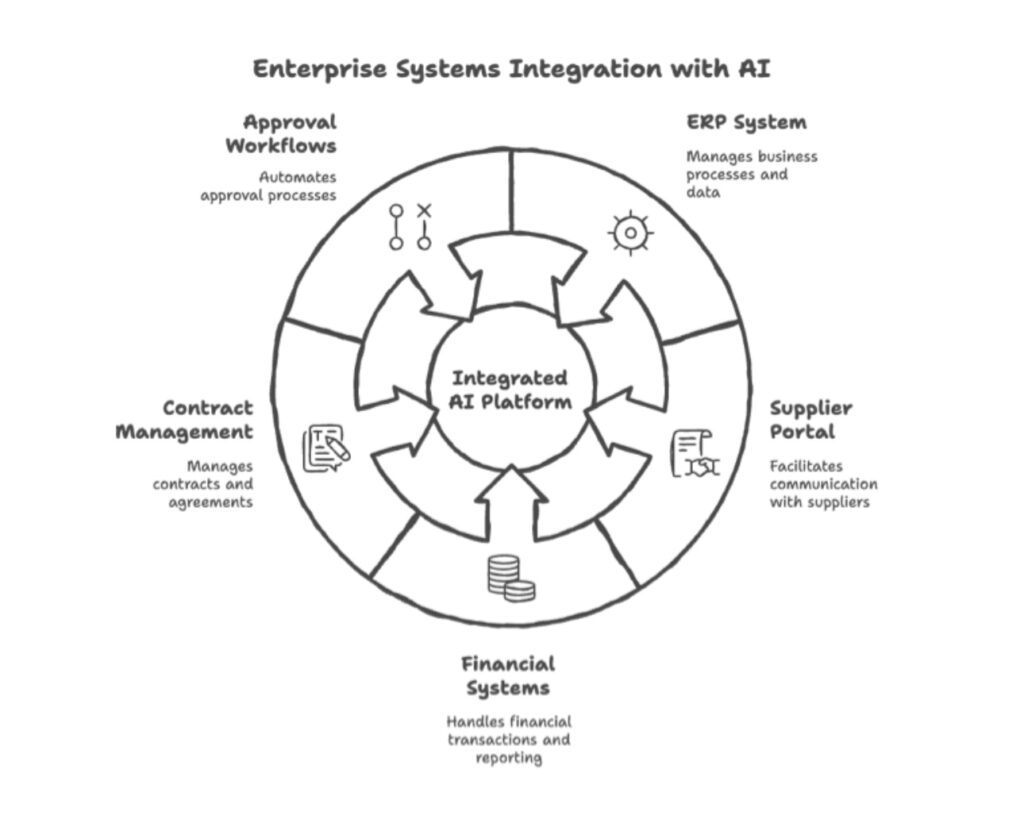
A strong answer is to treat AI as an integrated layer connected to ERP, finance, supplier portals, and contract management, so it can see context and operate within defined boundaries. Then you roll it out in phases, so adoption grows with trust.
Why an “integrated AI platform” beats point solutions
Point solutions can solve a narrow problem quickly. But procurement pain rarely stays narrow. Invoice exceptions connect to contract terms. Supplier risk connects to payment holds. Approval workflows connect to budget. If AI tools operate separately, you end up with multiple “smart” components that don’t agree, and people fall back to manual coordination. The hidden cost is swivel-chair work: copying data between tools, reconciling conflicting statuses, and re-explaining context in every handoff. Integration reduces that waste and makes improvements show up in cycle time, not just in dashboards.
An integrated AI platform doesn’t mean one monolithic product. It means one approach:
- shared data access and identity management;
- consistent governance and audit logging;
- orchestration of actions across systems;
- a common interface where users see explanations, not fragments.
The core systems AI must connect to
ERP: the system of record
ERP is where procurement and finance meet: POs, invoices, vendor master data, budgets, and payment status. AI needs ERP access to validate requisitions against policy, understand invoice/PO context, and track performance signals tied to orders and receipts. It’s also where you define truth. If AI disagrees with ERP, teams will trust ERP.
Approval workflows: the decision pipeline
Approvals reflect risk tolerance. AI can accelerate approvals by summarizing context for approvers (what changed? what’s the impact?), routing exceptions to the right person, and proposing recommended actions with evidence. But approvals also require restraint. AI should support the approver, not bypass them, unless policy allows automation for low-risk cases.
Contract management: the rulebook
Contracts are governance, often underused. When connected properly, AI can answer clause questions, flag deviations from negotiated terms, ensure renewals and notice periods aren’t missed, and link obligations to operational workflows (service levels, penalties, audit rights). The goal is simple: contract terms become operational controls, not static PDFs.
Supplier portal: the front line of communication
Suppliers share critical signals through portals: onboarding details, compliance documents, delivery updates, disputes. AI here can triage messages by urgency, detect risk language early, draft responses for human approval, and track commitments over time. When communication becomes structured and searchable, procurement stops chasing information and starts managing outcomes.
Financial systems: where control becomes real
Payments and cash management are where decisions become consequences. Integration helps AI flag unusual bank detail changes, correlate invoice exceptions with disputes, and support working-capital strategies without damaging supplier relationships. Governance must be strict here, automation levels should be conservative until trust is earned.
Designing the platform: 3 principles that reduce failure
1) One source of truth, many views
Different teams need different views: buyers, finance, legal, operations, but they should be anchored to consistent data and audit logs. If the AI tells finance one story and sourcing another, it will be rejected by both.
2) Guardrails as product features
Don’t treat guardrails as an add-on. Build them in:
- role-based permissions;
- approval thresholds;
- mandatory human review for high-risk actions;
- clear explanations of why recommendations were made.
3) Start with the workflow, not the model
Procurement doesn’t adopt features, but adopts workflows. A useful design question is: where does the agent sit?
- before a decision (prep and context);
- during a decision (recommendation with evidence);
- after a decision (execution and monitoring).
A phased implementation roadmap that builds trust
Rolling out an integrated AI platform is less like installing software and more like changing how procurement works. A phased roadmap keeps scope manageable and makes value visible early.

Foundation phase (60–90 days): set the base
Focus on readiness:
- confirm systems in scope (ERP, portal, contracts, approvals, finance);
- align supplier master data and identifiers;
- map key workflows and decision points;
- define governance (permissions, thresholds, audit needs);
- select 1–2 priority use cases that matter.
Pilot phase (90–120 days): prove value in real work
A pilot should run in production conditions, not a “clean room.” Choose a use case with enough volume to show impact and manageable risk: invoice exception triage, supplier message classification, or clause summaries for purchase requests. Success is not only accuracy; it’s adoption and measurable cycle-time reduction.
Expansion phase (6–12 months): scale by workflow
Scale proven workflows across categories, regions, or business units. Extend integrations, refine governance based on pilot learnings, train teams using real scenarios, and monitor performance as suppliers and data change. Formalize ownership: who maintains data, who monitors the agent, who resolves exceptions.
Optimization phase (ongoing): compound the advantage
Once the platform is stable, optimization becomes continuous improvement: add smarter recommendations (alternates, sourcing triggers), automate low-risk actions under policy, improve reporting narratives, and close feedback loops so the agent learns from resolved exceptions.
Common integration pitfalls to avoid
Two issues derail programs most often. First, teams connect systems but ignore data meaning: supplier might be an entity in ERP, a username in the portal, and a legal name in contracts. If you don’t resolve mapping early, AI will amplify inconsistencies and users will blame the agent for problems that started in master data.
Second, teams skip change management. If buyers and approvers don’t understand when the agent is advising versus acting, they will either over-trust it or ignore it. Short playbooks, simple in-product labels (“Recommended”, “Needs approval”, “Escalated”), and a clear feedback loop (“Was this recommendation helpful?”) keep adoption grounded. The best rollouts treat enablement as part of the platform, not a one-time training session.
An integrated AI platform in procurement isn’t a futuristic control center. It is connected systems plus clear guardrails, rolled out in phases. Do that well, and procurement gets something rare: speed with control, and modernization that stakeholders actually feel.

Alex Karichensky is the CEO of Digicode Europe, a global consulting and custom software development company. With extensive experience in procurement and supply chain digital transformation, he works with enterprises to modernize sourcing, contract management, and operational workflows through practical, scalable technology initiatives.