
- Albanian-Finnish Bliss raised EUR 232.4K to develop culturally intelligent AI infrastructure for therapy
- The startup combines licensed therapists with AI-powered tools for diaspora and multicultural communities
- Its next steps include therapist-trained AI companions, new diaspora markets, and stronger clinical oversight
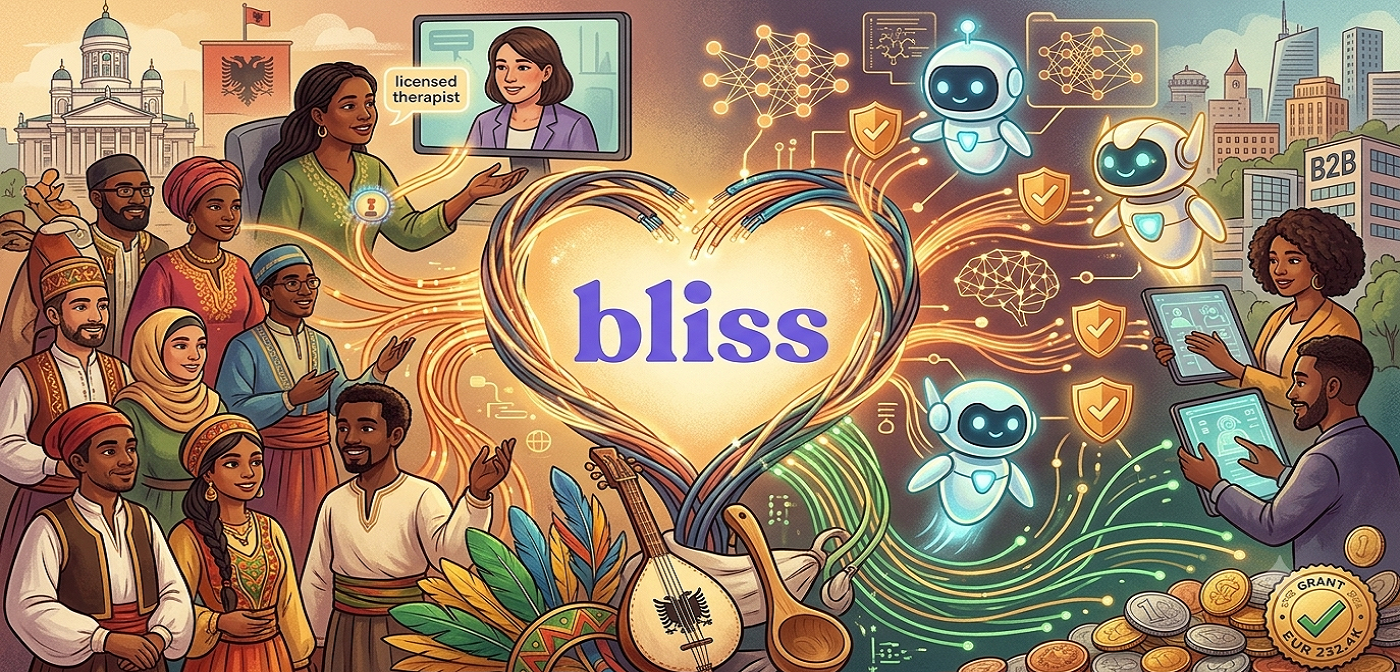
This March, Albanian-Finnish mental health startup Bliss raised EUR 232.4K in angel funding to develop what it describes as ‘culturally intelligent’ AI infrastructure for therapy. The round was led by Keiretsu Forum SEE, FinestLove VC, and Plug and Play Albania, combining angel investment with non-dilutive grants. Originally founded in Albania and now headquartered in Finland, Bliss is building a mental health platform around a straightforward premise: therapy does not always translate well across languages, family structures, migration experiences, and cultural expectations.

Jona Doda, Founder at Bliss
Bliss was founded in early 2025 by Jona Doda, whose own experience of moving from Albania to the UK at 16 became a decisive part of the motivation behind the company. After studying economics at the London School of Economics and marketing at the University of Leicester, Ms Doda spent more than a decade working in startups across fintech, proptech, and climatetech. She describes Bliss as the point where her professional experience, cultural background, and personal experience with mental health came together.
The startup initially focused on Albanian-speaking communities abroad, connecting diaspora users with qualified psychologists who understand both their language and cultural background. It has since moved toward a broader model for diaspora communities and internationally diverse workforces, operating between Tirana and Helsinki and reporting more than 50 licensed therapists across 10 countries. Its early B2B customers include Raiffeisen Bank and We Love Mondays.
‘We’re not building another chatbot. We’re building AI that understands the cultural layer of mental health, because that’s where most systems fail,’ Ms Doda said when announcing the funding. Bliss argues that more than 800 million people live outside their home countries and that many existing therapy platforms were designed around relatively monolingual and culturally homogeneous markets. Its answer is to combine licensed therapists with AI-powered cultural and linguistic matching, rather than treating translation as sufficient.
That distinction is important because the problem Bliss is addressing is not simply whether a therapist speaks the same language as a patient. Doda has previously pointed to social isolation, cultural identity, and the feeling of not belonging either in the country of residence or the country of origin as recurring issues among migrant users. She has also argued that a therapist from the same diaspora can sometimes understand the migration experience without the patient having to explain every cultural reference from the beginning.
‘Jona Doda met with Peter Vesterbacka, the founder of Slush, at Tirana Slush’d. Jona actually won the pitching competition. Then she came to Helsinki for Slush and we started discussions about the investment and collaboration. Looking back it was quite straight forward. FinestLove VC’s investment thesis is that ‘we invest in the people who love what they do’. Jona and her team are exactly that type of entrepreneurs and developers,’ FinestLove VC’s founding partner Kustaa Valtonen tells ITKeyMedia.
Cultural Sensitivity Has a Limit

Kustaa Valtonen, Founding Partner at FinestLove VC
This is also where Bliss’s proposition becomes more complicated — and potentially more curious than just another startup story about AI personalisation.
There is an important difference between understanding cultural context and treating cultural norms as something that healthcare providers should preserve. A patient may need a therapist who understands family expectations, religious traditions, gender roles, migration-related stigma, or the pressure to keep certain aspects of their life private. Understanding those pressures can make therapy more effective. It does not need to follow that the therapist, platform, or healthcare system should accommodate those expectations themselves.
This distinction matters particularly for people whose identities can conflict with the norms of their communities. A gay migrant, for example, may genuinely benefit from a therapist who understands exactly what kind and level of conflict or social consequences a potential coming-out could create. Naturally, culturally sensitive care should not mean telling that person that secrecy, discrimination, or unequal treatment is something they simply need to accept because it is part of their cultural environment.
In that sense, cultural sensitivity has to be reciprocal. It should help healthcare professionals understand the circumstances in which patients live, while preserving the individual’s right to autonomy and equal treatment. More broadly, integration also does not have to mean abandoning one’s heritage, but equally, multiculturalism does not have to mean blindly and non-critically preserving and cherishing every social norm that existed before migration.
For Bliss, this creates a more demanding product challenge than simply making an AI model better at recognising cultural references. If AI is going to understand the ‘cultural layer’ of mental health, it will also need to distinguish between cultural context that helps explain a person’s experience and cultural expectations that may themselves contribute to distress.
From Human Therapy to Therapist-Trained AI
The funding allows Bliss to move beyond its original therapist marketplace toward AI that can extend the relationship between sessions. The company describes its next product as therapist-trained digital companions: supervised AI systems designed around a therapist’s tone, therapeutic approach, and philosophy, while remaining under professional oversight. The model is intended to amplify human care rather than replace it.
This is a significant step for a startup whose original proposition was built around human cultural understanding. The more responsibility AI takes between therapy sessions, the more important its underlying assumptions become. A system that understands that a patient is navigating family pressure, for instance, needs to recognise that pressure as context without automatically treating the family’s expectations as the correct framework for the patient’s decisions.
The company is therefore positioning clinical oversight as a central part of its technology rather than an afterthought and shares that its first supervised AI companion is currently in development.
‘People are already turning to AI for emotional support, but most systems were never designed for real care. Bliss is building what the long-term model should look like: clinically grounded, culturally aware AI with strong human guardrails, and access to world-class therapists when it matters,’ Keiretsu Forum SEE’s CEO Dr Ravik Mima comments.
Scaling Beyond the Albanian Diaspora

Dr Ravik Mima, CEO at Keiretsu Forum SEE
This funding allows Bliss to go ahead with the launch of its first therapist-trained AI companions, continue expanding into additional diaspora markets including the US, develop B2B partnerships with multinational employers, and strengthen its AI governance and clinical oversight frameworks. Doda has also described the strategy as following communities rather than simply expanding country by country, pointing to Albanian communities in Italy and Germany and other diaspora groups such as Brazilians in the US and Portugal.
An approach like this gives Bliss a potentially broader market than an Albanian-language therapy platform, but it also raises the bar for the company. Cultural understanding becomes considerably harder when the product has to work across multiple communities, each with different languages, family structures, social expectations, and attitudes toward mental health.
The startup’s challenge, ultimately, is to prove that cultural intelligence can make mental healthcare more accessible without turning culture into a constraint on the individual. For a company whose central argument is that mainstream healthcare can fail when it ignores people’s backgrounds, the next question may be equally important: how can technology recognise where someone’s background matters without allowing that background to define what they are entitled to?
Responding to this tension could become one of Bliss’ most important tests as it moves from an online therapy platform for an underserved diaspora community toward AI infrastructure for mental healthcare across multiple cultures. The EUR 232K round enables the company to work out this response.

Kostiantyn is a freelance writer from Crimea but based in Lviv. He loves writing about IT and high tech because those topics are always upbeat and he’s an inherent optimist!