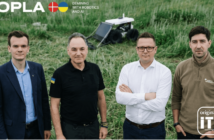


- Warsaw-based Orbotix raised EUR 6.5M to scale AI-powered autonomous drone swarming technology across Europe
- The company pioneers distributed micromanufacturing to ensure European defense sovereignty and rapid scalability
- Its Wasper UAV and ATA system enable coordinated, resilient, human-supervised swarm operations
- Orbotix’ aim is to lead Europe’s defense innovation ecosystem through AI-driven autonomy
This October, Orbotix—the Poland-based swarm drone developer and manufacturer—secured EUR 6.5M of strategic funding. The lead investor of the round is BVVC, and other participants include Gustav Söhne Verwaltung GmbH & Co. KG and Leryon Global Holdings.
Founders on a Mission of Building Europe’s Defense Future
Orbotix was founded in 2024 by Bogdan Ochiana (CEO), a Romanian entrepreneur with a global background in management consulting, and Sebastian Straube (Chief Strategy Officer), a Polish-German strategist and investor specializing in defense, space, and dual-use technologies.
Mr Ochiana was driven by the realities of the present-day security landscape. Particularly, the lessons emerging from Russia’s war against Ukraine made him see the urgent need for Europe to strengthen its technological sovereignty and equip operators with tools that enhance efficiency and survivability in modern conflict environments.
Mr Straube, in turn, brought an in-depth understanding of how innovation ecosystems can accelerate defense capabilities, thanks to his experience at Isar Aerospace and as a venture partner at the well-known firm Sunfish Partners (invested in CodeAlly, among others), where his role was to help scale early-stage defense and aerospace companies.
Together, the founding duo recognized that Europe needed a new kind of defense company, operating with the agility of a startup, the technological depth of an AI company, and the strategic mission focus of a defense player.
From Vision to Velocity

Sebastian Straube, Co-Founder and Chief Strategy Officer at Orbotix
Thus Orbotix came to be: a company built in Europe, for Europe, with the mission to deliver autonomous systems that strengthen the continent’s defense and security resilience. The idea was simple but ambitious: to redefine how Europe approaches defense and security through AI-powered autonomous systems. In one year and a half, Orbotix grew from concept to execution at a pace rarely seen in the defense sector.
‘We moved from concept to functional prototypes in just 2 months. Within 8 months, we conducted our first field demonstrations, and within 5 months, we had already integrated multiple system upgrades based on real operational feedback, and growing our team of 40 professionals spanning engineering, AI, robotics, marketing and defense strategy, with a headquarters in Warsaw and subsidiaries in Romania, Ukraine and Spain,’ Mr Straube recalls.
Presently, Orbotix develops AI-powered autonomous drone systems for military, law enforcement, and critical infrastructure applications. Its drones are designed for swarm coordination, enabling multiple units to operate collaboratively and adaptively in complex missions. With a diverse European team and engineering network with HQ in Poland, and operational presence in Romania and Spain, the company is a swarm of sorts itself, focusing on distributed micromanufacturing across the EU, striving for rapid production scalability and pan-European defense sovereignty.
Challenges: Agile Defense and Innovation Under Regulation
According to the team, one of the biggest standing challenges is to operate in an environment where innovation must advance in harmony with the strict standards that safeguard national and allied security.
‘We understand that in defense, safety and reliability take precedence. We’ve seen governments across Europe increasingly embrace a more agile, innovation-driven approach, as reflected in initiatives like the EU’s ReArm Europe strategy. At Orbotix, we’re proud to contribute to this evolution, as nations rise to the challenge of protecting the way of life built on our shared democratic values,’ Mr Ochiana states.
‘Orbotix’ capacity to revolutionize modern defense by combining cutting-edge AI technology with unparalleled innovation in autonomous drone systems as well as the management standing behind Orbotix have convinced us to invest in the company, as we see it necessary to defend our values of freedom, freedom of expression and tolerance,’ Gustav Söhne group’s chairperson Jan Dirk Elstermann adds.
Specific AI/algorithmic challenges also arise when developing swarming capabilities. Developing these capabilities means ensuring that multiple UAVs can coordinate and operate reliably in contested or GNSS-denied environments where communications and positioning may be disrupted, all while keeping the operator fully in control with minimal cognitive load.
Human-Centered Swarm Autonomy

Jan Dirk Elstermann, Chairperson at the Gustav Söhne Group
‘Our human-centered autonomy stack combines adaptive AI with robust communication and navigation systems. Orbotix’ Wasper UAV is built for autonomous operations and resilience under electronic warfare, maintaining reliable positioning even without satellites. Our ATA (Autonomous Target Acquisition) System uses neural networks for target recognition, enabling one operator to manage several drones and engage multiple targets simultaneously. Swarming and terminal guidance allow for coordinated, precise strikes across multiple units,’ Mr Ochiana assures.
Through frequency-hopping communication, redundant links, and AI-assisted coordination, Orbotix’ systems maintain autonomy and mission continuity even under heavy interference, preparing them to adapt dynamically and make safe, mission-driven decisions. This results in a system capable of functioning effectively, ethically, and independently, even in the most demanding operational scenarios.
Micromanufacturing and Modularity: A Model for Sovereignty Through Production Independence
Additionally, a distributed micromanufacturing model across the EU presents supply-chain and logistical bottlenecks.
‘Building a drone is like building a small flying computer, every component, from sensors and engines to software and antennas, must work in perfect harmony. In a distributed micromanufacturing model across the EU, that harmony must be replicated across several sites, suppliers, and standards,’ Mr Ochiana explains.
As such, coordination and consistency present more big challenges. Not every component exists on the market, and aiming for quality performance and full technological sovereignty, the need arises to design, test, and validate parts oneself. This, in turn, requires close collaboration between teams in different countries and a supply chain that can adapt quickly to small-batch, precision manufacturing.
Orbotix addresses this through a modular design philosophy and shared digital production protocols that ensure parts built in Poland, Romania, or Spain integrate seamlessly. The system allows for flexibility without losing precision, enabling the company to scale faster while keeping control over quality, reliability, and compliance with EU defense standards.
‘In the end, distributed micromanufacturing is not just a logistical model, it’s a strategic choice for sovereignty, ensuring Europe can build, maintain, and scale its own technologies independently and securely,’ Mr Straube emphasizes.
Scaling at a Wartime Pace: AI and Infrastructure

Joe Musselman, Founder and Managing Partner at BVVC
Orbotix’ EUR 6.5M strategic BVVC-led funding round is a key step to scale its AI-driven swarming technologies and expand micromanufacturing capabilities across Europe. BVVC prides itself in backing back founders who compress timelines and move capability from prototype to throughput at a wartime pace.
‘Orbotix embodies that ethos. We are proud to back companies that move at a no-fail pace and understand that the United States and our allies must grow stronger together and win,’ BVVC’s founder and managing partner Joe Musselman shares.
According to the co-founders, the new funds will accelerate Orbotix’ AI capabilities, particularly drone swarming, and fund the rollout of distributed micromanufacturing sites across the EU. More specifically, the priorities are:
- building production infrastructure in Romania and Ukraine;
- advancing swarming autonomy, a capability urgently needed on today’s battlefield, developed from first principles and based on operator-led use cases;
- hiring elite engineers to create high-value technical jobs across the region;
- scaling operationally at the speed modern defense innovation requires.
In parallel, the company is scaling its micromanufacturing network inside the EU, designed to be distributed, resilient, and operator-focused. The team is convinced that such a model allows Orbotix to ramp up production progressively without relying on a single bottleneck facility.
The New Era of Swarm Command
Overall, Orbotix’s vision of the future of swarm command is a shift from direct control to high-level supervision. One operator should no longer need to pilot multiple drones individually. Instead, they command a swarm as a single intelligent system, setting mission parameters while the AI autonomously manages formation, task allocation, and real-time decision-making.
The philosophy is ‘human-in-the-loop’ where the operator remains in command, defining objectives and maintaining oversight, but the system executes autonomously within clear ethical and operational boundaries. This ensures faster response times and reduces cognitive load without compromising safety or accountability.
The ultimate goal is to enhance operators’ focus on strategy and decision-making, while the swarm handles mission execution. This balance of human judgment and machine precision is what will define the next era of autonomous defense.
‘Swarm autonomy will decide outcomes on tomorrow’s battlefields. Orbotix is building it now, in Europe, at scale, and under allied control. Their distributed production model and operatorfirst design deliver the sovereign capacity NATO needs to prevail in a contested world,’ Mr Musselman agrees.
More Dual-Use Innovation

Bogdan Ochiana, Co-Founder and CEO at Orbotix
Additionally, Orbotix is exploring new concepts that extend our technology into civil and infrastructure protection. One of these initiatives is VIGIL-1, a concept UAV designed for infrastructure surveillance and situational awareness. The idea behind VIGIL-1 is to apply Orbotix’s defense-grade autonomy, reliability, and resilience to critical infrastructure monitoring, providing real-time intelligence for energy, transport, and emergency response sectors.
‘Although still in the concept stage, VIGIL-1 represents how we see the future of dual-use technology: systems that not only strengthen defense capabilities but also contribute to civil security and resilience across Europe,’ Mr Ochiana tells ITKeyMedia.
Toward a Self-Reliant European Defense Ecosystem
To conclude, Orbotix stands as part of a new formation of European defense innovators—companies that move fast and think globally. Such companies bridge the gap between innovation and operational readiness, delivering autonomous systems that strengthen Europe’s resilience and reduce dependence on external technologies.
‘Five years from now, we aim for Orbotix to be recognized as a key partner within Europe’s autonomous defense ecosystem, a collaborator trusted by governments, armed forces, and allies. Our vision is rooted in cooperation, adaptability, and coherent solutions that deliver real results where they matter most. We strive to lead in swarming intelligence, AI-driven decision systems, and distributed production, ensuring Europe’s defense capabilities remain both advanced and strategically self-reliant,’ Mr Ochiana concludes.
Ultimately, defense sovereignty is not just about producing hardware within Europe, but about cultivating knowledge, control, and trust in the defense systems. This is the legacy that modern defense tech must work toward: to build a Europe capable of defending itself through innovation, collaboration, and technological excellence.

Kostiantyn is a freelance writer from Crimea but based in Lviv. He loves writing about IT and high tech because those topics are always upbeat and he’s an inherent optimist!