
- Giraffe360 concluded its Cipio Partners-led USD 10M Series B round
- The platform evolved into AI-driven real estate marketing infrastructure layer
- The company emphasizes attention to balancing automation with strong user control across workflows
- With the recent funding, the focus includes hardware upgrades, product expansion, and global growth
This March, the Latvian-British AI-powered real estate martech Giraffe360 raised its Series B round of investment. The amount of the round is USD 10M, and the lead investor this time is the well-known VC fund Cipio Partners (invested in FintechOS, among others). The round was joined by the company’s investors from its 2022’s Series A round, including such active VC firms as Change Ventures (invested in Monetizr, among others), LAUNCHub Ventures (invested in GlycanAge, among others), Hoxton Ventures (known, among other things, for their standing support of Preply), and Founders Fund.
Giraffe360 in Recap: From Camera Maker to AI Marketing Platform
Founded in 2016 by brothers Mikus and Madars Opelts, Giraffe360 set out to simplify real estate visual content creation by combining proprietary camera hardware, AI processing, and cloud software. The company developed a robotic camera system that allowed agents and property professionals to capture high-quality images, virtual tours, and accurate floor plans without relying on traditional photography workflows.
In 2022, Giraffe360 raised its 16M Series A round of investment. This coincided with the launch of the Giraffe Go Cam, a lighter and more advanced version of the company’s property capture technology
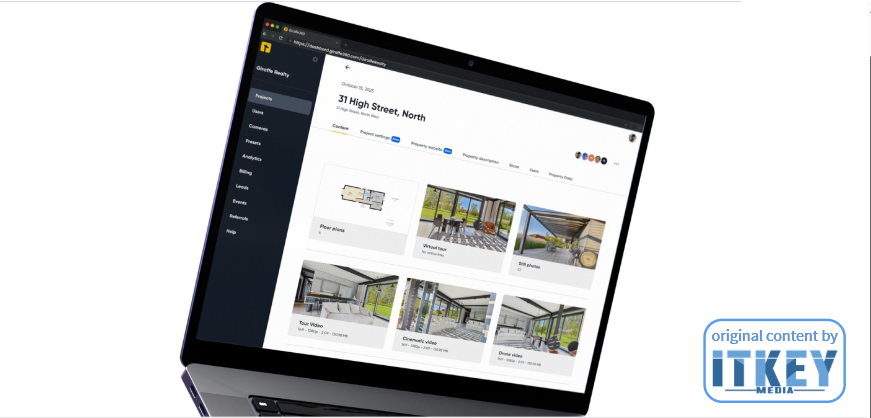
Since then, Giraffe360 has evolved from a camera provider into an AI-powered real estate marketing platform. Its system now turns a single property scan into a complete media package, including HDR photography, virtual tours, LiDAR-based floor plans, videos, property websites, virtual staging, and social media assets

Samy Jeffries, CRO at Giraffe360
More specifically, the company focused on expanding and further developing its media deliverables. Giraffe360’s CRO Samy Jeffries lists key milestones behind that:
- First, the expansion of the output itself. The platform moved from core assets like tours and floor plans into a broader set of deliverables: substantial upgrades to HDR photography core rendering pipelines, multiple video types, property websites, 2D and 3D floor plans, 3D property models with sunpath visualisations, third-party integrations, social media content, and a huge expansion in AI-led options like virtual staging. A single capture now leads to a diverse media output to tackle various challenges of modern marketing.
- Second, the development of the editing and delivery environment. This emphasized giving users control over how assets are packaged, branded, and distributed, representing a major shift, particularly for photographers building a service around the output, not just delivering files.
- Third, hardware improvements to accelerate speed, data capture, and what can be created from a space. This unlocked a different level of output, particularly when it comes to more advanced visual formats and faster turnaround times.
- Alongside, Giraffe360 scaled globally, now working across 40+ countries, and expanded its customer base beyond agents in Europe to include real estate photographers and media providers as a core audience.
‘The challenges have largely come from that same ambition. When you’re building both hardware and software, and trying to rethink how listing media is created and delivered, timelines move, expectations need managing, and you’re constantly balancing iteration with reliability. The last few years haven’t been about incremental improvements. They’ve been about building on and expanding our property marketing media pack, as well as integrating with the market, learning about our new client base and focusing on the tools we deliver to our clients to control and refine their media,’ Mr Jeffries comments.
Responding to Rising Expectations in Property Marketing
To recap, Giraffe360 has grown into a proptech company offering an end-to-end real estate marketing platform built around a proprietary LiDAR-enabled camera and AI-powered software. Agents capture a single property visit, which is automatically converted into a complete marketing package including HDR photos, floor plans, virtual tours, videos, and branded listing websites. The company operates on a subscription model that bundles hardware access and processing to help real estate professionals produce listing content faster and at scale.
The Giraffe360 team believes that the real estate media market has shifted from ‘underserved’ to one where expectations have materially increased in the past four years. High-quality listing media, once a differentiator, is now increasingly viewed as a baseline requirement, with buyers expecting rich pre-visit experiences and sellers expecting consistent presentation standards. As a result, agents and media providers are now judged directly on output quality, even in remote or digital-first decision-making contexts.
While sub-par listing media continues to exist in many markets, it fails to build buyer confidence or market differentiation and thus becomes less competitive. The company’s focus has therefore moved from filling a gap in the market to adapting to a structural change in how listings are created and distributed.
‘What’s emerging is something closer to an infrastructure layer for how listings are marketed. Instead of treating photography, tours, video, and social content as separate tasks, it’s becoming one connected process. You capture a property once, and that becomes the foundation for everything that follows; the assets, the variations, the way it’s presented across different channels. It’s not about adding more tools into the workflow. It’s about changing the workflow itself, so producing a high-quality, market-ready listing becomes the default rather than the exception,’ Mr Jeffries explains.
Regional Market Dynamics
The CRO highlights that the company’s international growth is shaped less by regulation and more by fundamentally different real estate market structures across regions:
- In the US, where there are roughly two million agents operating in a highly competitive, brand-driven environment, marketing is essential to professional visibility. Many agents operate as independent businesses within larger brokerages and rely on dedicated real estate photographers or media partners rather than capturing content themselves. In this context, success depends on strong, repeatable relationships between agents and photographers. The photographer’s role extends to becoming a trusted partner responsible for high-quality presentation, which drives recurring collaboration and business retention.
- By contrast, the UK is described as more agent-led, with less emphasis on individual personal branding and higher-volume, lower-fee media production This structure results in greater reliance on in-house content creation where solutions are aimed directly at agents who need efficient ways to produce professional listing media themselves.
- Mainland Europe is a diverse hybrid of these two models. Despite regional differences in workflow ownership, all markets are converging toward a shared expectation: higher-quality, more consistent property presentation as the standard baseline for listings.
Balancing Automation and Human Control
Giraffe360’s product philosophy centers on managing the tension between automation and user control. The team is convinced that poorly designed automation can slow workflows and reduce output quality to overly generic results, so the focus is on selectively automating repetitive, non-creative tasks while preserving room for professional judgment.
In this model, automation is primarily used for time-consuming production work such as formatting, editing, resizing assets, and generating variations for different distribution channels. This ensures that agents and media providers start from a consistent, high-quality baseline without needing to manually repeat operational steps for each listing. At that, control remains a key requirement, particularly for photographers and agents who rely on stylistic differentiation and personal branding. Users can still adjust, personalize, and refine outputs based on property characteristics, client expectations, or their own creative approach.
‘As AI becomes more capable, that line becomes more important. There’s a difference between helping someone visualise a space and creating something that doesn’t exist. Buyers are making significant decisions based on what they see, often before they visit in person, so trust in that content is critical. So the approach is quite deliberate: use AI to elevate and scale what’s already there, not to tear down walls and fabricate something new. And keep the user in control of that process, so they’re accountable for what goes out under their name,’ Mr Jeffries tells ITKeyMedia.
As real estate professionals face an expanding and often fragmented ecosystem of AI tools, pricing models, and workflows, Giraffe360’s strategy is to consolidate relevant capabilities—whether developed internally or integrated from external providers—into a single coherent system that simplifies adoption and reduces operational complexity. The underlying principle is that, despite automation, responsibility for the final marketed content ultimately remains with the agent or photographer, separating production efficiency from human decision-making.
While the system enables a single property visit to generate a full set of listing media, this capability doesn’t remove and emphasizes the need for human input in shaping the final outcome. Automating processing and repetitive production tasks, including the generation of core marketing assets, the platform doesn’t replace the judgment required to determine how a property should be presented, what narrative should be emphasised, and which aspects are most relevant to different buyers or sellers.
‘Even at a practical level, there are still moments where intervention matters. How you prepare a property before capture, what do you highlight in property, how you position it in the market, how you package and present the output to a client. Those aren’t things you automate away without losing something important. The way we see it, it’s not about removing the human role, it’s about giving users more power and space to focus,’ Mr Jeffries shares.
Further Product Development, Hardware Evolution, and Market Expansion

Nils Matthies, Principal at Cipio Partners
To Cipio Partners, Giraffe360 stands out through its unique combination of proprietary hardware, AI-powered automation, and software in a one-stop solution for real estate professionals.
‘Led by outstanding entrepreneurs who have proven their vision and execution capabilities, the company is well positioned to become a category leader in digital real estate marketing.” the fund’s principal Nils Matthies states.
The recent USD 10M funding is meant to support the continued development of Giraffe360’s AI-powered platform, expansion of its product capabilities, and growth of its operations across existing and new markets.
Mr Jeffries expands upon three main areas across which the investment gets allocated:
- Product development. This includes increasing automation, improving user control, and expanding the ability to transform a single scan into complete, market-ready listing content. Over the coming years, the objective is to reduce manual work within real estate media workflows while maintaining flexibility and creative control for users.
- Hardware evolution. The PRO Camera represents part of a broader roadmap, highlighting the importance of improving capture quality, speed, and the range of data collected, as stronger inputs enable more advanced automation and higher-value media outputs.
- Market expansion. While Giraffe360 is already present in more than 40 countries, the company’s focus is on increasing market depth rather than simply expanding into new territories. This includes growing adoption among media providers in North America and supporting wider agent adoption across European markets.
‘This financing allows us to accelerate our vision at a pivotal moment for the industry, as real estate marketing shifts toward AI-powered, immersive, media-rich digital experiences. Giraffe360 is building the infrastructure powering this transition — from data capture to intelligent, automated marketing,’ the company’s co-founder and CEO Mikus Opelts adds.

Mikus Opelts, Co-Founder and CEO at Giraffe360
The Giraffe360 team anticipates all the mentioned initiatives to compound over the next two to three years. The company centers its success metrics on customer impact, including adoption, workflow integration, usage frequency, listings processed, and customers’ ability to grow their businesses. With the platform already supporting the capture and presentation of around half a million properties annually, the target is to increase that scale and become a more embedded part of customers’ daily operations.
Vision: Embedded in the Workflow of Real Estate
‘We remain centred on how listing media is created and making that process faster, more consistent, and easier to scale without losing quality. We also empower businesses to turn that media output and diversity into winning new clients or listings. While there’s always a temptation to stretch into adjacent areas or position as something broader, that only works if you’re genuinely solving the problem at the core first. For us, that’s still about solving property presentation and helping customers grow their business. If we’re doing the job properly, we become part of the workflow, and everything else connects to it,’ Mr Jeffries concludes.
Giraffe360’s evolution reflected a broader transformation taking place in real estate, where property marketing is moving from fragmented, manual processes toward integrated, technology-driven workflows. By combining hardware, AI, and automation while keeping professionals in control of the final output, the company is addressing a growing need for faster, more consistent, and higher-quality property presentation. As buyer expectations continue to rise and digital experiences become central to real estate decisions, Giraffe360’s ambition is to become a foundational layer in how properties are captured, marketed, and experienced globally.

Kostiantyn is a freelance writer from Crimea but based in Lviv. He loves writing about IT and high tech because those topics are always upbeat and he’s an inherent optimist!