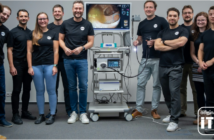


- British startup GlycanAge with Croatian founders translates glycan science into clinically actionable biological aging diagnostics
- The company focuses on early risk detection through stable, inflammation-linked IgG glycan biomarkers
- The company emphasizes ethical data stewardship, clinician support, and careful communication
- The new funding round of EUR 7.4M accelerates hospital adoption, regulatory progress, and expansion into women’s health
This January, the British-Croatian longevity diagnostics startup GlycanAge raised EUR 7.4M of investment. The lead investor of the round is Fifth Quarter Ventures, joined by GlycanAge’s previous supporters: the well-known Bulgarian VC firm LAUNCHub Ventures (invested in Thinkpilot, among others) and Kadmos Capital, alongside Guinness Ventures, BrightCap Ventures, South Central Ventures, Impetus Capital, Vesna Deep Tech VC, and Lightfield Equity.
A Family-Founded Company Rooted in World-Class Science
GlycanAge was founded in 2020 by Professor Gordan Lauc (CSO), Nikolina Lauc (CEO), and Filip Lauc (CTO). Gordan Lauc is a pioneer of human glycomics and co-founder of the Human Glycome Project. He is also the founder of Genos Glyco, Professor of Biochemistry at the University of Zagreb, Honorary Professor at King’s College London, and a Johns Hopkins Scholar. With 800+ publications, 19,800+ citations, and an H-index of 75, Professor Lauc discovered GlycanAge as one of the first systemic measures of biological aging based on immune glycosylation and co-founded this startup to bring the science from the lab to the general public. As Chief Scientific Officer, he continues to lead its scientific direction and research.
His daughter Nikolina Lauc grew up surrounded by scientific innovation and is deep-rooted in entrepreneurship, having founded her first company at 18 and later built a successful travel-tech startup. Ms Lauc has led GlycanAge from a cutting-edge research project into a commercial platform empowering individuals and practitioners to take proactive control of health and aging. A serial entrepreneur with proven experience in scaling startups and leading growing teams, she is also a Draper University alumna and a Foresight Institute fellow.
Her brother Filip Lauc comes from a computer science background, having previously founded an IT company. At GlycanAge, he leads product and technology development, transforming complex biological data into clear and personalized health learnings and action insights.
The family team created GlycanAge after realizing how glycan biomarkers can reveal biological aging and inflammation long before symptoms appear. The co-founders see their mission in bridging the gap between advanced glycan science and everyday healthcare.
What GlycanAge Measures, and Why It Matters
Simply put, GlycanAge is a blood test that measures chronic inflammation and shows how fast a body is aging on the inside. Instead of just looking at how old a person is based on their documents, it measures one’s biological age based on the long-term built-up chronic inflammation in the body, which is closely linked to future health risks and outcomes.

Elina Halatcheva, Managing Partner at BrightCap Ventures
It’s worth specifying that, as is common in diagnostics, the naming overlaps. ‘GlycanAge’ can refer to the company that develops, validates, and deploys glycan-based diagnostics, as well as to the specific biomarker output produced by its flagship test, namely the biological age estimate derived from IgG glycosylation patterns. In practice, one can use ‘your GlycanAge’ to mean the result of the blood test, while ‘GlycanAge’ as a proper noun refers to the startup and its platform.
‘Backed by rigorous scientific validation, GlycanAge has pioneered the first IgG glycan ‘inflammaging’ bioclock, redefining how users and clinicians understand aging, inflammation, and long-term health. We see tremendous potential as GlycanAge advances from preventive analytics toward clinically actionable diagnostics and want to support the company in this journey,’ BrightCap Ventures’ managing partner Elina Halatcheva comments,
What makes this important is that many health problems develop quietly for years before diagnosis and even before symptoms appear. By showing early signs of stress and aging in the body, GlycanAge provides people with a clearer picture of their health status early on, prompting such lifestyle changes as improving sleep, diet, exercise, etc., before problems occur.
Designed for Chronic Signals, Not Short-Term Noise
Seeing how glycans are exceptionally sensitive to inflammation and the environment, GlycanAge was specifically designed to reflect sustained (chronic) biological changes rather than short-term (acute) fluctuations.
The test analyzes glycans attached to IgG antibodies, which circulate for approximately twelve weeks/three months. This reduces sensitivity to short-term (acute) effects such as stress, minor illness, or temporary lifestyle changes. Unlike markers that change rapidly, IgG glycosylation reflects longer-term inflammatory status.
In addition, GlycanAge evaluates 29 IgG glycans and integrates them into multiple composite indexes and an overall biological age score. This multivariate approach reduces the impact of random variation in individual markers.

Nikolina Lauc, Co-Founder and CEO at GlycanAge
‘In fact, GlycanAge shows remarkable stability and low intra-individual variability in repeat samples limited to approximately +-1 year, well below the threshold of most meaningful interventions. This means that if you were to test today and then re-test tomorrow or the next week, but simply changed one or a few lifestyle habits for a short period of time, or went through a short-term cold, your results will be the same or varying with +-1. Hence, if no proper habit was established for at least twelve weeks, it is highly likely that this won’t be indicated in your results, simply because no meaningful biological shift has occurred. This level of stability allows clinicians and clients to interpret glycan changes with confidence, knowing they reflect true underlying biological shifts, rather than short-term noise,’ Ms Lauc explains.
The algorithm was developed using large population datasets and focuses on glycan patterns that consistently change with age. Improvements in GlycanAge generally align with broader changes in health-related factors rather than isolated biomarker shifts.
Data Ownership and Ethical Boundaries
Looking further, GlycanAge’s framework makes data ownership legally straightforward: healthcare organizations controlling the testing retain medical records ownership under HIPAA (US) and GDPR (EU), leaving patients the absolute right to access their data and withdraw consent for future use.
GlycanAge operates as a data steward rather than a data owner, meaning patients remain in control of their information. Patients explicitly authorize which data is processed and retained, the company collects only what is necessary for a specific clinical indication, and all data access is documented so it is clear who uses the data and for what purpose. They can download their glycan profiles personally and directly, and GlycanAge does not use glycan data beyond clinical care or anonymized research without explicit permission.
Ms Lauc warns against using glycan data for insurance underwriting, employment decisions, or credit evaluation in the future. GlycanAge is convinced that this is inappropriate because biological age metrics are probabilistic. They change over time and applying them as fixed measures of individual risk outside healthcare contexts is scientifically and ethically unsound. The GlycanAge technology is intended for clinical insight and prevention only.
Importantly, the team insists on viewing GlycanAge as a decision-support tool, not a prescriptive protocol, and it’s up to clinicians to decide how to act on glycan data. They interpret it alongside standard laboratory tests, medical history, and lifestyle information. An elevated GlycanAge often supports existing assessments related to metabolic health, chronic inflammation, or stress-related risk.
‘In practice, this leads to greater emphasis on established interventions such as metabolic control, weight management, hormone optimization, physical activity, sleep, and stress reduction. Repeated testing allows clinicians to assess whether interventions are associated with measurable biological changes over time. While formal guidelines are still emerging, the use of biomarkers prior to full guideline development is common in clinical practice,’ Ms Lauc tells ITKeyMedia.
Education and Communication to Prevent Anxiety and Over-Medicalization
The team realizes that, as a biomarker that reflects future health risk, GlycanAge can create GlycanAge creating anxiety or even over-medicalisation in otherwise healthy people, if it’s presented without context. The company deliberately positions and communicates GlycanAge not as a diagnosis, let alone a verdict on one’s health, but a signal about inflammatory and immune aging that needs interpretation alongside lifestyle, clinical markers, and longitudinal trends.
When working with direct consumers, GlycanAge pairs its tests with a 40-minute 1:1 results interpretation/consultation session with in-house glycan specialists, who communicate this and go deeper into each individual’s health profile. On the other hand, when working with practitioners, clinics, and partners, GlycanAge educates their teams to interpret glycan data and work with their clients on improving their health in an anxiety-free way.
Aligning Prevention with Today’s Healthcare Practices
Overall, seeing how hospitals are structured around diagnosis and treatment, this can limit early adoption of prognostic biomarkers. GlycanAge’s steady approach focuses on defined clinical areas, including cardiometabolic risk and women’s health, rather than broad screening. GLycan data can integrate into hospital systems and appear alongside standard laboratory results. For example, at St. Catherine’s Hospital in Zagreb, Croatia, glycan data are reviewed within existing clinical workflows.

Gergana Gesheva, Partner at Impetus Capital
St Catherine Specialty Hospital in Zagreb became GlycanAge’s first pilot site, marking an important step toward integrating glycan testing into routine hospital care. Building on this initial deployment, the company’s ambition is to expand into up to ten or more hospitals across Europe and the Middle East over the coming year. In parallel, GlycanAge has partnered with King Abdulaziz City for Science and Technology to establish its first Saudi-based laboratory, which will act as a national hub for glycan testing and technology transfer.
‘Economic structure is another factor. Preventive testing does not always align with fee-for-service models, while secondary prevention, such as reducing the risk of recurrent cardiovascular events, fits current reimbursement frameworks. Initial hospital use is focused there. Technical integration also requires compatibility with electronic health record systems and dedicated implementation partnerships.’ Ms Lauc adds.
Investors on Long-Term Impact
According to Impetus Capital’s partner at Gergana Gesheva, GlycanAge strongly aligns with her firm’s mission to support innovative companies that create long-term value through science, technology, and real societal impact.
‘We invested in GlycanAge because they are making prevention measurable and scalable. Their solution enables individuals and healthcare providers to identify risk earlier, intervene sooner, and reduce costly downstream outcomes—an important step toward shifting healthcare from reactive treatment to proactive prevention,’ Ms Gesheva states.
‘We are constantly looking for founders with the ambition and potential to change the world, and we see exactly that in GlycanAge. We’re excited to support their team as they advance the use of their flagship biomarkers, expanding from longevity and preventative-care into broad clinical applications and routine lab testing. By translating cutting-edge scientific breakthroughs into practical tools for hospital settings, GlycanAge is a perfect example of what we are committed to back – companies creating a better future,’ South Central Ventures’ investment manager Tina Kastrevc adds.
Scaling and Expansion

Tina Kastrevc, Investment Manager at South Central Ventures
GlycanAge’s new funding is meant to accelerate the clinical development of its technology and expand access to glycan testing for clinicians worldwide. Specifically, it targets three measurable milestones over 18-24 months:
- Hospital Deployments: From one hospital in Croatia to 5–8 across Europe, Middle East, and Asia, each with indication-specific protocols.
- Indication Development: Completing cardiovascular secondary prevention validation, beginning women’s health (perimenopause) pilot studies. Clear success metrics here would embody peer-reviewed publications in high-impact journals demonstrating clinical utility.
- Regulatory Advancement: Progressing from clinical validation under IVDR frameworks toward CE marking or equivalent, alongside US CLIA optimization.
- Commercial Scale: Establishing permanent US presence and expanding laboratory capacity to 10,000+ tests monthly.
Beyond hospital expansion, GlycanAge pursues two strategic initiatives:
- Software and AI Integration: The startup is developing decision-support tools that integrate glycan data with EHR systems, enabling clinicians to see glycan trends, intervention recommendations, and outcome predictions within existing workflows.
- Women’s Health Initiative: Perimenopause (a 10–15iyear transition period with profound metabolic changes) is a perfect use case for glycan monitoring. The team is designing protocols to identify perimenopausal status and tailor interventions earlier, addressing a long-standing clinical gap. Seeing how medicine has historically excluded women from research, leading to systematic misdiagnosis, this positions GlycanAge as not just a biomarker platform but as a corrective to healthcare inequity.
GlycanAge’s work effectively shifts aging and chronic disease from something detected too late into something measurable early, interpretable over time, and actionable before damage becomes irreversible. By grounding prevention in robust biology rather than vague wellness claims, the company is helping clinicians and individuals understand risk as a dynamic process, not a fixed fate. This points toward a healthcare model that is quieter, earlier, fairer, and ultimately far more humane than reactive medicine.

Kostiantyn is a freelance writer from Crimea but based in Lviv. He loves writing about IT and high tech because those topics are always upbeat and he’s an inherent optimist!