
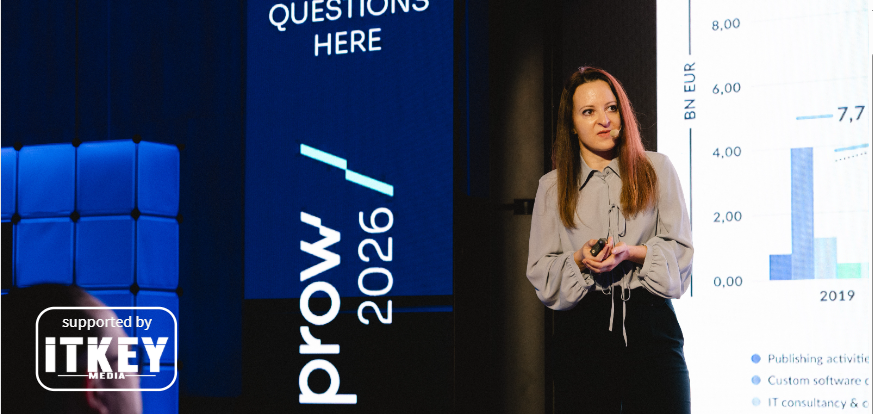
- At PROW Conference 2026 on October 30th in Timișoara,Romania, ANIS Romania’s VP Diana Sipos delivered her keynote speech Romania’s Tech Sector at an Inflection Point
- The speech pointed out how Romania’s EUR 25.6B tech industry faces slowing growth, demanding a more sustainable business model
- The seeker is convinced that its future competitiveness depends on intellectual property, product commercialization, collaboration, and increased research investment
- ANIS advocates R&D incentives, IP Box schemes, and stronger cooperation towards Digital Romania 2030
Romania’s technology industry has grown into one of the country’s most important economic assets, but its next phase of development will depend on something more than engineering talent and software services: the ability to create, own, and commercialize intellectual property. This was the central message of Diana Sipos, VP at ANIS Romania, during her keynote speech, Romania’s Tech Sector at an Inflection Point, at PROW Conference 2026, held at the Timișoara Convention Center on October 30th, 2026.
The presentation offered conference attendees an exclusive preview of selected findings from the forthcoming ANIS Industry Study 2025, providing a data-driven perspective on the Romanian IT industry’s market trends, talent dynamics, growth drivers, and emerging challenges. Drawing on the association’s research and its ongoing engagement with the industry, Ms Sipos examined both the progress made by the sector and the structural changes needed to sustain its competitiveness.
The keynote brought a broader industry perspective to the 6th edition of PROW, a conference dedicated to digital products and the professionals building them. Bringing together product leaders, founders, investors, UX researchers, designers, and technology practitioners, the event explored how AI is reshaping product management, decision-making, and organizational processes. Against this backdrop, Ms Sipos’s presentation raised a fundamental question for the Romanian technology community: How can the country move from being a strong technology services destination to becoming a more significant source of globally competitive products and innovation?
A Strong Industry, but Is the Growth Model Sustainable?
The figures presented by Ms Sipos illustrate the scale of Romania’s technology industry. According to the latest ANIS research, based on 2025 data, the combined turnover of the IT sector reached EUR 25.6B and almost tripled in volume between 2019 and 2025, demonstrating consistent growth and an increasingly substantial contribution to the national economy.
‘The tech industry in Romania has become quite an asset. It is large, it is productive, more than the other sectors in the economy.’
The positive trajectory is also visible in employment. Ms Sipos reported a 4.6% increase in the number of IT employees, bringing the sector to its highest employment level in the period covered by the study. At the same time, turnover grew by approximately 10% compared with 2024.
The difference between these growth rates points to a change in how companies are developing. Rather than relying exclusively on expanding their workforces, businesses are increasingly concentrating on efficiency, automation, and the value generated by their products, processes, and solutions.
The entrepreneurial landscape is evolving as well. Ms Sipos highlighted the growing number of companies operating in the industry, from smaller entities to larger enterprises. A broad base of startups and SMEs is particularly important for building a sustainable ecosystem, creating the conditions for emerging businesses to grow into larger enterprises and potentially become unicorns.
However, the industry’s impressive historical performance does not guarantee that the same growth drivers will remain sufficient. ANIS’s research, conducted with industry specialists, indicates that Romania’s IT sector has recorded average annual growth of 17.7% over the period analyzed. Yet, if the existing structural conditions remain unchanged, the industry could reach a plateau, with future growth falling to approximately 2% annually, broadly in line with the Romanian economy.
For Ms Sipos, this is the moment when the industry needs to make strategic choices about its future. Maintaining the current model might preserve its existing position, but it will not necessarily allow Romania to strengthen its place on the global technology map.
Moving Beyond Services: The Economic Value of IP

Diana Sipos, VP at ANIS Romania
One of the central themes was the need to complement Romania’s established software engineering and IT services capabilities with more product development and intellectual property creation.
The distinction goes beyond changing the business models of individual companies. It concerns how much economic value the technology industry generates and retains within the country.
Ms Sipos explained that businesses developing and commercializing their own intellectual property can create a significantly greater economic impact than service-based companies generating comparable turnover. According to the figures presented, the additional economic impact through spillover effects can reach 13% for companies engaged in more dynamic, innovative product development and commercialization.
This means that the opportunity for Romania is not simply to increase the volume of software development work performed locally. It is to develop products, own the underlying technology, bring innovations to market, and capture a greater share of the value created. Yet there are several bottlenecks that continue to limit the country’s ability to make this transition.
Innovation in Silos and the Collaboration Gap
Comparing Romania with peer countries such as Poland, Estonia, and the Czech Republic, ANIS identified several areas where the local ecosystem has room to improve. One of the most notable findings concerns collaboration. According to the research presented by Ms Sipos, only 16% of Romanian companies engage in ecosystem-based innovation, working with other organizations to develop new solutions and products. The European average stands at 26%, while Poland reaches 39%.
‘We innovate, but we innovate little, and we work in silos. Why is that?’
For Ms Sipos, the figures point to a broader challenge: Romanian companies need to become more open to collaborative activities, partnerships, and joint innovation initiatives. This is particularly relevant in the context of European competition. Companies are not competing only with other Romanian businesses for opportunities and funding: they are operating in a wider European market where the ability to build partnerships, combine expertise, and validate ideas can make a significant difference.
Ms Sipos encouraged attendees to make the best of such opportunities as PROW to establish connections, identify potential partners, and explore joint access to European funding. Collaboration, in this sense, is not simply a networking exercise but a practical way to increase the innovation capacity of the industry.
Another bottleneck concerns research and development investment. Ms Sipos pointed to the limited effectiveness and accessibility of Romania’s existing R&D tax incentives, highlighting an R&D investment figure of only 0.07%.
‘0.07% is practically nothing. We advocate here for enlarging the schemes, but also making a framework that is really easily accessible by companies.’
The challenge is about encouraging companies to invest more in research as much as ensuring that the available support mechanisms are practical and accessible, particularly for smaller businesses and startups that may lack the resources to navigate complex administrative procedures.
From Innovation to Products That Reach the Market
Another finding highlighted during the keynote concerned the ability of Romanian companies to turn innovation efforts into commercial products.
According to the figures presented, only 12 out of every 100 Romanian companies manage to bring a product to market, on average. MS Sipos contrasted this with Germany’s significantly stronger product-development performance, illustrating the gap between developing technological capabilities and successfully commercializing them.
This distinction matters because innovation that never reaches the market cannot deliver its full economic potential. Research, engineering, and experimentation need to translate into products that find customers, generate revenue, and establish sustainable business models.
For an audience of product leaders and practitioners, this part of the presentation connected particularly closely with the broader challenges explored throughout PROW. Building a successful product requires more than technical expertise. It involves identifying market opportunities, validating ideas, understanding customers, and making strategic decisions about development and commercialization.
Romania’s tech sector has already demonstrated its capacity of delivering complex software engineering projects and services. The next challenge is to turn more of that expertise into products that can compete internationally.
Digital Romania 2030: The Policy Changes ANIS Wants to See
Based on its research and consultations with industry specialists, ANIS has developed a package of proposed measures and a vision for Romania’s digital development towards 2030. Ms Sipos outlined several priorities that the association is promoting in its discussions with government authorities.
- The first concerns simplifying and expanding existing R&D incentives. One of the proposals is a refundable R&D tax credit that would make support available to startups, small businesses, and larger companies alike, allowing them to offset their research and development investments against their tax obligations. Ms Sipos noted that the refundable tax credit represents progress at the legislative level, although implementation regulations are still required to make it fully operational.
- Another proposal is the introduction of IP Box schemes, similar to those adopted across a number of other OECD countries. Such mechanisms can provide a more favorable tax regime for intellectual property developed and registered in Romania, encouraging companies to retain and commercialize their innovations locally.
- Beyond fiscal measures, ANIS is also advocating for stronger cooperation across the innovation ecosystem. This involves bringing companies together, facilitating partnerships, encouraging access to European funding, and improving communication between the private sector and public authorities.
These priorities reflect the association’s broader ambition to strengthen Romania’s position in the international technology market by addressing the conditions that influence innovation, investment, and product development.
Building the Next Chapter Together
Ms Sipos’s keynote at PROW Conference 2026 offered a picture of an industry that has achieved considerable scale but is approaching an important turning point. Romania can boast about an established tech sector, a substantial talent pool, and a growing base of companies. What remains uncertain is whether these strengths can be translated into a more innovation-driven and product-oriented economy.
The transition will require effort from several sides:
- Companies need to invest in R&D, develop their own intellectual property, commercialize more products, and become more collaborative.
- Policymakers need to provide a more supportive and accessible framework for innovation.
- And the wider technology community will need to recognize that sustainable growth depends on building connections and working together.
Such was the broader message behind Ms Sipos’s invitation to companies to engage with ANIS and contribute to the association’s work representing the industry in discussions with public authorities.
‘The stronger together, the better, and we can build a resilient IT industry going forward.’
By bringing together professionals working across product management, technology, design, and business, PROW Conference provides a setting for discussions that extend beyond individual products and companies. Ms Sipos’s presentation added an important national industry perspective to these conversations, revealing why the next stage of Romania’s tech development will depend not only on what its companies can build, but also on how effectively they can innovate, collaborate, and turn ideas into lasting economic value.

Kostiantyn is a freelance writer from Crimea but based in Lviv. He loves writing about IT and high tech because those topics are always upbeat and he’s an inherent optimist!