

- Oradea-based FIORA5 is developing configurable RISC-V processor IP for efficient, predictable computing in edge devices
- Targets include up to 50% less silicon area and 60% lower energy consumption
- Vest Ventures’ investment will support product development, team growth, proof-of-concept validation, and commercial partnerships
- The fund plans EUR 1.4M in technology investments throughout the fourth quarter of 2026
Romanian deep-tech startup FIORA5 is developing a processor architecture designed to combine high-performance computing with predictable real-time execution and lower energy consumption, targeting devices such as smart glasses and edge AI systems. This October, the Oradea-based company became the first startup to receive a direct investment from Vest Ventures as the regional fund moves from acceleration into financing, with EUR 1.4M in technology investments planned for the fourth quarter of 2026. For FIORA5, the funding marks a step toward validating a proprietary processor design that its founders hope to turn into internationally licensed intellectual property.
From Open Architecture to a Competitive Processor
The startup is building on RISC-V, an open instruction-set architecture that allows companies to develop their own processors without relying on a proprietary instruction set. FIORA5’s proposition is to develop the processor core itself, giving chip designers a configurable implementation they can integrate into their own systems-on-chip rather than requiring them to build a CPU from scratch. The distinction matters because an open architecture does not provide a finished processor, and developing, verifying and optimizing one can require years of engineering work.
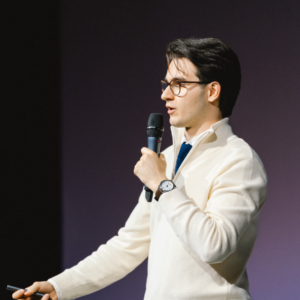
Darian Domocoș, Co-Founder and CEO at FIORA5
The company emerged from a technical problem encountered by co-founder and CTO Alin Petru Părcălab through his work on semiconductor projects with different clients. Darian Domocoș, FIORA5’s co-founder and CEO, explains that the founders combine electrical engineering, computer science, and business backgrounds, and have worked together for almost six years.
‘The solution we are developing initially started as a side project by our CTO, Alin,’ Mr Domocoș recalls, describing how recurring limitations in existing CPU solutions prompted the exploration of a different microarchitecture.
What began as an engineering project eventually became a business built around licensing processor IP to companies developing chips and electronic products. Rather than competing to manufacture finished processors, FIORA5 intends to sell or license designs that customers can integrate into their own silicon, allowing them to concentrate resources on other parts of their products. The name reflects that ambition, standing for Fast Implementation Of RISC-V Architecture, with the final ‘5’ serving as a stylized reference to the ‘V’ in RISC-V.
Combining Performance With Predictable Real-Time Computing, While Targeting Smaller, More Energy-Efficient Devices
FIORA5’s technical focus is a 64-bit application-class processor core intended to combine capabilities that are often addressed through separate processor designs. Application processors are built to handle complex workloads, while real-time processors emphasize predictable response times, an important requirement in systems where timing matters as much as computational performance. The startup aims to bring both capabilities into a single configurable IP offering, potentially reducing the need for customers to integrate and manage multiple processor cores.
The company is designing for constrained edge devices, where processing performance must be balanced against power consumption, thermal limits, and silicon area. FIORA5’s current development targets include up to 50% lower silicon area and up to 60% lower energy consumption compared with selected reference processor implementations, although those figures remain targets that need to be validated as development progresses. The first markets it plans to pursue are smart glasses and edge AI accelerators, where local processing can reduce dependence on remote computing while keeping devices compact and power-efficient.
The timing, Mr Domocoș argues, reflects changes both in the underlying technology and in the products being developed around it. RISC-V has matured enough to support more sophisticated customized processors, while edge AI, robotics and wearables are creating demand for local computation that must operate within tight power and thermal constraints.
‘As a startup, we can focus on these gaps and build a product around specific customer needs rather than trying to serve every possible application,’ the CEO explains, contrasting FIORA5’s targeted approach with the broad-market priorities of established semiconductor companies.
Preparing for Proof of Concept and Industry Partnerships

Cristobal Alonso, Managing Director and General Partner at Vest Ventures
For prospective customers, the business case is less about access to an open architecture than the cost and time required to turn it into a competitive processor. Naturally, companies can build their own RISC-V implementations, but doing so requires specialized engineering, verification and optimization before the design is ready for commercial integration. FIORA5 hopes to make licensing its configurable core an attractive alternative when a customer would rather accelerate product development than invest years in developing its own CPU implementation.
The company is still working toward its first proof of concept, targeted for the first half of 2027, while building its team and developing relationships with industry partners. Its advisors bring experience from semiconductor companies including Codasip, Imagination Technologies, and Tenstorrent, and the startup is also advancing a prospective strategic partnership with a Silicon Valley-based company. It’s important to note that the planned 2027 milestone is part of the technology-validation process, rather than a promise that a finished commercial processor will be available that year.
Building semiconductor IP from Romania presents challenges beyond finding the right engineers, Mr Domocoș notes, including access to capital, advanced electronic design automation tools, prototyping infrastructure and specialized expertise. The company sees Romania’s engineering talent as an advantage, but recognizes that competing internationally will also require stronger connections to global semiconductor customers and partners. Participation in ChipStart EU and the development of international relationships are among the ways FIORA5 is working to address those gaps.
Vest Ventures’ Move from Acceleration to Direct Investment
Vest Ventures’ investment provides an early source of capital as the company moves toward its technical milestones. The fund’s first announced investment in this phase is part of a wider plan to deploy EUR 1.4M into technology companies during the fourth quarter of 2026, following its initial accelerator cohort. Cristobal Alonso, Managing Director and General Partner at Vest Ventures, sees the transaction as a test of whether the accelerator can help companies progress from early validation to funded development.
‘An accelerator proves its value when the progress achieved during the program translates into stronger companies and—where a solid investment case exists—into capital for the next growth stage,’ Mr Alonso says. He adds that the fund is allocating EUR 1.4M in the quarter to startups with relevant technology, founders capable of execution and ambitions to build from Romania for international markets. Beyond financing, Vest Ventures aims to provide access to expertise and networks that can help companies develop and expand further.

Sorin Maxim, General Director at ADR Vest
The investment also fits a broader regional effort to connect early-stage technology companies with the resources needed to grow beyond Romania. Sorin Maxim, Director General of the ADR Vest, says the goal is to create an ecosystem where promising businesses can access both capital and expertise.
‘FIORA5 demonstrates why we created Vest Ventures: so that startups possessing the technology, the team, and a solid development plan can make the leap from acceleration to investment,’ Mr Maxim emphasizes.
What Comes Next
For FIORA5, the immediate priorities are product development, team growth and commercial development, with further validation needed before its processor IP can be adopted in commercial products. The company is working toward its first proof of concept while establishing partnerships and preparing for the next stages of development, in a market where technical credibility must precede commercial scale. Its longer-term ambition is to build a processor-IP business from Romania that gives global chip designers another option for efficient, configurable computing at the edge.
Vest Ventures will support startup growth through four similar accelerator cohorts and regional pre-acceleration programs, guiding founders from initial ideas and MVPs to market validation, investment, and scaling. The second cohort begins on November 2, 2026. Interested entrepreneurs are welcome to apply at vestventures.vc to access mentorship, expertise, networks, and potential investment opportunities.

Kostiantyn is a freelance writer from Crimea but based in Lviv. He loves writing about IT and high tech because those topics are always upbeat and he’s an inherent optimist!