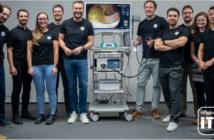


- Prague-based HTG Medical evolved its Urogram device from a hackathon prototype into certified medical technology
- More than 4,000 bedside testing hours helped refine Urogram for real-world ICU conditions
- The startup raised EUR 450K to accelerate commercial expansion across Europe and beyond
- HTG plans to prioritize hospital expansion, international registrations, deployments, and sustainable profitability
A problem encountered at a 2019 medical hackathon has taken Czech medtech startup HTG Medical from a rough prototype to a certified medical device now preparing for international expansion. This July, the Prague-based startup raised EUR 450K in its Pre-Seed round co-led by Garage Angels and Electron Capital Partners, with JIC Ventures and returning investors Jinej fond and Dendis Capital also participating. The financing comes after HTG Urogram completed European Medical Device Regulation certification in 15 months, giving the startup the regulatory foundation to begin commercial rollout beyond the Czech Republic.
HTG Urogram automates one of the most repetitive jobs in intensive care: measuring and recording how much urine a patient produces. The compact device continuously measures the contents of a patient’s drainage bag, records the result every five minutes and sends the data into hospital information systems, removing the need for nurses to repeatedly read and manually chart the measurement. The HTG team claims the system can return up to 60 minutes per nurse per shift while providing more frequent and consistent data for clinical decisions.
How the Company Started
The company did not begin with a polished medical device or a business plan for an international medtech company. It started at a 2019 hackathon at Prague’s Institute for Clinical and Experimental Medicine (IKEM), where the team was challenged by ICU physician Marek Šramko to digitize urine-output monitoring. The founders came second rather than first, but the hospital’s request to continue developing the idea proved more important than the result of the competition.
HTG Medical was formally founded in autumn 2021 by CTO Max Klimeš and COO Krištof Šaman, with CEO Tobiáš Vybíral joining the team the following year. All three had experience with hackathons, where they had learned to take narrowly defined problems and build working solutions under time pressure. What made the IKEM project different was that the problem came directly from clinical practice and that the hospital was prepared to put early prototypes into a real ICU.
From Prototype to ICU-Ready Product

Max Klimeš, Co-Founder and CTO at HTG Medical
The original prototype was little more than wires and a lit-up display, enough to demonstrate the concept but nowhere near something a nurse could rely on during a clinical shift. More than 4,000 hours of bedside use and testing across more than 100 patients forced the team to solve a very different set of problems, from measurement precision and wireless communication to battery life, physical design, and integration with hospital systems. Today, HTG Medical describes its Urogram as a quiet, compact device designed to fit into existing ICU routines rather than demand a new workflow.
For Mr Klimeš, this evolution changed the challenge the company was tackling. It was no longer to measure urine output, but whether it could do so reliably enough and unobtrusively enough to survive a real-life ICU environment.
‘The original hackathon prototype was, by our own account, little more than wires and a lit-up display — just enough to demonstrate the idea. Over 4,000 hours of real bedside monitoring, the product evolved into something built for actual ICU conditions, with a precision load-cell sensor, wireless transmission and direct integration into hospital information systems. We’ve moved past asking whether the product is technically capable, and are now focused on how fast we can bring it to more patients, in the EU and beyond,’ the CTO explains.
To Disappear Into Existing Workflows
The focus on disappearing into the existing workflow is central to the product’s design. HTG Urogram requires no cables or infrastructure changes, communicates wirelessly, and runs for more than three months on standard AA batteries.
The founders also see the regulatory process itself as part of the company’s competitive position. Medical Device Regulation certification is a demanding process, and HTG Medical completed it in 15 months while building around European manufacturing and component traceability, turning a requirement that can slow medtech companies down into a milestone for international expansion.
Solving an Overlooked Healthcare Problem and Winning Over Skeptical Clinicians
Another barrier is less technical: the problem itself is easy to overlook. Manual urine-output logging is important in intensive care, but it is hardly the kind of headline-grabbing challenge that’s likely to dominate the product roadmap of a large medical-device manufacturer.
This creates an opening for a focused startup willing to work directly with clinicians. The product was developed with nurses, physicians, and biomedical engineers from the get-go, and according to HTG Medical’s current website, more than 50 ICU professionals across European hospitals have been involved in validating the system.

Tobiáš Vybíral, CEO at HTG Medical
Mr Vybíral admits that the team’s relationship with clinical staff also taught them that skepticism is not necessarily an obstacle to overcome, but a test that the product needs to pass. Nurses and doctors have seen technologies that look convincing in a laboratory only to become impractical on a ward, so the HTG team prioritizes hands-on use and feedback. Once staff have worked with Urogram for around a week, the company sees their reaction change because the device removes work instead of adding another layer to operate.
The positioning matters for physicians in particular because Urogram is intended as a monitoring tool rather than a replacement for clinical judgment. The company presents the system as a way to provide more timely and consistent information while leaving decisions about patient care with medical professionals.
Investor Confidence Follows Clinical Progress

Aleš Filipenský, Investment Director at Garage Angels
This combination of clinical validation and regulatory progress facilitated the latest round. Garage Angels’ investment director Aleš Filipenský points out the fact that HTG had taken the product all the way from a hackathon concept to certified deployment was central to the decision:
‘Healthcare is a segment where innovation takes hold slowly and with difficulty, which made us even more convinced by the HTG Medical team, who took Urogram from a hackathon idea to a certified product deployed with real patients. The combination of a strong founding team, MDR certification and a clear business model with recurring revenue was decisive for us. We believe HTG has the potential to become a commercially successful medtech solution on global markets, and we’re glad to be part of it.’
JIC Ventures, which joined the round as one of the startup’s new backers, sees HTG Medical as an example of the kind of hardware-and-software company it wants in its portfolio. Managing Partner Radim Kocourek argues that the company’s origins in a problem identified by clinicians give it a different starting point from technology looking for a healthcare application after the fact:
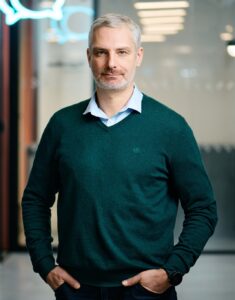
Radim Kocourek, Managing Partner at JIC Ventures
‘HTG Medical came about the way technology startups are meant to — out of a real problem named by the people on the ground. The doctors at IKEM knew what wasn’t working, and the team turned that into a product. Not every fund has the appetite or the backing to invest in hardware and software; for us it’s natural territory, and that’s part of why HTG Medical is now in our portfolio.
‘They come with a model where the customer doesn’t spend more than they do today but gets automation and data on top. In hospitals, that’s a real way in. The team is fast, motivated, and now holds a certification that opens the door to its first sales. The ambition to move into Europe is, in this case, a logical next step, not just an aspiration,’ his colleague Miloš Sochor adds.
The existing investors are also increasing their exposure as the company reaches its next stage. Jan Sláma, an investor at Jinej fond, shares that his fund joined the new round pro rata because the team has delivered on the commitments attached to its earlier investment:
‘It’s great to see the team, product, and overall strategy moving forward in huge steps. The founders delivered on what they promised with our previous investment, so we believe they’ll pull it off again now. Overall, what we like about HTG is that they’re solving a very specific problem with a very specific and valuable solution, and the demand from hospitals is significant.
The demand from investors was larger than the amount HTG ultimately chose to take. According to Mr Klimeš, total offers exceeded €1 million against a smaller target, allowing the company to select how much capital it actually wanted to bring onto its balance sheet rather than simply maximizing the round.
The Upcoming International Commercial Expansion and the Challenges of Europe’s Tougher Markets

Jan Sláma, Investor at Jinej fond
The recently raised EUR 450K will primarily fuel commercial expansion, with Austria, Spain, France, and the Netherlands among the company’s immediate European targets. HTG Medical has already established relationships with international distributors, while its MDR certification additionally supports registration efforts outside the EU, e.g. Australia, Singapore, Malaysia, and Saudi Arabia.
The founders say the strongest indication that the timing is right is coming from potential customers and distribution partners themselves. The team reports that hospitals and distributors across different countries are proactively approaching HTG to ask when the device will be available locally, creating an inbound pipeline rather than forcing the startup to build every market from scratch.
Germany and France are likely to be among the more difficult European markets, however, because of their size, established procurement structures, and slower adoption cycles. The UK presents a different challenge because it follows its own regulatory pathway outside the EU MDR framework, while HTG Medical is also preparing for its first registrations and deployments outside Europe.
For the next two years, the company will therefore measure progress less by another round of product development and more by commercial traction. The number of hospitals and ICU wards reached through distributors, the first non-EU registrations and deployments, and the path toward sustainable profitability will determine whether the current expansion has worked.
Building Beyond a Single Device
Moving further, HTG Medical is not planning to turn every possible ICU task into a product at once. Instead, the founders want to apply the same formula that produced Urogram: identify a repetitive and error-prone process clinicians already have to perform, automate it without forcing hospitals to redesign their workflows, and build on the sensing, connectivity, data-integration and regulatory infrastructure the company has already developed.
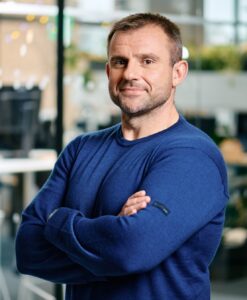
Miloš Sochor, Managing Partner at JIC Ventures
This approach could eventually turn the startup into something broader than a maker of a single monitoring device. At that, the founders are tying any expansion to the success of Urogram, with new products expected to reuse the company’s existing technology, and only move forward once the first product is commercially self-sustaining.
Thus, the recent EUR 450,K round is less about inventing the next product and more about taking the first one out of the Czech hospitals where it was born. A project that started with a second-place finish at an IKEM hackathon has already become a certified medical device, and HTG Medical is now betting that the same mundane ICU problem that gave birth to Urogram can give the startup a foothold in hospitals far beyond Prague.

Kostiantyn is a freelance writer from Crimea but based in Lviv. He loves writing about IT and high tech because those topics are always upbeat and he’s an inherent optimist!