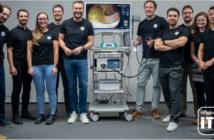


- Prague-based AI-powered medical imaging startup Carebot serves hundreds of hospitals across more than ten countries
- Carebot’s Horizon platform significantly simplifies adoption across multiple medical imaging AI applications
- Following the recent EUR 1.5M investment, Carebot plans international expansion, further product development, and more talent acquisition to support that
The Czech startup Carebot is already deploying its AI across hundreds of hospitals in more than ten countries. Following the startup’s EUR 1.5M round, its next challenge is to turn that adoption into a global medical imaging platform — and ultimately make AI a standard part of healthcare.
For years, the discussion around medical AI has focused on whether algorithms can match or outperform doctors at specific diagnostic tasks. For Carebot, the Prague-based startup developing AI for medical imaging, that is only part of the equation: a model can work, receive regulatory approval and still have little impact if doctors do not trust it or hospitals cannot integrate it into their everyday workflows. Carebot has now raised more than EUR 1.5M in its largest funding round to date, led by Garage Angels and Electron Capital Partners, as it looks to build on the clinical adoption it has already achieved.
Two Founders with Complementary Perspectives
The company, founded in 2021 by Matěj Misař (CEO) and Daniel Kvak (CTO), began with a technology designed to support the interpretation of chest X-rays during the COVID-19 pandemic. Since then, their startup has expanded into musculoskeletal imaging and mammography, built its Horizon platform to connect multiple AI applications. Carebot now works with hundreds of hospitals in more than ten countries, while the number of hospitals running its AI has tripled over the past year and contracted monthly recurring revenue has increased by 750%.

Matěj Misař, Co-Founder and CEO at Carebot
Mr Misař, Carebot’s CEO and co-founder, recalls that the company emerged from the combination of two very different backgrounds: ‘Daniel brought deep technological and research expertise in artificial intelligence and medical imaging, while my background was much more focused on business, communication and turning complex ideas into something that can work in the real world. The initial impulse came during the COVID era, when healthcare systems were under enormous pressure and the limited capacity of medical professionals became particularly visible.’
An Extra Pair of Eyes
This starting point shaped Carebot’s philosophy toward medical AI. Rather than attempting to replace physicians, the company set out to create what Mr Misař describes as an additional pair of eyes that could help clinicians identify findings, prioritize examinations, and reduce repetitive workload. The founders also learned early that a technically strong algorithm would have limited value unless it could be integrated into PACS and RIS systems, accepted by clinicians and incorporated into routine clinical practice.
For Dr Kvak, who leads Carebot’s technological and research development alongside Mr Misař, the journey has therefore consisted of several stages:
‘The first stage was technological and clinical,’ he notes. ‘We needed to demonstrate not only that the model could perform well, but that it could meaningfully support physicians in real clinical environments.’ Regulation followed, with clinical validation, quality management, and European medical device requirements becoming essential steps in moving the technology from development toward routine use.
A Single AI Layer and the Integration Issue
Carebot now has three CE-certified products: Carebot AI CXR for chest X-rays, AI Bones for fracture detection, and the recently certified Carebot AI MMG for mammography. Its broader Horizon platform is intended to bring these proprietary solutions together with additional AI applications, including CT, so that hospitals can introduce multiple AI capabilities without managing a separate system for every algorithm.
Importantly, the startup sees integration as one of the biggest barriers to widespread medical AI adoption.
‘Hospitals do not want to manage ten AI vendors, ten integrations, and ten different interfaces,’ Mr Misař points out. ‘They need AI to become part of the infrastructure they already use.’ Carebot is therefore positioning its Horizon as an environment through which hospitals can gradually add AI across different imaging modalities, not merely another collection of diagnostic algorithms.
Europe as the Testing Ground
The company’s European origins have influenced this approach. Europe offers a particularly fragmented healthcare environment, with differences in languages, reimbursement models, procurement procedures, hospital IT systems, and clinical practices between countries. Mr Misař argues that learning to deploy medical AI in such an environment has forced Carebot to develop a product capable of adapting to drastically different healthcare systems (even as access to capital remains more limited than for many competitors from across the ocean).
The team believes that this ability to deploy across different environments is becoming more important than the size of a startup’s funding round alone. Carebot’s technology is already used by university hospitals, regional hospitals, and smaller municipal healthcare facilities. The company assures that all those customers are paying for the technology and using it in routine practice rather than treating it solely as an experiment.
‘I do not believe that the future leader in radiology AI will necessarily be the company with the most capital,’ Mr Misař argues. ‘Clinical evidence, integration, physician trust, commercial sustainability, and the ability to deploy successfully at scale will ultimately be what matters.’
Clinician Trust and the Realities of Scale

Radim Kocourek, Managing Partner at JIC Ventures
Emphasis on adoption was also central to JIC Ventures‘ decision to participate in the new round. For the fund’s managing partner Radim Kocourek, at JIC Ventures, the most significant evidence came directly from the clinicians using the technology.
‘Radiologists described situations where Carebot flagged a finding that might otherwise have been missed,’ Mr Kocourek notes. ‘On top of that, the team managed to fit its technology directly into the daily running of hospitals, and it is precisely that combination — the trust of doctors and effective deployment in hospitals — on which a European leader can be built.’
The figures behind the investment reinforce that picture. Carebot tripled the number of hospitals running its AI over the past year, while its contracted MRR grew 750%, and signed contracts point toward more than tenfold growth by the end of 2026. The company is also already involved in a national tender in Poland covering 477 hospitals, while individual deployments include institutions such as Zagłębiowskie Centrum Onkologii, Szpital Uniwersytecki im. Karola Marcinkowskiego w Zielonej Górze, and Wojewódzki Szpital Specjalistyczny im. Najświętszej Maryi Panny w Częstochowie.
Naturally, international deployment brings specific complications. Dr Kvak emphasizes how while the underlying pathology remains the same when Carebot crosses a border, but the healthcare system around it does.
‘Countries use different languages, PACS and HIS systems, reporting conventions and clinical protocols,’ Dr Kvak explains. ‘Radiologists also have different expectations regarding how and when AI results should appear in their workflow, so international expansion cannot simply mean deploying exactly the same application in twenty countries.’
The solution, in Carebot’s view, is not to build a separate AI model for every market, but to create robust technology validated across different patient populations, equipment and clinical environments, surrounded by a sufficiently flexible integration and localization layer. Every new market consequently becomes another test of whether the technology can work beyond one hospital, one healthcare system or one population.
Choosing Next Problems to Tackle
The startup is also becoming more selective about which medical problems it tackles next.
‘I do not start with the question: ‘What else can AI detect?’ Dr Kvak explains. ‘The more important question is: ‘Where is there a meaningful clinical problem that AI can help solve?’
Examination volumes, shortages of specialists, the risk of significant findings getting overlooked, and the amount of repetitive work involved all feed into that decision, as does the potential to demonstrate measurable value for doctors and patients.
From Radiology Support to Early Detection
This line of thinking has taken Carebot from chest X-rays into musculoskeletal imaging and further into mammography. Its newly certified Carebot AI MMG supports radiologists with lesion localization and risk scoring, estimated lesion measurements, breast density assessment, image quality evaluation and structured reporting, reflecting the company’s broader interest in areas where large examination volumes and the importance of early detection create a meaningful opportunity for AI.
Early detection is becoming a particularly important part of Carebot’s strategy. Through an early lung cancer detection programme with Bristol Myers Squibb, hundreds of thousands of routine chest X-rays have already been analysed across several European countries, demonstrating how AI could potentially be used to identify serious disease earlier, in addition to assisting with the interpretation of an examination ordered for another reason.
Mr Misař sees that as a significant shift in how medical AI should be understood: ‘A chest X-ray may originally be taken because of an injury, a preoperative examination or another indication. Yet it can contain a finding that fundamentally changes the future of that patient, and I therefore see a major opportunity for AI not only to make diagnosis faster, but to help healthcare systems identify serious diseases earlier.’
Toward Permanent Infrastructure
The challenge now is turning individual deployments and successful pilots into systematic adoption. According to Mr Misař, healthcare systems have largely moved beyond the question of whether AI can work in radiology; instead, they are wrestling with procurement, financing, integration, responsibility and how to measure clinical and operational value. That is why the gap between a hospital testing an AI product and making it part of its permanent infrastructure remains one of the industry’s biggest obstacles. Carebot’s own history illustrates that distinction.
‘This year we won’t just confirm our current pace of growth; we also need to strengthen the team and bring new tools to market that help catch disease earlier,’ Mr Misař says of the company’s next phase. ‘We’re looking for ways to scale Carebot even faster while keeping our core know-how, quality and capacity to innovate inside the company, with our goal staying the same throughout: to make AI a standard part of healthcare.’
Funding the Next Phase and Measuring Impact Beyond Revenue

Dr Daniel Kvak, Co-Founder and CTO at Carebot
The recent funding will primarily be directed toward international expansion, product development, and the people and infrastructure required to support a growing number of hospitals across different healthcare systems. Carebot is also preparing to raise a substantially larger round of up to EUR 10M to finance global expansion and stronger local and commercial teams.
The company will not measure the next two years purely by revenue, however. Mr Misař says the more meaningful indicators will include the number of healthcare providers actively using Carebot, the number of examinations analysed, how deeply the technology is embedded in clinical workflows, and whether the company can demonstrate measurable benefits for both physicians and patients.
For Dr Kvak, the ultimate question is similarly about what AI enables doctors to do rather than what it does instead of them.
‘I do not believe radiologists will disappear, but I do believe their work will change significantly,’ he observes. ‘The real opportunity is to improve what a radiologist can achieve with the technology, allowing them to spend more of their time where their expertise is truly irreplaceable.’
Reports from Clinical Frontline and the Move Toward Everyday AI
Carebot already has evidence behind that vision. In one of its multicentre studies evaluating chest X-ray interpretation, radiologists’ sensitivity increased from 76% without AI support to 91% with AI support, while specificity remained stable, according to the company.
The startup’s longer-term ambition is therefore broader than becoming another radiology AI vendor. Mr Misař envisions Carebot as an infrastructure layer through which hospitals can introduce new AI capabilities without treating every algorithm as an entirely new IT project, while using the same infrastructure to pursue healthcare goals such as earlier detection of lung and breast cancer.
This would represent a significant evolution from the company’s starting point during the COVID pandemic. Carebot began by trying to give doctors an additional pair of eyes when healthcare systems were under pressure; its next challenge is to prove that those extra eyes can become a trusted, scalable and measurable part of everyday healthcare.

Kostiantyn is a freelance writer from Crimea but based in Lviv. He loves writing about IT and high tech because those topics are always upbeat and he’s an inherent optimist!