
- Ukrainian-Danish AI Defense Tech Dropla Tech evolved from humanitarian demining technology into real-time explosive threat detection
- Its Blue Eyes platform has recorded over 5,000 confirmed detections with accuracy exceeding 90%
- Funding from MITS Capital will support Danish manufacturing capacities, autonomy qualification, and expansion across NATO markets
- Further on, Dropla Tech aims to expand its sensing technology into broader civilian mapping applications
This July, Dropla Tech—the Ukrainian-Danish manufacturer of AI-powered unmanned ground vehicles (UGVs) for explosive threat detection—announced a round of investment by the well-known Ukrainian-American fund MITS Capital (invested in NORDA Dynamics, among others). The investment comes as part of Dropla Tech’s participation in MITS Accelerator Batch 3, and the amount of the deal remains undisclosed.
The Founders’ Background and Their Mission Born from War
Dropla was founded in 2023 by four Ukrainian founders: Illarion Karnaukh (Lead Designer), V’yacheslav Shvaydak (CEO), Max Tkachenko (Head of Engineering), and Dmytro Zarubin (CTO).
While the team has relatively little background in defense, Mr Shvaydak does hold a Lt. rank in the armored land division (alongside a Master’s in technical protection of information and a Ph.D. in economics). He and Mr Zarubin met in the Lieutenants’ school in Dnipro. Overall, the four co-founders spent years building and exiting businesses and lecturing at universities before starting Dropla Tech.
After the war erupted, like many Ukrainians, the co-founders realized they had to do their part. Later on, came the understanding of the landmine contamination problem, which emerged as a major issue during the counter-offensive operations in spring 2023. The Dropla Tech team decided to address this problem without realizing what they were getting themselves into.
Ukraine became one of the most heavily mined countries in the world, and the people doing the clearing were walking into fields with detectors and probes. The team started from the conviction that multi-sensor fusion and machine learning would produce the most impact.
From Dropla Vision to Blue Eyes
The startup’s first product was Dropla Vision — software to combine sensory information from three domains: optics, magnetics, and electromagnetics.
‘After a year of our endeavors in the humanitarian demining scene, while attempting to create cutting-edge demining technology, we were approached by the Special Forces of Ukraine. They had noticed our results in multi-sensor fusion for humanitarian demining and had a very blunt conversation with us. They literally said: ‘Stop doing bullshit and help the frontline. Because if we don’t hold the frontline, there will be no land for humanitarian demining.’ Mr Shvaydak recalls.
This prompted Dropla Tech to pivot to real-time threat detection — because Special Forces wanted the data in real time, not after a day of post-processing in the cloud. That is how the Blue Eyes family of systems was born: a system to perform threat detection with georeferencing in GNSS-denied environments.
The Seer and the Model Reset
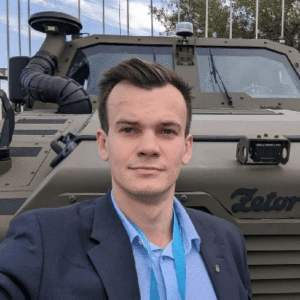
Vyacheslav Shvaydak, Co-Founder and CEO at Dropla Tech
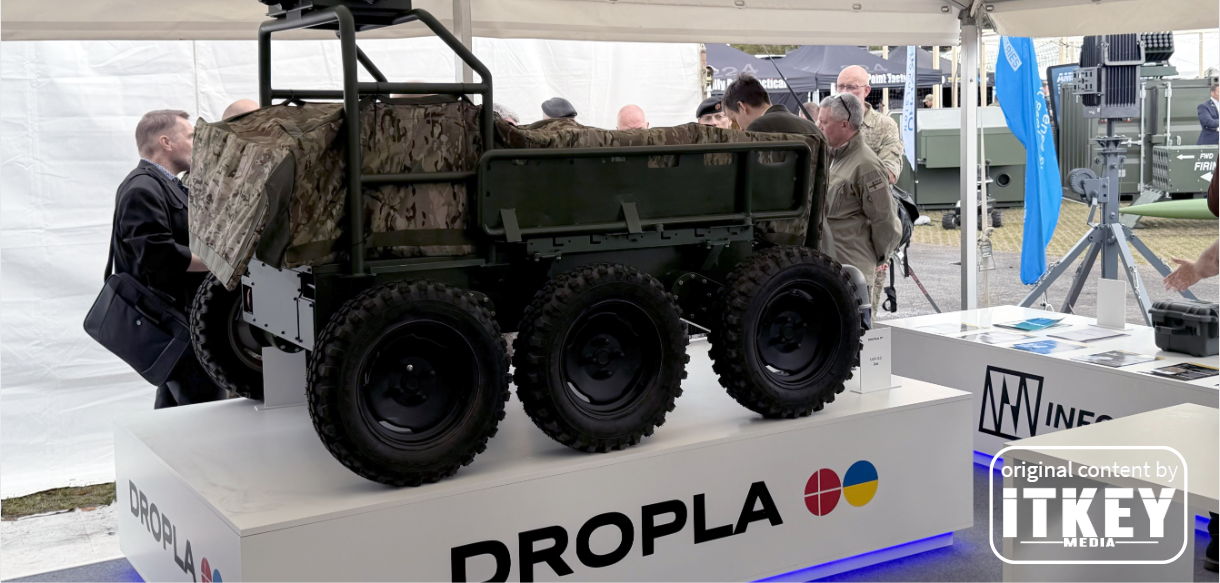
Finally, the Dropla Seer came to be — a multi-sensor reconnaissance complex. As Mr Shvaydak admits, this is a pinnacle of Dropla Tech’s IP, which went into service across four Ukrainian oblasts as a prototype and now awaits global deployment next year.
According to the company, Blue Eyes has now produced more than 5,000 confirmed explosive threat detections in Ukraine at over 90% accuracy. It carries a NATO Stock Number and NATO codification is complete, which matters more than it sounds, because it is the difference between a prototype and something an alliance member can actually procure.
‘The hardest thing we overcame was our own business model. We began as an operational demining contractor. That was the wrong shape: it made us a service company competing on labor cost under strict certified compliance. But we transformed into a technology provider: hardware, autonomy software, and platforms sold to NATO and allied governments,’ Mr Shvaydak tells ITKeyMedia.
Building Across Ukraine and Denmark
Dropla Tech’s engineering, manufacturing, and commercial functions span two very different environments such as Denmark and Ukraine. The founders list two most significant lessons they’ve learned from building such a company:
- First, do not run one company in two countries. Run two companies with a clear interface. Dropla Tech has a Danish entity and a Ukrainian entity, each with its own management, its own compliance perimeter, and a documented boundary between them, that eliminates any ambiguity about which entity owns what becomes an export-control problem, not a management inconvenience.
- Second, the two environments run on different clocks, and both are correct. Ukrainian engineering iterates in days because the feedback loop is a front line. Danish procurement and certification move in quarters because the output has to survive an audit.
‘The conjunction of these two is what makes our company stable and agile,’ the CEO emphasizes.
Frontline Lessons
Naturally, real-world deployment in Ukraine changed Dropla Tech’s product roadmap in ways that could never have emerged from laboratory testing alone. Mr Shvaydak points out how a laboratory provides clean GNSS, good light, and a camera that always sees. Real-world deployment in Ukraine, on the other hand, has none of those.
The Dropla Tech team learned to design for what they internally call camera-blind seconds – dust, smoke, or sun directly into the lens – where the vehicle has to keep a straight line on wheel odometry and motor current alone. They learned that satellite communications drop and the platform must transition to a predefined safe state rather than improvise. They learned that seasonal terrain destroys naive visual localization: the same field in fresh snow or with bare field edges is a different place to a machine, and that is a named, measured degradation mode in our plan rather than an unbounded unknown.
Designing Trustworthy AI
Moreover, when soldiers rely on AI to identify explosive threats, trust becomes critical. To measure, build, and maintain operator confidence in the system beyond reporting accuracy metrics, Dropla Tech does the following:
- Keeping a human in the loop by architecture, not by policy. The detection-to-cue pipeline requires explicit operator confirmation, in a field-in-the-message format, not a setting that could be quietly disabled.
- Maintaining a strict division of labor. The platform’s systems find and move, while targeting and engagement belong to the operator. Additionally, the platform is designed for graceful degradation, i.e. when a sensing stage fails, the system announces reduced capability rather than continuing to look confident.
‘Trust is built by predictable failure and honest reporting of false positives. It’s easy to imagine the amount of debris and different objects on the frontline. We run 17 different detection algorithms in parallel, edge-inferencing. Operators forgive a system that tells them when it does not know. They never forgive one that guesses,’ Mr Shvaydak states.
What’s Next?

Perry Boyle, Co-Founder and CEO at MITS Capital
MITS Capital’s co-founder and CEO Perry Boyle and his team are excited to welcome Dropla Tech to the MITS family. According to him, Mr Shvaydak has achieved an important feat of creating a truly transnational Danish-Ukrainian defense company, poised to integrate Ukraine into Europe’s defense architecture.
Dropla Tech defines three directions of development for the company in view of the recent funding:
- Serial production capacity in Denmark, so that an order in units rather than samples is a scheduling question and not an engineering project.
- Autonomy: taking ground autonomy stack from a demonstrated prototype to a qualified system (‘which is the difference between impressing an evaluator and passing an acceptance test).
- And the commercial and certification work that lets one platform be sold across several NATO countries instead of one.
Two years out, Mr Shvaydak expects his startup to be judged on four things:
- units delivered and accepted by NATO-member customers,
- whether the company holds more than one national customer,
- autonomy qualified to a level against which a defense customer will readily sign
- and Blue Eyes detections in the field.
‘I would rather be measured on delivered units, threats detected, and the number of complete missions than on headcount or valuation,’ Mr Shvaydak shares.
Beyond Defence
Going further, Dropla Tech sees significant potential for its technology beyond military applications, but believes humanitarian mine action is only the beginning. However, for civilian demining, the company’s systems must meet higher standards for documentation, traceability, and reliability than in military operations. Equipment must also be cost-effective and easy for local teams to maintain.
Nevertheless, the team firmly believes that the underlying technology indeed has very broad applications. For instance, the Dropla Seer platform combines mobile sensors, edge computing, and precise mapping to create detailed, georeferenced models of terrain. With adjusted sensor configurations, this technology could be used for agriculture, forestry, national mapping, border and infrastructure monitoring, disaster response, and search and rescue.
These civilian markets have every chance to become larger than defense eventually, because they involve recurring, large-scale mapping and monitoring programs. In other words, defense made the technology viable, while civilian applications could ultimately turn Dropla Tech into a global sensing and mapping company.

Kostiantyn is a freelance writer from Crimea but based in Lviv. He loves writing about IT and high tech because those topics are always upbeat and he’s an inherent optimist!