

- Stargate Hydrogen’s Aurora technology remains central to Åland-based Redrock’s planned 40 MW electrolyser installation
- With Stargate hydrogen’s technology at the core, Redrock aims to develop Åland into a replicable Nordic renewable-fuel production model
- Future plans include pre-FEED, FEED, permitting, and FID readiness by late 2027 or early 2028
The hydrogen project originally developed under OX2 in Åland is taking a broader shape under its new Åland-based owner, Redrock Energy Ab. Working with the well-known Estonian electrolyser developer Stargate Hydrogen, the companies are now developing what Redrock describes as a full-value Power-to-X project combining renewable electricity, green hydrogen, CO2 capture and methanation, with the ambition of producing e-methane for maritime, industrial and road-transport markets.
From Hydrogen Project Toward Integrated Power-to-X Ecosystem
The cooperation between Stargate Hydrogen and OX2 was announced in October 2025, when the companies said they would work toward deploying Stargate’s 10 MW Aurora electrolyser technology in Åland. At the time, the project was presented primarily as a large-scale green hydrogen production facility and as a potential demonstration of industrial-scale hydrogen technology in the Nordics.
Since then, however, the project and the company behind it have both changed.
In early 2026, OX2 Åland was spun out through a management buyout and became Redrock Energy, with the Åland-based team taking full ownership of the company and its local projects. The transition brought decision-making closer to the market while allowing the team to continue developing the hydrogen project and its wider energy ecosystem.

Anders Wiklund, Partner and CEP at Redrock
‘When Redrock conducted the management buyout from OX2 in early 2026, we took full control of the project and brought the company home to Åland and Finland. This meant bringing the decision making closer to the market where we operate. We believe that this creates trust for many involved in the project, neighbors to the project area, stakeholders, authorities, customers, and partners,’ Redrock’s partner and CEO Anders Wiklund tells ITKeyMedia.
‘Redrock is fully owned by persons actively involved in the company; we invest our own time and money into the projects. This clearly shows that we believe in the project, the model, and future maturation of the Power to X market in general, ultimately creating even more trust and transparency toward us as individuals involved in the project,’ he adds.
Local ownership is also connected to Redrock’s involvement in the wider Finnish hydrogen ecosystem. The company is participating in the ABB-led H2 Springboard initiative, which brings together industrial companies, technology providers and project developers around hydrogen and Power-to-X technologies.
From Green Hydrogen to Renewable E-Methane
One of the most significant changes since the original Stargate-OX2 announcement has been the evolution of the EnergyPark Åland concept itself. The project initially focused on producing green hydrogen for industrial offtakers. But the island’s limited industrial demand and lack of a gas grid led Redrock to look further downstream, toward the production of renewable e-methane.
‘In the current project model, the green hydrogen is produced for downstream methanation on site. Since the project is developed on an island with no gas grid availability and a limited industrial offtake, it is challenging to find a business case for hydrogen,’ Redrock’s partner and CCO Kenneth Rosenberg-Brunila explains.
The solution is to integrate the hydrogen production into a larger system. The current concept combines a behind-the-meter photovoltaic plant, CO2 capture, green hydrogen production, and methanation, with the resulting e-methane targeting several markets.
‘An in-depth market study showed that e-methane is the fuel that has the best market opportunity both short and long term. Around the island, the Baltic Sea, Gulf of Finland and Bothnia Bay there are already numerous vessels operating on LNG. Today we have a strong off-take portfolio, from different markets, including maritime, industry, and road transport customers,’ Mr Rosenberg-Brunila notes.
The maritime connection is particularly relevant for the Åland Islands. Redrock sees the region’s location and existing maritime economy as an advantage as shipping companies look for alternatives to fossil fuels.
Expanding on the original electrolyser installation, the resulting project is now intended as an integrated energy system in which the different components can be optimized together rather than developed as separate assets.
‘Combining all technologies in the same project gives us a unique opportunity to optimize the full value chain without conflict of interest. We can create the best value for the project and the customers,’ Mr Wiklund says.
How the Estonian Innovator Fits the Åland Vision
In the meantime, Stargate Hydrogen’s technology remains an important part of that architecture. According to Mr Rosenberg-Brunila, the relationship with the Estonian innovator in next-generation alkaline electrolysers began when the now-Redrock team was still part of OX2. Stargate Hydrogen stood out because of its approach to scaling electrolyser technology.
‘Whereas many big OEM’s built mega factories, Stargate approach was scale to fit, where focus laid in the technology and product rather than commercializing at scale. This strategy, combined with a solid product that has been tested and approved by Fortum in the Loviisa project, shows maturity in a small company that we have not seen elsewhere,’ the CCO reminds.
Mr Rosenberg-Brunila adds that the development of Stargate Hydrogen’s next-generation stack and modular platform has reinforced the original assessment. The technology is based around Stargate’s Aurora platform, with the Åland project originally announced around a 10 MW system module. Redrock’s current development concept envisages a 40 MW electrolyser installation as part of the wider EnergyPark.
For Redrock, the fit is specifically about Stargate Hydrogen system’s compact design, outdoor operation, and maintainability, as well as the Estonian partner’s willingness to work directly on the ground with the project team.
‘We are confident we have a tight synergy here; first because of their 10 MW modular system, the Aurora, which is compact and engineered for easy maintenance, an outdoors solution that can operate even in the harshest climates. Second point is their hands-on approach, always willing to have men on the ground, working with us, and ensuring any issues can be solved swiftly,’ Mr Rosenberg-Brunila specifies.
“They are an Estonian company and share the experience of how to work on sub-zero conditions,” he adds.
From Demonstration to Larger Deployment
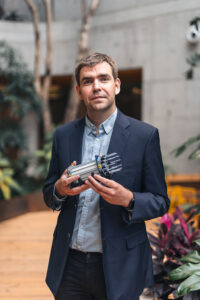
Marko Virkebau, Co-Founder and CEO at Stargate Hydrogen
Stargate Hydrogen has previously positioned the Åland project as an opportunity to demonstrate its industrial-scale technology in the Nordic market. When the original agreement was announced in October 2025, its CEO Marko Virkebau specifically described the project as a way to demonstrate both the scalability and cost competitiveness of Stargate Hydrogen’s new system while positioning Åland as a Nordic hydrogen hub.
October 2025 was also the time when the spatial plan for the project area entered into legal force. Redrock eventually secured the building permit for the photovoltaic plant, which also entered into legal force in April 2026. This allowed the company to move the Power-to-X part of the development toward the next stage.
‘With the spatial plan in legal force, we now have all the prerequisites to go into the next phase of the development of the Power-to-X part, with pre-FEED, FEED and permitting, with the ambition to be fully permitted and ready for FID in late 2027 / early 2028,’ Mr Wiklund explains.
A Growing Industrial Architecture
The project is developed within the H2 Springboard ecosystem, where Redrock is working alongside technology and industrial partners. The company has signed an LOI with Finnish technology company Q-Power covering biological methanation and liquefaction technology, while a separate May 2026 agreement with ABB focuses on electrification, automation, energy optimization, and system integration. This creates a broader industrial architecture around the original electrolyser project, with Stargate supplying a key component of the hydrogen-production chain.
For Redrock, the objective extends beyond a single project in Åland. EnergyPark Åland is intended to serve as a proof of concept for a modular approach that could eventually be replicated elsewhere.
‘What we develop in the EnergyPark Åland project is of course a project. We see this project as our flagship and proof of concept, showing that a society can transition into a green economy,’ Mr Rosenberg-Brunila states. ‘ But it is not just about the project; it is equally important to understand that it is a transformation for the local community. Something new is being created. How the community takes advantage of this is equally important as the project.’
The broader ambition is reflected in Redrock’s participation in H2 Springboard. The company wants the experience gained at EnergyPark Åland to help establish a blueprint for projects combining renewable electricity, hydrogen, synthetic fuels and industrial applications. The emphasis is on modularity and replication: If the individual technologies and their integration can be demonstrated in Åland, the same approach could potentially be adapted to other markets and energy systems.
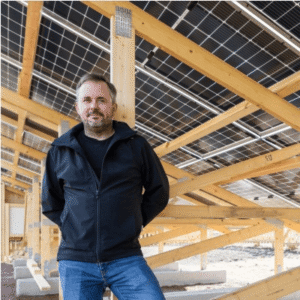
Kenneth Rosenberg-Brunila, Partner and Chief Commercial Officer at Redrock
‘The knowledge that we have gained so far, gives us the basis for future expansion of the project concept. Within the H2Springboard project, we work together with many partners to develop a blueprint for these types of projects, with the main focus: modularity, scalability and replication,’ Mr Rosenberg-Brunila admits.
For Mr Wiklund, the immediate test is more straightforward: the electrolyser has to work reliably and according to the project’s schedule: ‘The 40 MW project is the first of hopefully many deployments. To consider this a successful deployment we want to see green hydrogen being produced reliably, meaning high electrolyser availability and in accordance with the project’s timeline. These are the two main factors that will give us confidence to continue moving forward.’
A Model for Future Energy Systems
Moreover, developing the components in parallel has helped Redrock reduce dependence on any single external prerequisite. Power supply, permitting, technology, and downstream applications have been developed alongside one another rather than sequentially.
‘Most projects are struggling with power sourcing, feedstock, or permitting issues. What we did was to develop everything in parallel, with our ears to the ground. This approach has set a solid base for the project and sized it according to the local pre-requisites,’ Mr Wiklund explains.
This approach could ultimately become the project’s most transferable asset. Redrock believes the EnergyPark concept could be relevant in regions where existing energy infrastructure is weak or undergoing fundamental reconstruction.
‘The concept EnergyPark is specifically suitable for weak grids, or in energy systems that need reconstruction, for example Ukraine, where the potential for re-thinking the energy system and utilization of all types of energies can be incorporated in an early design phase,’ Mr Wiklund concludes.
Meanwhile, for Stargate Hydrogen, the Åland project represents something that has become increasingly important as the company moves from technology development toward commercial deployment: putting its electrolyser platform into an integrated energy system with a defined downstream use.
The partnership that began as an OX2-Stargate Hydrogen project has therefore evolved into something broader under Redrock — a locally owned Power-to-X development in which hydrogen is no longer the final product, but one part of a larger renewable-fuel value chain.
The evolving partnership between Estonian Stargate Hydrogen and Åland-based Redrock demonstrates how cross-border collaboration turns an ambitious hydrogen project into a broader, integrated Power-to-X ecosystem. What began under OX2 as a large-scale electrolyser deployment has matured under local ownership into a more comprehensive project, while retaining Stargate Hydrogen’s technology as a key pillar.

Kostiantyn is a freelance writer from Crimea but based in Lviv. He loves writing about IT and high tech because those topics are always upbeat and he’s an inherent optimist!